publications
the papers behind the research
177 total, 7 as first author, h-index: 57, i10-index: 130, citations: 12,004 (1,061 as first author)
Orcid: 0000-0003-1614-196X
View on Astrophysical Data Service (ADS): https://ui.adsabs.harvard.edu/public-libraries/ZLE6-g9VSRK43Gm-HPLh2A
Highlights
The 22 papers below are ones where I’m a first, second, or third author.
- COSMOS2020: A Panchromatic View of the Universe to z∼10 from Two Complementary CatalogsJ. R. Weaver, O. B. Kauffmann, O. Ilbert, H. J. McCracken, A. Moneti, and 53 more authorsThe Astrophysical Journal Supplement Series, Jan 2022
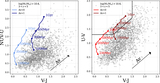
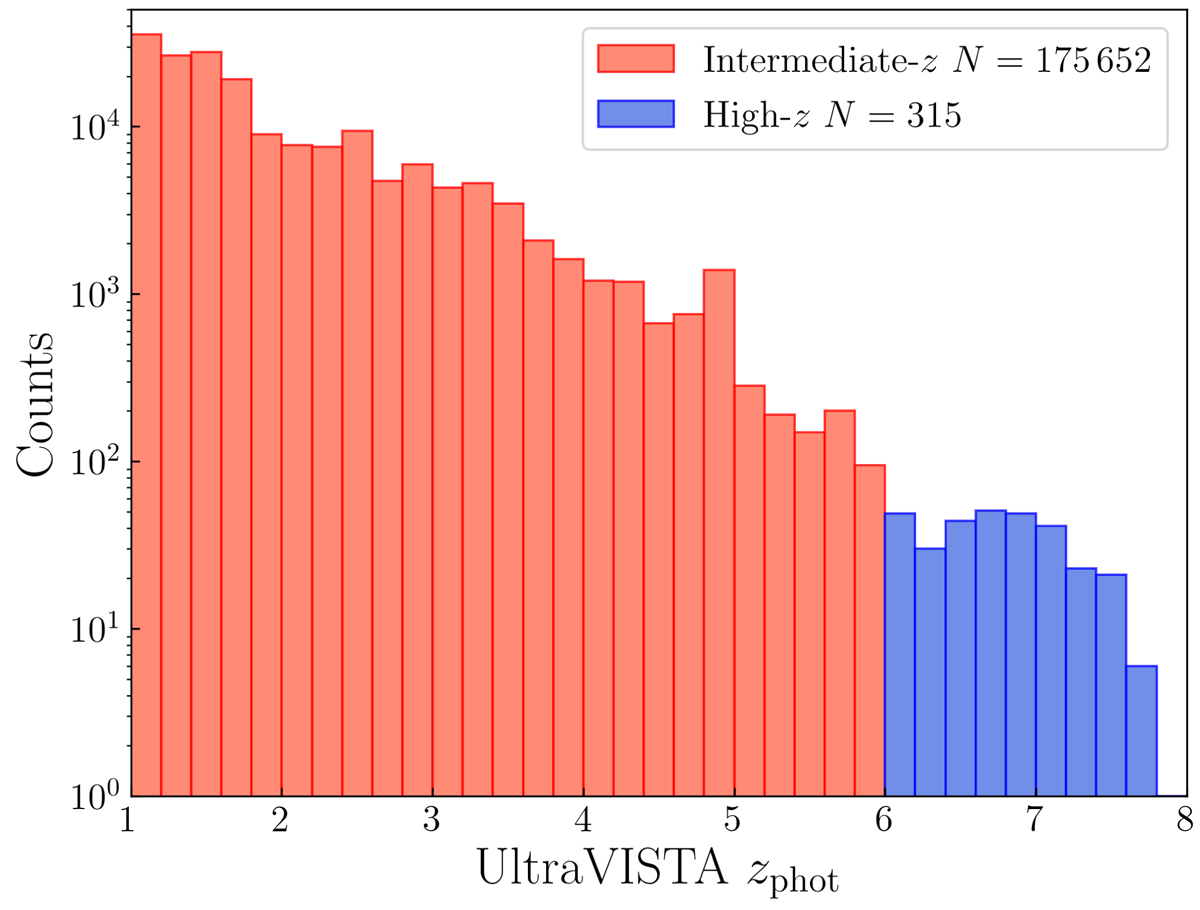
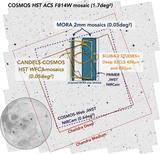
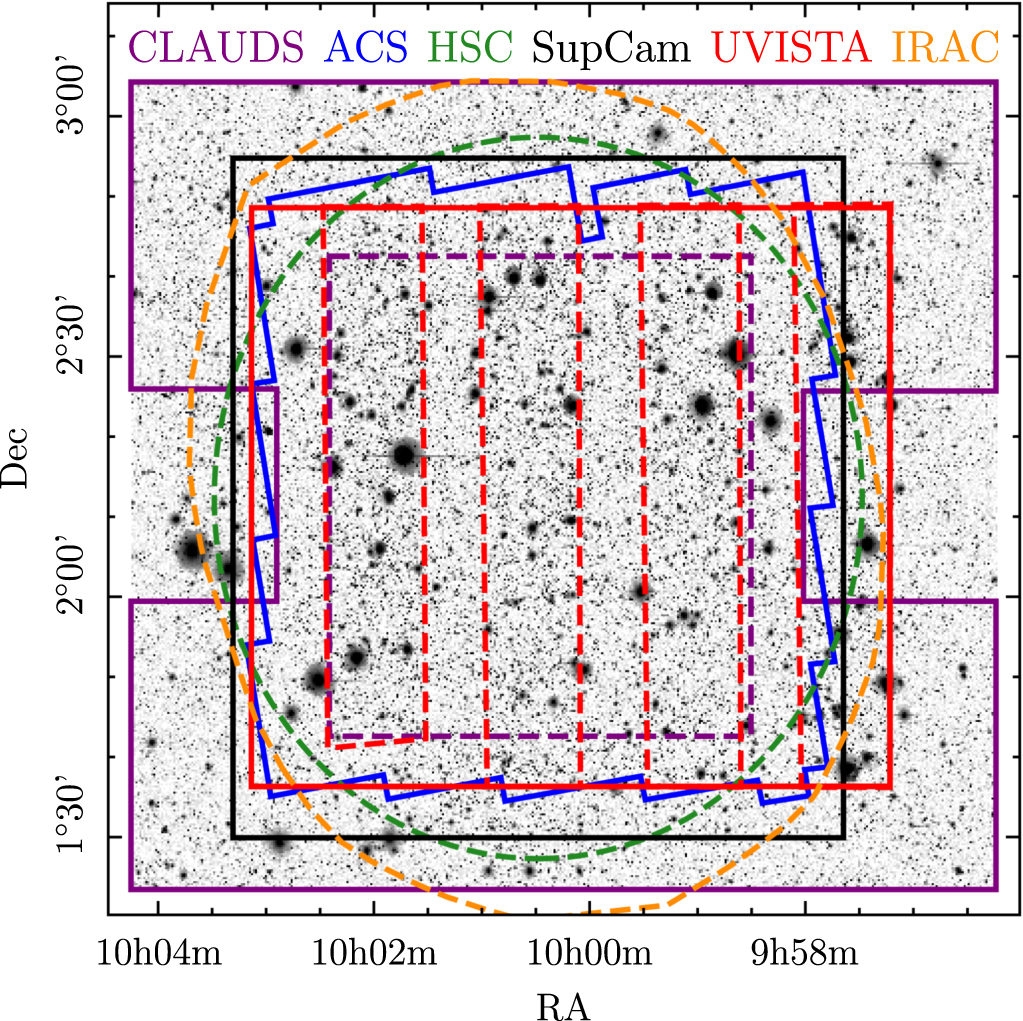
The Cosmic Evolution Survey (COSMOS) has become a cornerstone of extragalactic astronomy. Since the last public catalog in 2015, a wealth of new imaging and spectroscopic data have been collected in the COSMOS field. This paper describes the collection, processing, and analysis of these new imaging data to produce a new reference photometric redshift catalog. Source detection and multiwavelength photometry are performed for 1.7 million sources across the 2 deg^2 of the COSMOS field, \raisebox-0.5ex\textasciitilde966,000 of which are measured with all available broadband data using both traditional aperture photometric methods and a new profile-fitting photometric extraction tool, THE FARMER, which we have developed. A detailed comparison of the two resulting photometric catalogs is presented. Photometric redshifts are computed for all sources in each catalog utilizing two independent photometric redshift codes. Finally, a comparison is made between the performance of the photometric methodologies and of the redshift codes to demonstrate an exceptional degree of self-consistency in the resulting photometric redshifts. The i < 21 sources have subpercent photometric redshift accuracy and even the faintest sources at 25 < i < 27 reach a precision of 5%. Finally, these results are discussed in the context of previous, current, and future surveys in the COSMOS field. Compared to COSMOS2015, it reaches the same photometric redshift precision at almost one magnitude deeper. Both photometric catalogs and their photometric redshift solutions and physical parameters will be made available through the usual astronomical archive systems (ESO Phase 3, IPAC-IRSA, and CDS).
- COSMOS2020: The galaxy stellar mass function. The assembly and star formation cessation of galaxies at 0.2< z ≤ 7.5J. R. Weaver, I. Davidzon, S. Toft, O. Ilbert, H. J. McCracken, and 28 more authorsAstronomy & Astrophysics, Sep 2023
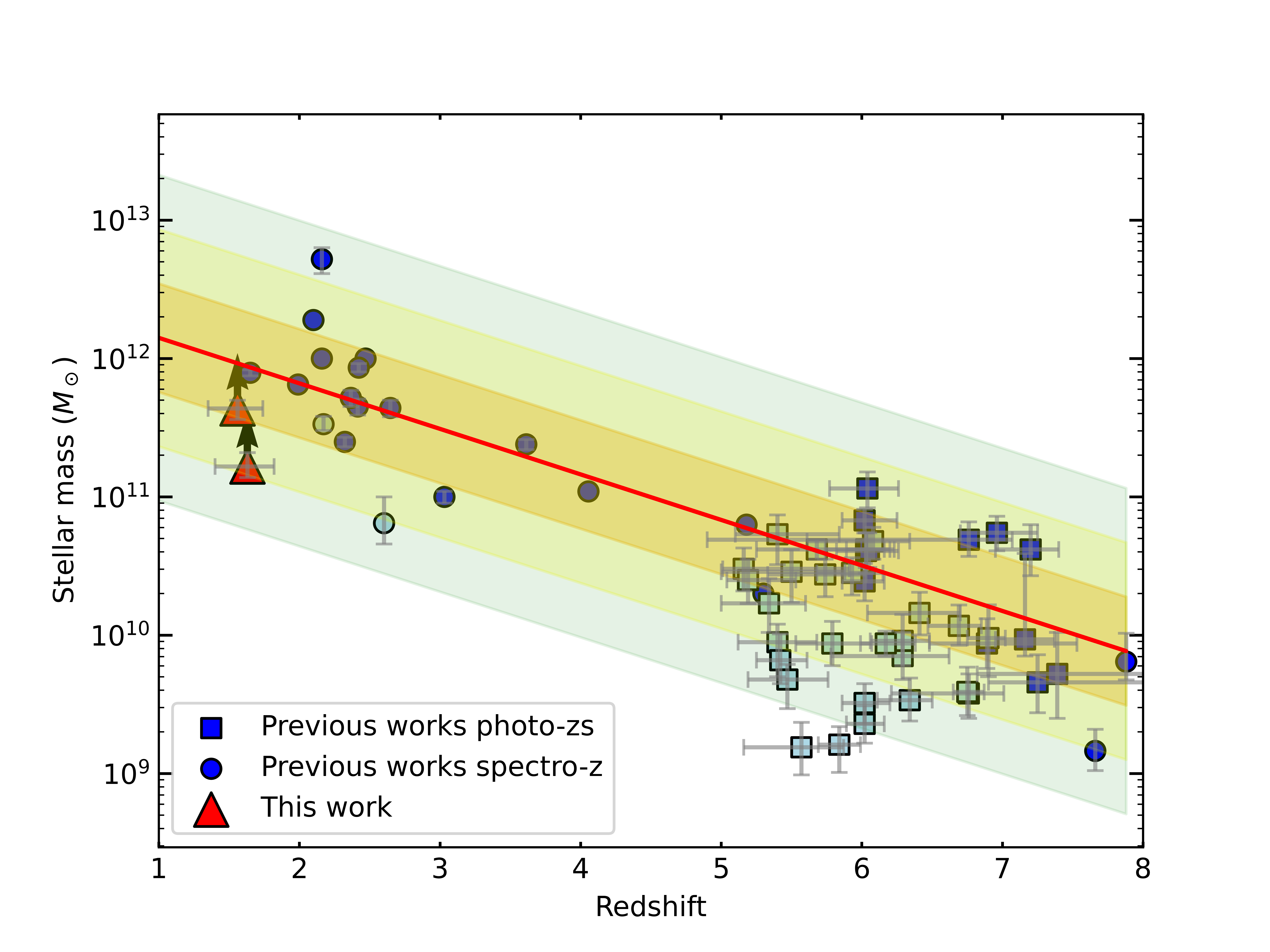
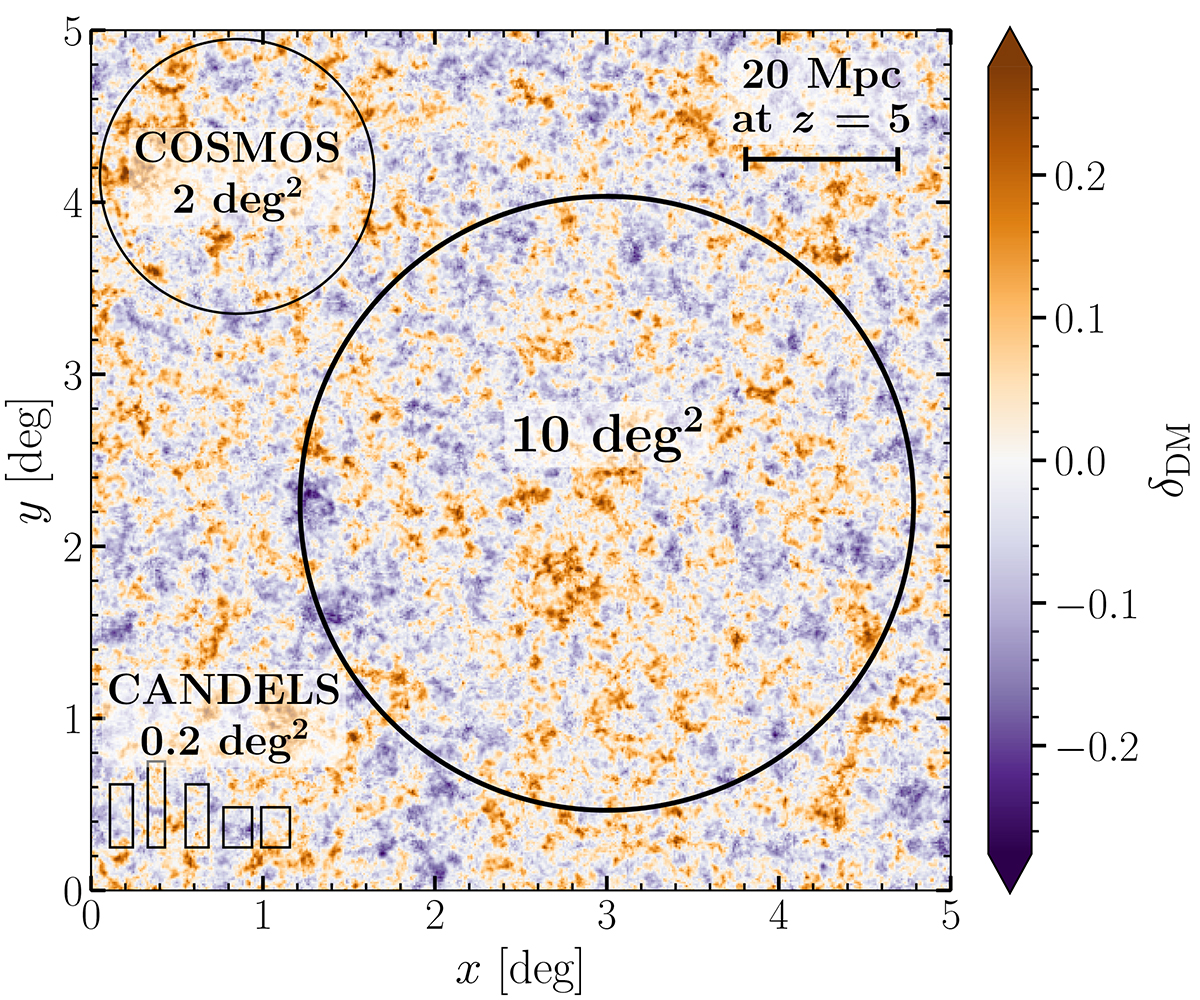
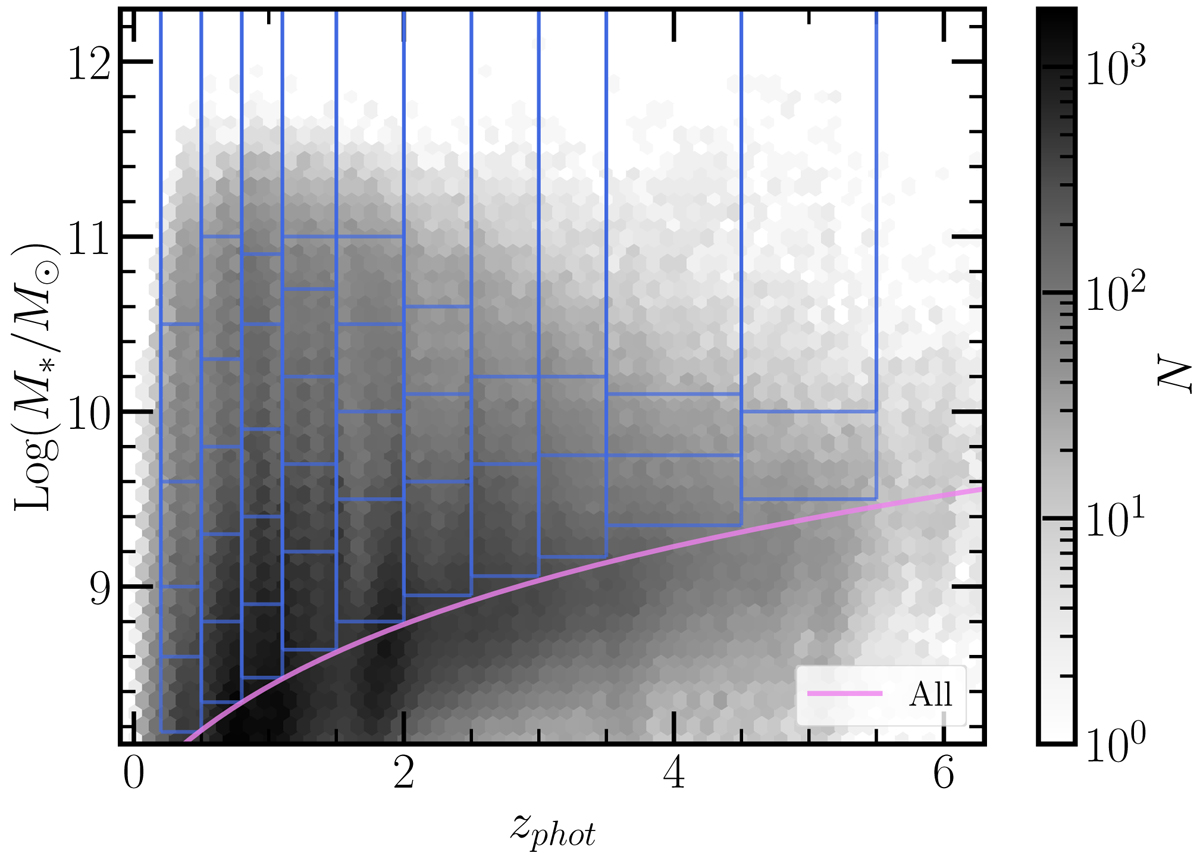
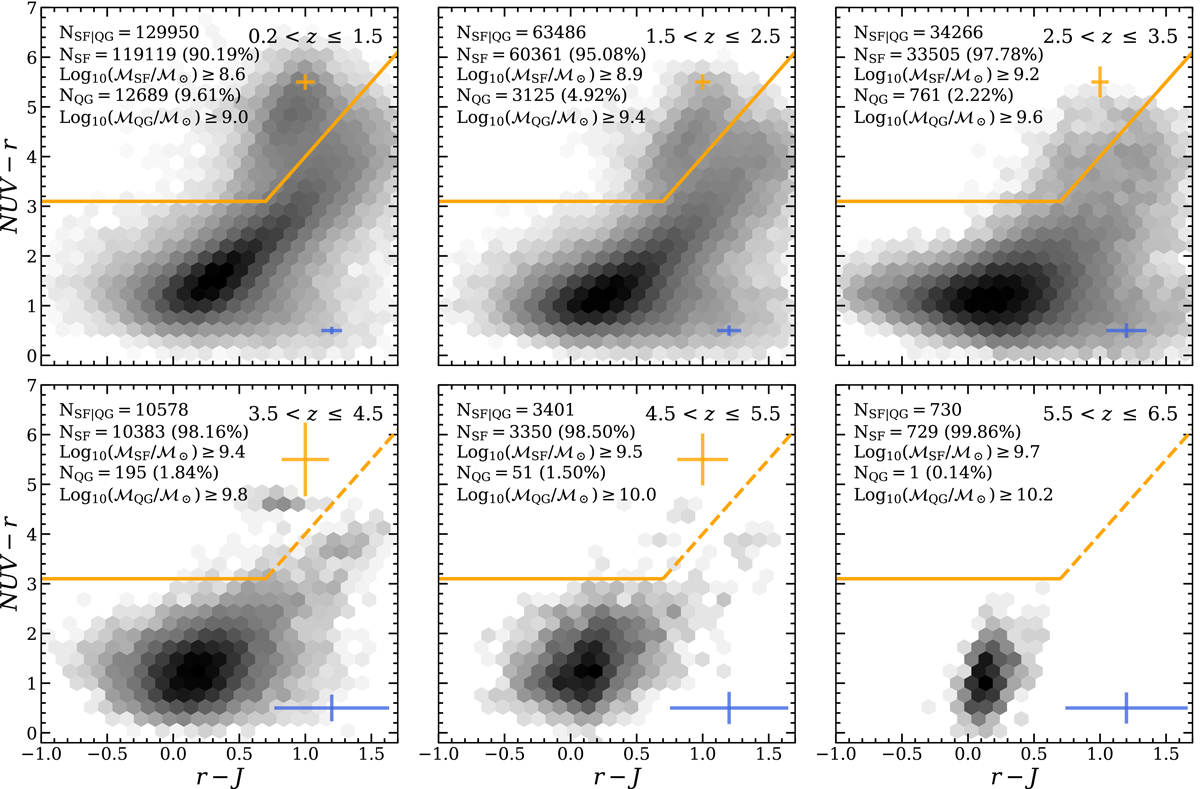
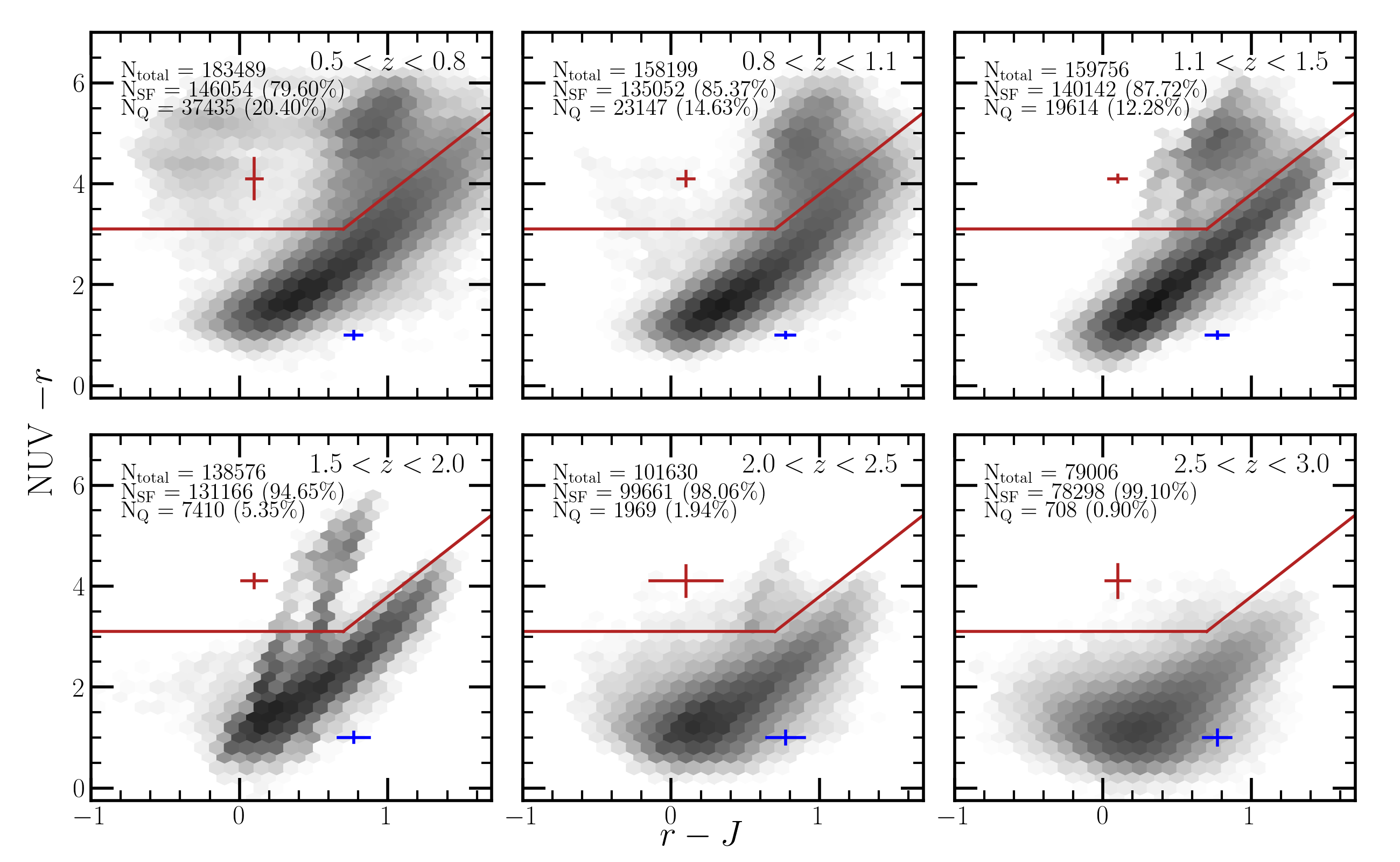
Context. How galaxies form, assemble, and cease their star formation is a central question within the modern landscape of galaxy evolution studies. These processes are indelibly imprinted on the galaxy stellar mass function (SMF), and its measurement and understanding is key to uncovering a unified theory of galaxy evolution. \Aims: We present constraints on the shape and evolution of the galaxy SMF, the quiescent galaxy fraction, and the cosmic stellar mass density across 90% of the history of the Universe from z = 7.5 \textrightarrow 0.2 as a means to study the physical processes that underpin galaxy evolution. \Methods: The COSMOS survey is an ideal laboratory for studying representative galaxy samples. Now equipped with deeper and more homogeneous near-infrared coverage exploited by the COSMOS2020 catalog, we leverage the large 1.27 deg^2 effective area to improve sample statistics and understand spatial variations (cosmic variance) - particularly for rare, massive galaxies - and push to higher redshifts with greater confidence and mass completeness than previous studies. We divide the total stellar mass function into star-forming and quiescent subsamples through NUVrJ color-color selection. The measurements are then fit with single- and double-component Schechter functions to infer the intrinsic galaxy stellar mass function, the evolution of its key parameters, and the cosmic stellar mass density out to z = 7.5. Finally, we compare our measurements to predictions from state-of-the-art cosmological simulations and theoretical dark matter halo mass functions. \Results: We find a smooth, monotonic evolution in the galaxy stellar mass function since z = 7.5, in general agreement with previous studies. The number density of star- forming systems have undergone remarkably consistent growth spanning four decades in stellar mass from z = 7.5 \textrightarrow 2 whereupon high-mass systems become predominantly quiescent (“downsizing”). Meanwhile, the assembly and growth of low-mass quiescent systems only occurred recently, and rapidly. An excess of massive systems at z ≈ 2.5 ‒ 5.5 with strikingly red colors, with some being newly identified, increase the observed number densities to the point where the SMF cannot be reconciled with a Schechter function. \Conclusions: Systematics including cosmic variance and/or active galactic nuclei contamination are unlikely to fully explain this excess, and so we speculate that they may be dust-obscured populations similar to those found in far infrared surveys. Furthermore, we find a sustained agreement from z ≈ 3 ‒ 6 between the stellar and dark matter halo mass functions for the most massive systems, suggesting that star formation in massive halos may be more efficient at early times. \\textbackslashData files containing sample IDs and key measurements are available for download: <A href=“https://d oi.org/10.5281/zenodo.7808832”>https://doi.org/10.5281/zenodo.7 808832</A>
- The UNCOVER Survey: A First-look HST + JWST Catalog of 60,000 Galaxies near A2744 and beyondJohn R. Weaver, Sam E. Cutler, Richard Pan, Katherine E. Whitaker, Ivo Labbé, and 41 more authorsThe Astrophysical Journal Supplement Series, Jan 2024
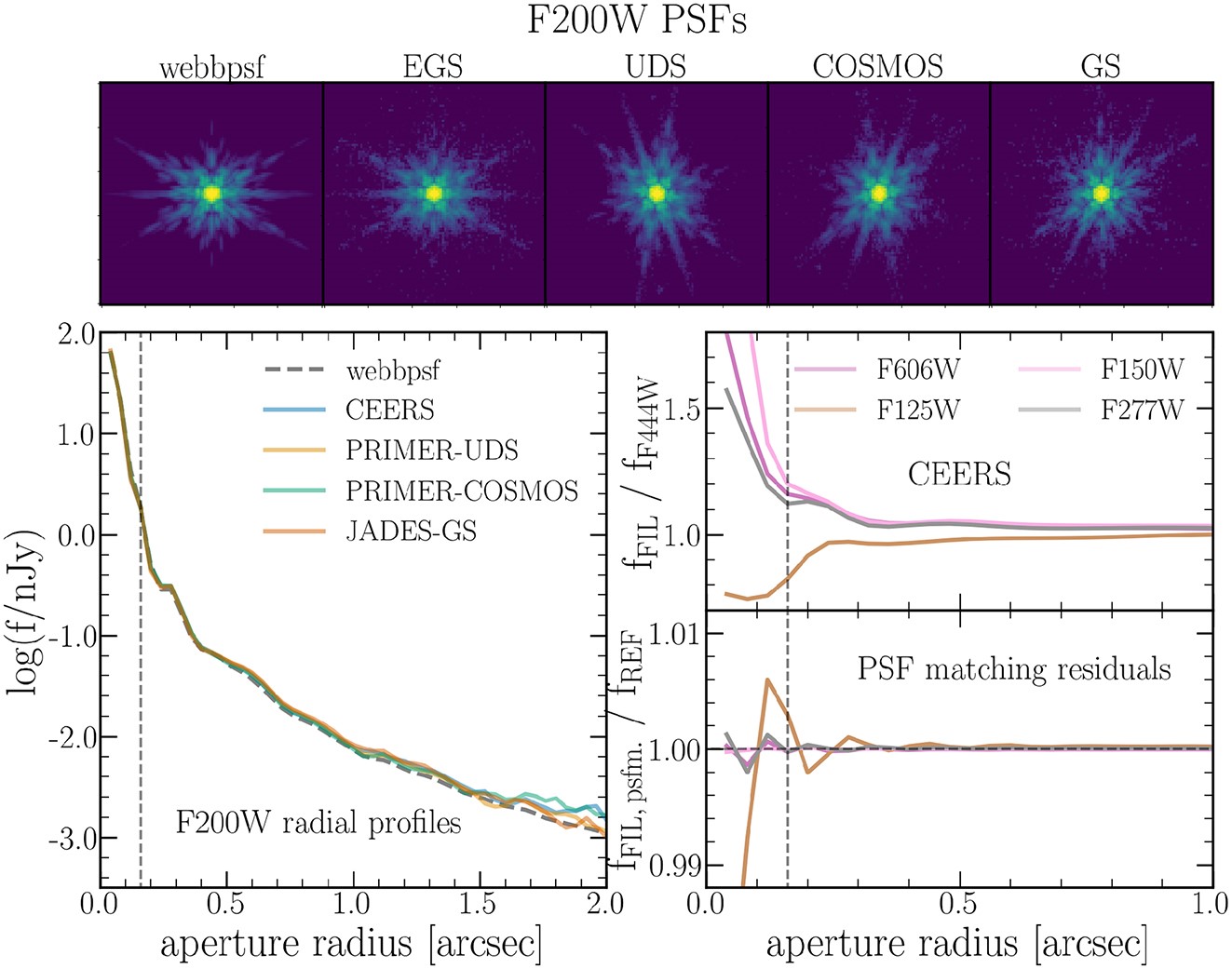
In 2022 November, the James Webb Space Telescope (JWST) returned deep near-infrared images of A2744-a powerful lensing cluster capable of magnifying distant, incipient galaxies beyond it. Together with existing Hubble Space Telescope (HST) imaging, this publicly available data set opens a fundamentally new discovery space to understand the remaining mysteries of the formation and evolution of galaxies across cosmic time. In this work, we detect and measure some 60,000 objects across the 49 arcmin^2 JWST footprint down to a 5σ limiting magnitude of \raisebox-0.5ex\textasciitilde30 mag in 0.″32 apertures. Photometry is performed using circular apertures on images matched to the point-spread function (PSF) of the reddest NIRCam broad band, F444W, and cleaned of bright cluster galaxies and the related intracluster light. To give an impression of the photometric performance, we measure photometric redshifts and achieve a σ _NMAD ≈ 0.03 based on known, but relatively small, spectroscopic samples. With this paper, we publicly release our HST and JWST PSF-matched photometric catalog with optimally assigned aperture sizes for easy use, along with single aperture catalogs, photometric redshifts, rest-frame colors, and individual magnification estimates. These catalogs will set the stage for efficient and deep spectroscopic follow up of some of the first JWST-selected samples in summer of 2023.
- UNCOVERing the extended strong lensing structures of Abell 2744 with the deepest JWST imagingLukas J. Furtak, Adi Zitrin, John R. Weaver, Hakim Atek, Rachel Bezanson, and 16 more authorsMonthly Notices of the Royal Astronomical Society, Aug 2023
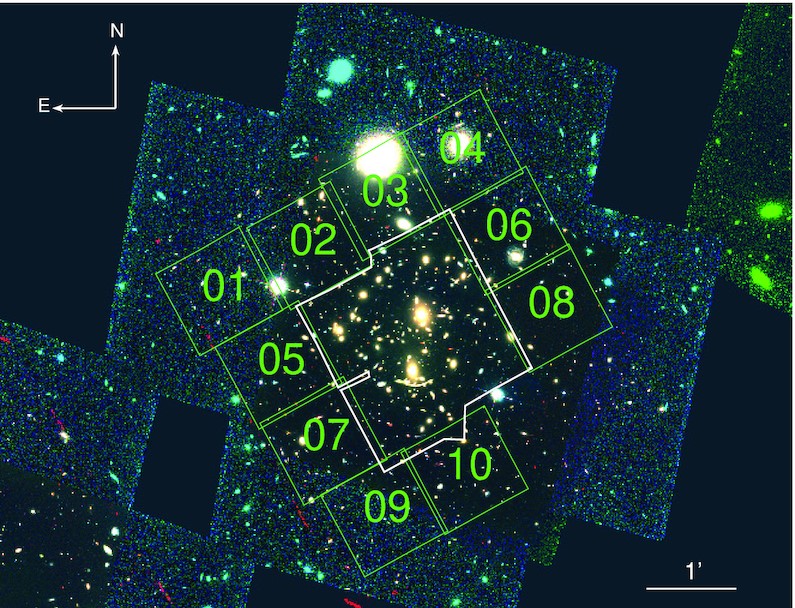
We present a new parametric lens model for the massive galaxy cluster Abell 2744 based on new ultra-deep JWST imaging taken in the framework of the UNCOVER program. These observations constitute the deepest JWST images of a lensing cluster to date, adding to existing deep Hubble Space Telescope (HST) images and the recent JWST Early Release Science and Director’s Discretionary Time data taken for this field. The wide field of view of UNCOVER (\raisebox-0.5ex\textasciitilde45 arcmin^2) extends beyond the cluster’s well-studied central core and reveals a spectacular wealth of prominent lensed features around two massive cluster sub-structures in the north and north-west, where no multiple images were previously known. We identify 75 new multiple images and candidates of 17 sources, 43 of which allow us, for the first time, to constrain the lensing properties and total mass distribution around these extended cluster structures using strong lensing (SL). Our model yields an effective Einstein radius of θ_E, main = 23.2 \pm 2.3 arcsec for the main cluster core (for z_s = 2), enclosing a mass of M(< θ_E, main) = (7.7 \pm 1.1) \texttimes 10^13 M_☉, and θ_E, NW = 13.1 \pm 1.3 arcsec for the newly discovered north-western SL structure enclosing M(< θ_E, NW) = (2.2 \pm 0.3) \texttimes 10^13 M_☉. The northern clump is somewhat less massive with θ_E, N = 7.4 \pm 0.7 arcsec enclosing M(< θ_E, N) = (0.8 \pm 0.1) \texttimes 10^13 M_☉. We find the northern sub-structures of Abell 2744 to broadly agree with the findings from weak lensing analyses and align with the filamentary structure found by these previous studies. Our model in particular reveals a large area of high magnification values between the various cluster structures, which will be paramount for lensed galaxy studies in the UNCOVER field. The model is made publicly available to accompany the first UNCOVER data release.
- UNCOVER: A NIRSpec Census of Lensed Galaxies at z = 8.50─13.08 Probing a High-AGN Fraction and Ionized Bubbles in the ShadowSeiji Fujimoto, Bingjie Wang, John R. Weaver, Vasily Kokorev, Hakim Atek, and 31 more authorsThe Astrophysical Journal, Dec 2024
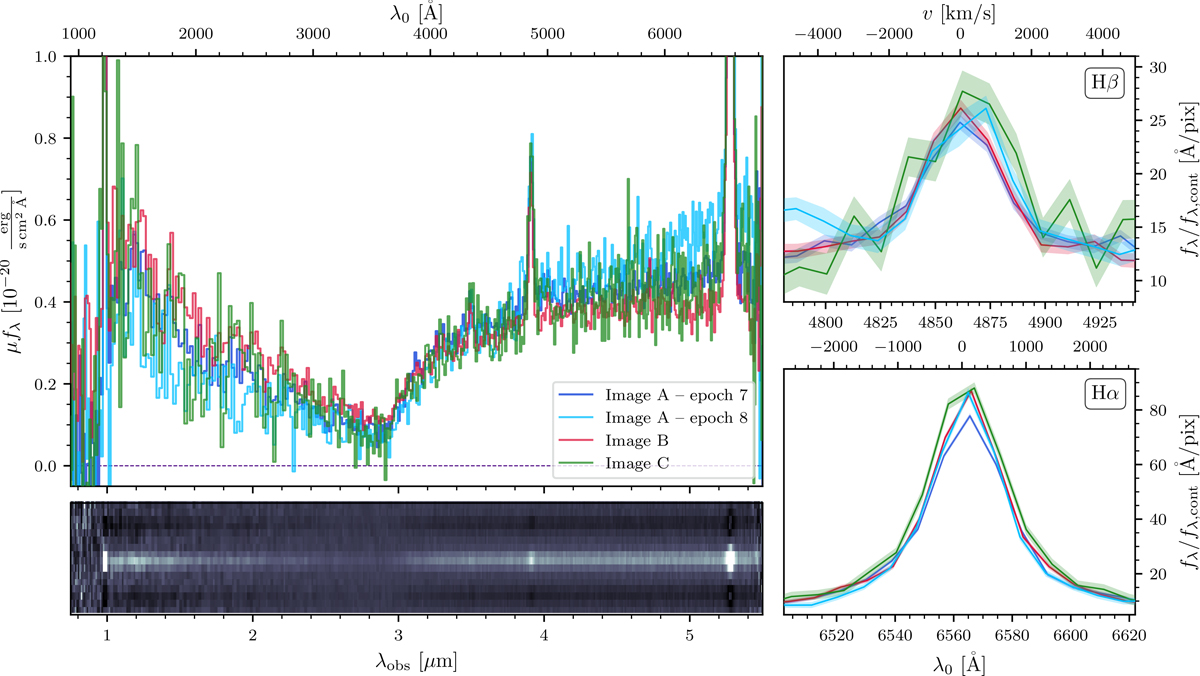
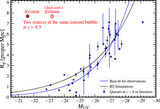
We present JWST NIRSpec prism spectroscopy of lensed galaxies at z ≳ 9 found behind the massive galaxy cluster Abell 2744 in the UNCOVER Cycle 1 Treasury Program. We confirm the redshift via emission lines and/or the Lyα break for 10 galaxies at z = 8.50─13.08 down to M _ V = -17.3. We achieve a 100% confirmation rate for z > 9 candidates reported in H. Atek et al. Using six sources with multiple line detections, we find that offsets in redshift estimates between the lines and the Lyα break alone can be \pm0.2, raising caution in designing future follow-up spectroscopy for the break-only sources with the Atacama Large Millimeter/submillimeter Array. With spec-z- confirmed sources in UNCOVER and the literature, we derive lower limits on the rest-frame ultraviolet (UV) luminosity function (LF) at z ≃ 9─12 and find that these lower limits agree with recent photometric measurements. We identify at least two unambiguous and several possible active galactic nucleus (AGN) systems based on X-ray, broad Hβ, high ionization lines, and excess in the UV LF. This requires the AGN LFs at z ≃ 9─10 to be comparable or even higher than the X-ray AGN LF estimated at z ∼ 6 and suggests a plausible cause of the high abundance of z > 9 galaxies claimed in the recent photometric measurements is AGNs. One UV-luminous source is confirmed at the same redshift as a broad-line AGN at z = 8.50 with a physical separation of 380 kpc in the source plane. These two sources show emission blueward of Lyα, indicating a giant ionized bubble enclosing them with a radius of 7.69 \pm 0.18 pMpc. Our results imply that AGNs have a nonnegligible contribution to cosmic reionization.
- Medium Bands, Mega Science: A JWST/NIRCam Medium-band Imaging Survey of A2744Katherine A. Suess, John R. Weaver, Sedona H. Price, Richard Pan, Bingjie Wang, and 38 more authorsThe Astrophysical Journal, Nov 2024
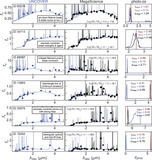
In this paper, we describe the “Medium Bands, Mega Science” JWST Cycle 2 survey (JWST-GO-4111) and demonstrate the power of these data to reveal both the spatially integrated and spatially resolved properties of galaxies from the local Universe to the era of cosmic dawn. Executed in 2023 November, MegaScience obtained ∼30 arcmin^2 of deep multiband NIRCam imaging centered on the z ∼ 0.3 A2744 cluster, including 11 medium-band filters and the two shortest-wavelength broadband filters, F070W and F090W. Together, MegaScience and the UNCOVER Cycle 1 treasury program provide a complete set of deep (∼28─30 mag_AB) images in all NIRCam medium- and broadband filters. This unique data set allows us to precisely constrain photometric redshifts, map stellar populations and dust attenuation for large samples of distant galaxies, and examine the connection between galaxy structures and formation histories. MegaScience also includes ∼17 arcmin^2 of NIRISS parallel imaging in two broadband and four medium-band filters from 0.9 to 4.8 μm, expanding the footprint where robust spectral energy distribution (SED) fitting is possible. We provide example SEDs and multiband cutouts at a variety of redshifts, and use a catalog of JWST spectroscopic redshifts to show that MegaScience improves both the scatter and catastrophic outlier rate of photometric redshifts by factors of 2─3. Additionally, we demonstrate the spatially resolved science enabled by MegaScience by presenting maps of the [O III] line emission and continuum emission in three spectroscopically confirmed z > 6 galaxies. We show that line emission in reionization-era galaxies can be clumpy, extended, and spatially offset from continuum emission, implying that galaxy assembly histories are complex even at these early epochs. We publicly release fully reduced mosaics and photometric catalogs for both the NIRCam primary and NIRISS parallel fields (jwst- uncover.github.io/megascience).
- Two Distinct Classes of Quiescent Galaxies at Cosmic Noon Revealed by JWST PRIMER and UNCOVERSam E. Cutler, Katherine E. Whitaker, John R. Weaver, Bingjie Wang, Richard Pan, and 29 more authorsThe Astrophysical Journal Letters, Jun 2024
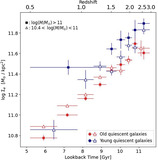
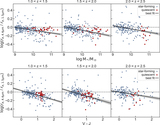
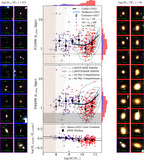
We present a measurement of the low-mass quiescent size─mass relation at cosmic noon (1 < z < 3) from the JWST PRIMER and UNCOVER treasury surveys, which highlights two distinct classes of quiescent galaxies. While the massive population is well studied at these redshifts, the low-mass end has been previously underexplored due to a lack of observing facilities with sufficient sensitivity and spatial resolution. We select a conservative sample of low-mass quiescent galaxy candidates using rest-frame UVJ colors and specific star formation rate criteria and measure galaxy morphology in both rest-frame UV/optical wavelengths (F150W) and rest-frame near-infrared (F444W). We confirm an unambiguous flattening of the low-mass quiescent size─mass relation, which results from the separation of the quiescent galaxy sample into two distinct populations at \mathrmlog(M_⋆/M_⊙)∼10.3 : low-mass quiescent galaxies that are notably younger and have disky structures, and massive galaxies consistent with spheroidal morphologies and older median stellar ages. These separate populations imply mass quenching dominates at the massive end while other mechanisms, such as environmental or feedback-driven quenching, form the low-mass end. This stellar mass-dependent slope of the quiescent size─mass relation could also indicate a shift from size growth due to star formation (low masses) to growth via mergers (massive galaxies). The transition mass between these two populations also corresponds with other dramatic changes and characteristic masses in several galaxy evolution scaling relations (e.g., star formation efficiency, dust obscuration, and stellar-to-halo mass ratios), further highlighting the stark dichotomy between low-mass and massive galaxy formation.
- Remarkably Compact Quiescent Candidates at 3 < z < 5 in JWST-CEERSLillian Wright, Katherine E. Whitaker, John R. Weaver, Sam E. Cutler, Bingjie Wang, and 7 more authorsThe Astrophysical Journal Letters, Mar 2024
In this Letter, we measure the rest-frame optical and near-infrared sizes of 10 quiescent candidates at 3 < z < 5, first reported by Carnall et al. We use James Webb Space Telescope Near-Infrared Camera F277W and F444W imaging obtained through the public CEERS Early Release Science program and imcascade, an astronomical fitting code that utilizes multi-Gaussian expansion, to carry out our size measurements. When compared to the extrapolation of rest-optical size─mass relations for quiescent galaxies at lower redshift, 8 out of 10 candidates in our sample (80%) are on average more compact by ∼40%. A total of 7 out of 10 candidates (70%) exhibit rest-frame infrared sizes ∼10% smaller than rest-frame optical sizes, indicative of negative color gradients. Two candidates (20%) have rest-frame infrared sizes ∼1.4\texttimes larger than rest-frame optical sizes; one of these candidates exhibits signs of ongoing or residual star formation, suggesting this galaxy may not be fully quenched. The remaining candidate is unresolved in both filters, which may indicate an active galactic nucleus. Strikingly, we observe three of the most massive galaxies in the sample (log(M _⋆/M _☉) = 10.74─10.95) are extremely compact, with effective radii ∼0.7 kpc. Our findings provide no indication that the size evolution relation flattens out, and may indicate that the size evolution of quiescent galaxies is steeper than previously anticipated beyond z > 3.
- The Farmer: A Reproducible Profile-fitting Photometry Package for Deep Galaxy SurveysJ. R. Weaver, L. Zalesky, V. Kokorev, C. J. R. McPartland, N. Chartab, and 15 more authorsThe Astrophysical Journal Supplement Series, Nov 2023
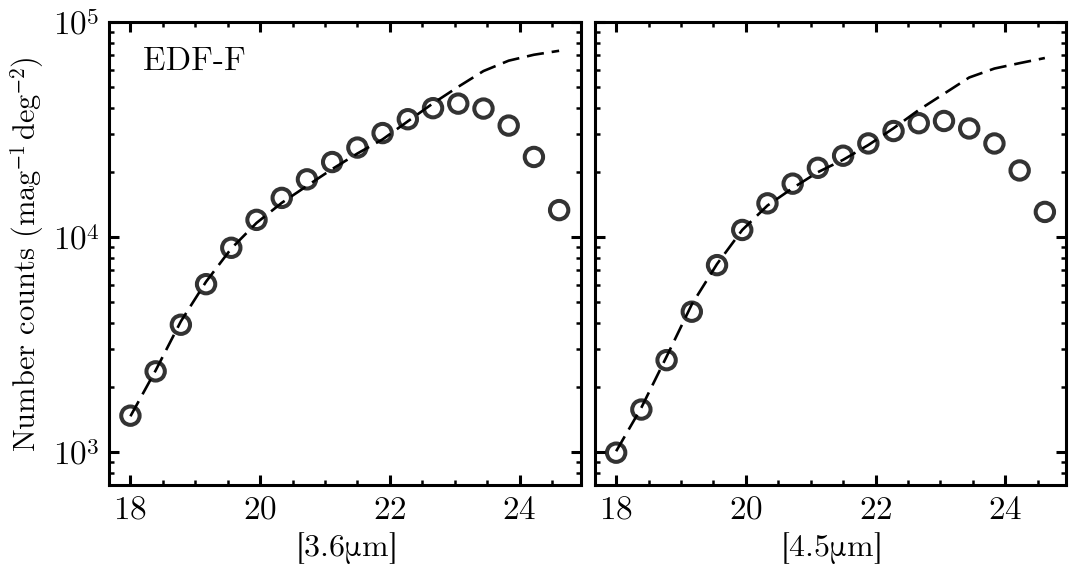
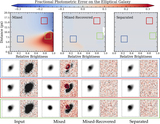
While space-borne optical and near-infrared facilities have succeeded in delivering a precise and spatially resolved picture of our Universe, their small survey area is known to underrepresent the true diversity of galaxy populations. Ground-based surveys have reached comparable depths but at lower spatial resolution, resulting in source confusion that hampers accurate photometry extractions. What once was limited to the infrared regime has now begun to challenge ground-based ultradeep surveys, affecting detection and photometry alike. Failing to address these challenges will mean forfeiting a representative view into the distant Universe. We introduce The Farmer: an automated, reproducible profile-fitting photometry package that pairs a library of smooth parametric models from The Tractor with a decision tree that determines the best-fit model in concert with neighboring sources. Photometry is measured by fitting the models on other bands leaving brightness free to vary. The resulting photometric measurements are naturally total, and no aperture corrections are required. Supporting diagnostics (e.g., χ ^2) enable measurement validation. As fitting models is relatively time intensive, The Farmer is built with high-performance computing routines. We benchmark The Farmer on a set of realistic COSMOS-like images and find accurate photometry, number counts, and galaxy shapes. The Farmer is already being utilized to produce catalogs for several large-area deep extragalactic surveys where it has been shown to tackle some of the most challenging optical and near-infrared data available, with the promise of extending to other ultradeep surveys expected in the near future. The Farmer is available to download from GitHub (https://github.com/astroweaver/the_farmer) and Zenodo (https://doi.org/10.5281/zenodo.8205817).
- Cosmic Evolution of Gas and Star FormationNick Scoville, Andreas Faisst, John Weaver, Sune Toft, Henry J. McCracken, and 18 more authorsThe Astrophysical Journal, Feb 2023
Atacama Large Millimeter/submillimeter Array (ALMA) observations of the long-wavelength dust continuum are used to estimate the gas masses in a sample of 708 star-forming galaxies at z = 0.3-4.5. We determine the dependence of gas masses and star formation efficiencies (SFEs; SFR per unit gas mass) on redshift (z), M _*, and star formation rate (SFR) relative to the main sequence (MS). We find that 70% of the increase in SFRs of the MS is due to the increased gas masses at earlier epochs, while 30% is due to increased efficiency of star formation (SF). For galaxies above the MS this is reversed-with 70% of the increased SFR relative to the MS being due to elevated SFEs. Thus, the major evolution of star formation activity at early epochs is driven by increased gas masses, while the starburst activity taking galaxies above the MS is due to enhanced triggering of star formation (likely due to galactic merging). The interstellar gas peaks at z = 2 and dominates the stellar mass down to z = 1.2. Accretion rates needed to maintain continuity of the MS evolution reach >100 M _☉ yr^-1 at z > 2. The galactic gas contents are likely the driving determinant for both the rise in SF and AGN activity from z = 5 to their peak at z = 2 and subsequent fall at lower z. We suggest that for self-gravitating clouds with supersonic turbulence, cloud collisions and the filamentary structure of the clouds regulate the star formation activity. ^* 2022 AAS Russell Lecture by Scoville. We provide the science background behind the Russell Lecture and draw extensively on previous work in Scoville et al. ().
- COSMOS2020: Identification of High-z Protocluster Candidates in COSMOSMalte Brinch, Thomas R. Greve, John R. Weaver, Gabriel Brammer, Olivier Ilbert, and 19 more authorsThe Astrophysical Journal, Feb 2023
We conduct a systematic search for protocluster candidates at z ≥ 6 in the Cosmic Evolution Survey (COSMOS) field using the recently released COSMOS2020 source catalog. We select galaxies using a number of selection criteria to obtain a sample of galaxies that have a high probability of being inside a given redshift bin. We then apply overdensity analysis to the bins using two density estimators, a Weighted Adaptive Kernel estimator and a Weighted Voronoi Tessellation estimator. We have found 15 significant (>4σ) candidate galaxy overdensities across the redshift range 6 ≤ z ≤ 7.7. The majority of the galaxies appear to be on the galaxy main sequence at their respective epochs. We use multiple stellar-mass-to-halo-mass conversion methods to obtain a range of dark matter halo mass estimates for the overdensities in the range of \raisebox-0.5ex~10^11-10^13 M _☉, at the respective redshifts of the overdensities. The number and the masses of the halos associated with our protocluster candidates are consistent with what is expected from the area of a COSMOS-like survey in a standard Λ cold dark matter cosmology. Through comparison with simulation, we expect that all of the overdensities at z ≃ 6 will evolve into Virgo-/Coma-like clusters at present (i.e., with masses \raisebox-0.5ex~10^14-10^15 M _☉). Compared to other overdensities identified at z ≥ 6 via narrowband selection techniques, the overdensities presented appear to have \raisebox-0.5ex\textasciitilde10\texttimes higher stellar masses and star formation rates (SFRs). We compare the evolution in the total SFR and stellar mass content of the protocluster candidates across the redshift range 6 ≤ z ≤ 7.7 and find agreement with the total average SFR from simulations.
- COSMOS2020: UV-selected galaxies at z ≥ 7.5O. B. Kauffmann, O. Ilbert, J. R. Weaver, H. J. McCracken, B. Milvang-Jensen, and 14 more authorsAstronomy & Astrophysics, Nov 2022
This paper presents a new search for z ≥ 7.5 galaxies using the COSMOS2020 photometric catalogues. Finding galaxies at the reionisation epoch through deep imaging surveys remains observationally challenging. The larger area covered by ground- based surveys such as COSMOS enables the discovery of the brightest galaxies at these high redshifts. Covering 1.4 deg^2, our COSMOS catalogues were constructed from the latest UltraVISTA data release (DR4) combined with the final Spitzer/IRAC COSMOS images and the Hyper-Suprime-Cam Subaru Strategic Program DR2 release. We identified 17 new 7.5 < z < 10 candidate sources, and confirm 15 previously published candidates. Using deblended photometry extracted by fitting surface brightness models on multi-band images, we selected four candidates which would be rejected using fixed aperture photometry. We tested the robustness of all our candidates by comparing six different photometric redshift estimates. Finally, we computed the galaxy UV luminosity function in three redshift bins centred at z = 8, 9, 10. We find no clear evolution of the number density of the brightest galaxies M_UV < ‒21.5, in agreement with previous works. Rapid changes in the quenching efficiency or attenuation by dust could explain such a lack of evolution between z ∼ 8 and z ∼ 9. A spectroscopic confirmation of the redshifts, already planned with JWST and the Keck telescopes, will be essential to confirm our results.
- A Method to Distinguish Quiescent and Dusty Star-forming Galaxies with Machine LearningCharles L. Steinhardt, John R. Weaver, Jack Maxfield, Iary Davidzon, Andreas L. Faisst, and 3 more authorsThe Astrophysical Journal, Mar 2020
Large photometric surveys provide a rich source of observations of quiescent galaxies, including a surprisingly large population at z > 1. However, identifying large, but clean, samples of quiescent galaxies has proven difficult because of their near- degeneracy with interlopers such as dusty, star-forming galaxies. We describe a new technique for selecting quiescent galaxies based upon t-distributed stochastic neighbor embedding (t-SNE), an unsupervised machine-learning algorithm for dimensionality reduction. This t-SNE selection provides an improvement both over UVJ, removing interlopers that otherwise would pass color selection, and over photometric template fitting, more strongly toward high redshift. Due to the similarity between the colors of high- and low-redshift quiescent galaxies, under our assumptions, t-SNE outperforms template fitting in 63% of trials at redshifts where a large training sample already exists. It also may be able to select quiescent galaxies more efficiently at higher redshifts than the training sample.
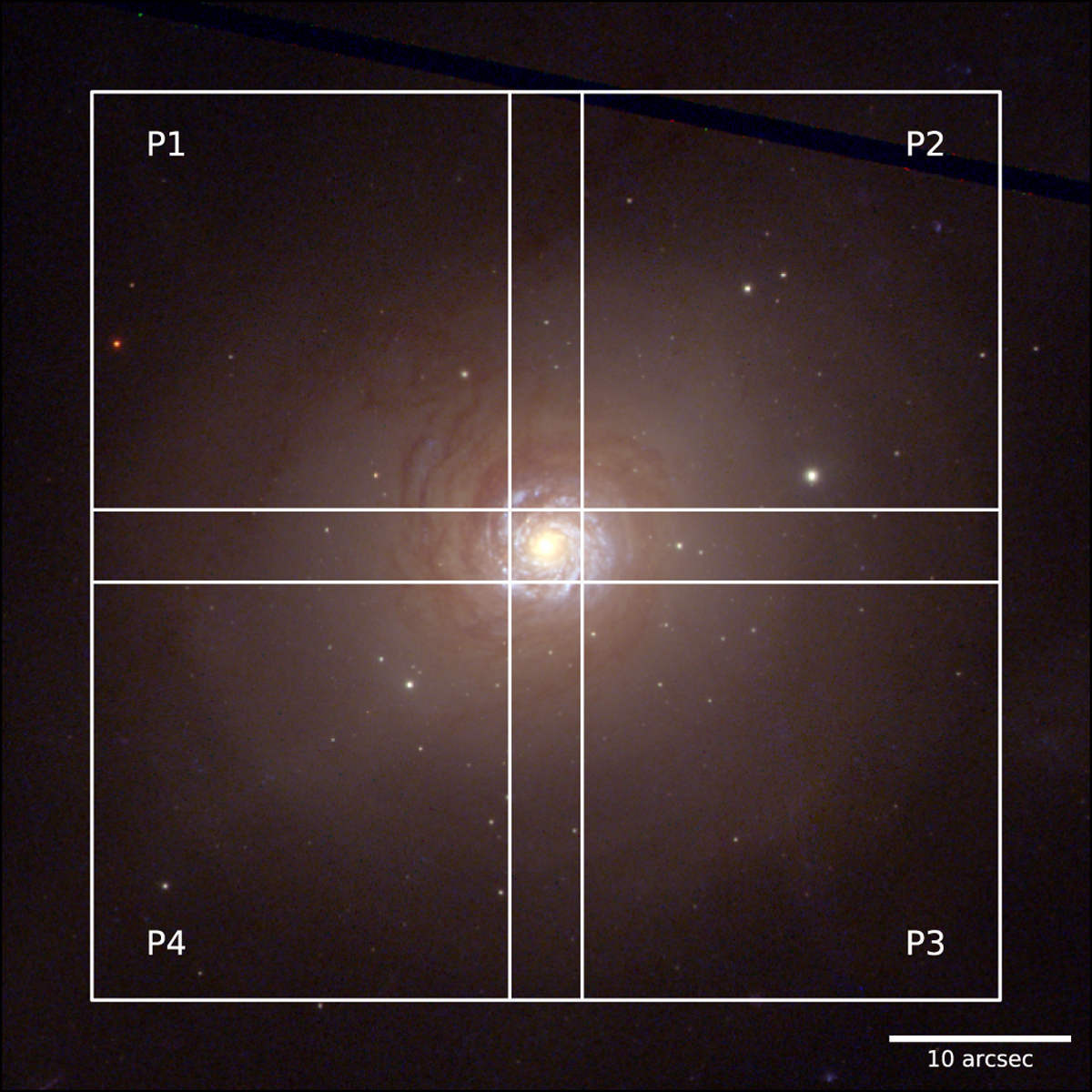
- History and destiny of an emerging early-type galaxy. New IFU insights on the major-merger remnant NGC 7252J. Weaver, B. Husemann, H. Kuntschner, I. Martín-Navarro, F. Bournaud, and 5 more authorsAstronomy & Astrophysics, Jun 2018
Context. The merging of galaxies is one key aspect in our favourite hierarchical ΛCDM Universe and is an important channel leading to massive quiescent elliptical galaxies. Understanding this complex transformational process is ongoing. \Aims: We aim to study NGC 7252, which is one of the nearest major-merger galaxy remnants, observed 1 Gyr after the collision of presumably two gas-rich disc galaxies. It is therefore an ideal laboratory to study the processes inherent to the transformation of disc galaxies to ellipticals. \Methods: We obtained wide-field IFU spectroscopy with the VLT-VIMOS integral-field spectrograph covering the central 50“ \texttimes 50” of NGC 7252 to map the stellar and ionised gas kinematics, and the distribution and conditions of the ionised gas, revealing the extent of ongoing star formation and recent star formation history. \Results: Contrary to previous studies, we find the inner gas disc not to be counter-rotating with respect to the stars. In addition, the stellar kinematics appear complex with a clear indication of a prolate-like rotation component which suggests a polar merger configuration. The ongoing star formation rate is 2.2 \pm 0.6 M_☉ yr^-1 and implies a typical depletion time of 2 Gyr given the molecular gas content. Furthermore, the spatially resolved star formation history suggests a slight radial dependence, moving outwards at later times. We confirm a large AGN-ionised gas cloud previously discovered 5 kpc south of the nucleus, and find a higher ionisation state of the ionised gas at the galaxy centre relative to the surrounding gas disc. Although the higher ionisation towards the centre is potentially degenerate within the central star forming ring, it may be associated with a low- luminosity AGN. \Conclusions: Although NGC 7252 has been classified as post-starburst galaxy at the centre, the elliptical-like major-merger remnant still appears very active. A central kpc-scale gas disc has presumably re-formed quickly within the last 100 Myr after final coalescence. The disc features ongoing star formation, implying Gyr long timescale to reach the red sequence through gas consumption alone. While NGC 7252 is useful to probe the transformation from discs to ellipticals, it is not well-suited to study the transformation from blue to red at this point.
- UNCOVERing the High-redshift AGN Population among Extreme UV Line EmittersHelena Treiber, Jenny E. Greene, John R. Weaver, Tim B. Miller, Lukas J. Furtak, and 21 more authorsThe Astrophysical Journal, May 2025
JWST has revealed diverse new populations of high-redshift (z ∼ 4─11) active galactic nuclei (AGNs) and extreme star-forming galaxies that challenge current photoionization models. In this paper, we use rest-frame UV emission-line diagnostics to identify AGN candidates and other exceptional ionizing sources, complementing previous studies predominantly focused on broad-line AGNs. From a parent sample of 205 z_spec > 3 UNCOVER galaxies with NIRSpec/PRISM follow-up, we identify 12 galaxies with C IV, He II, and/or C III] emission. Three of these galaxies also exhibit clear N III] and/or N IV] lines. Leveraging the combined rest-optical and UV coverage of PRISM, we limit the emission-line model space using the sample’s [O III]/Hβ distribution, significantly decreasing the overlap between AGN and star formation models in the UV diagnostics. We then find that the five He II emitters are the strongest AGN candidates, with further support from two [Ne V] detections and one X-ray detection from Chandra. Our Balmer line fits also reveal one new broad-line AGN at z = 6.87. We cannot robustly quantify the AGN fraction in this sample, but we note that close to 20% of M_* > 2 \texttimes 10^9 M_⊙ parent sample galaxies are AGN candidates. The lower-mass line emitters, which are consistent with both AGN and star-forming photoionization models, have more compact sizes and higher specific star formation rates than the parent sample. Higher- resolution and deeper data on these UV line emitters should provide much stronger constraints on the obscured AGN fraction at z > 3.
- Euclid: Early Release Observations ─ A preview of the Euclid era through a galaxy cluster magnifying lensH. Atek, R. Gavazzi, J. R. Weaver, J. M. Diego, T. Schrabback, and 198 more authorsAstronomy & Astrophysics, May 2025
We present the first analysis of the Euclid Early Release Observations (ERO) program that targets fields around two lensing clusters, Abell 2390 and Abell 2764. We use imaging data from the Visible instrument (VIS) and the Near-Infrared Spectrometer and Photometer (NISP) to produce photometric catalogs for a total of ∼500 000 objects. The imaging data reach a typical depth of 5 σ in the range 25.1─25.4 AB in the NISP bands and 27.1─27.3 AB in the VIS band. Using the Lyman-break method in combination with photometric redshifts, we searched for high-redshift galaxies. We identified 30 Lyman- break galaxy (LBG) candidates at z > 6 and 139 extremely red sources (ERSs), most of which likely lie at lower redshift. The VIS imaging is deeper than the NISP imaging, which means that we can routinely identify high-redshift Lyman-break galaxies at about a magnitude of 3, which reduces contamination by brown dwarf stars and low-redshift galaxies. The difficulty of spatially resolving most of these sources in 0″.3 pix^-1 imaging means that it is difficult to distinguish between galaxies and quasars. Spectroscopic follow- up campaigns of these bright sources will help us to constrain the bright end of the ultraviolet galaxy luminosity function and the quasar luminosity function at z > 6, and it will constrain the physical nature of these objects. Additionally, we performed a combined strong- and weak-lensing analysis of A2390, and we show that Euclid will contribute to constraining the virial mass of galaxy clusters better. We also identify optical and near- infrared counterparts of known z > 0.6 clusters in these data. These counterparts exhibit strong-lensing features. This establishes that Euclid can characterize high-redshift clusters. Finally, we provide a glimpse of the ability of Euclid to map the intracluster light out to larger radii than current facilities, which enables us to understand the cluster assembly history better and to map the dark matter distribution. This initial dataset illustrates the diverse spectrum of legacy science that is possible with the Euclid survey. ★This paper is published on behalf of the Euclid Consortium.
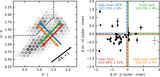
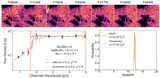
- Euclid: Early Release Observations ─ NISP-only sources and the search for luminous z = 6─8 galaxiesJ. R. Weaver, S. Taamoli, C. J. R. McPartland, L. Zalesky, N. Allen, and 183 more authorsAstronomy & Astrophysics, May 2025
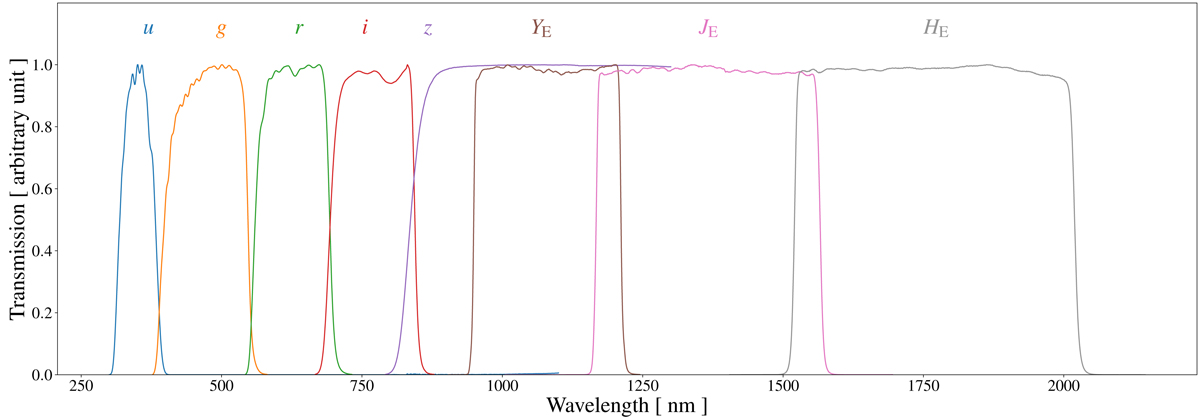
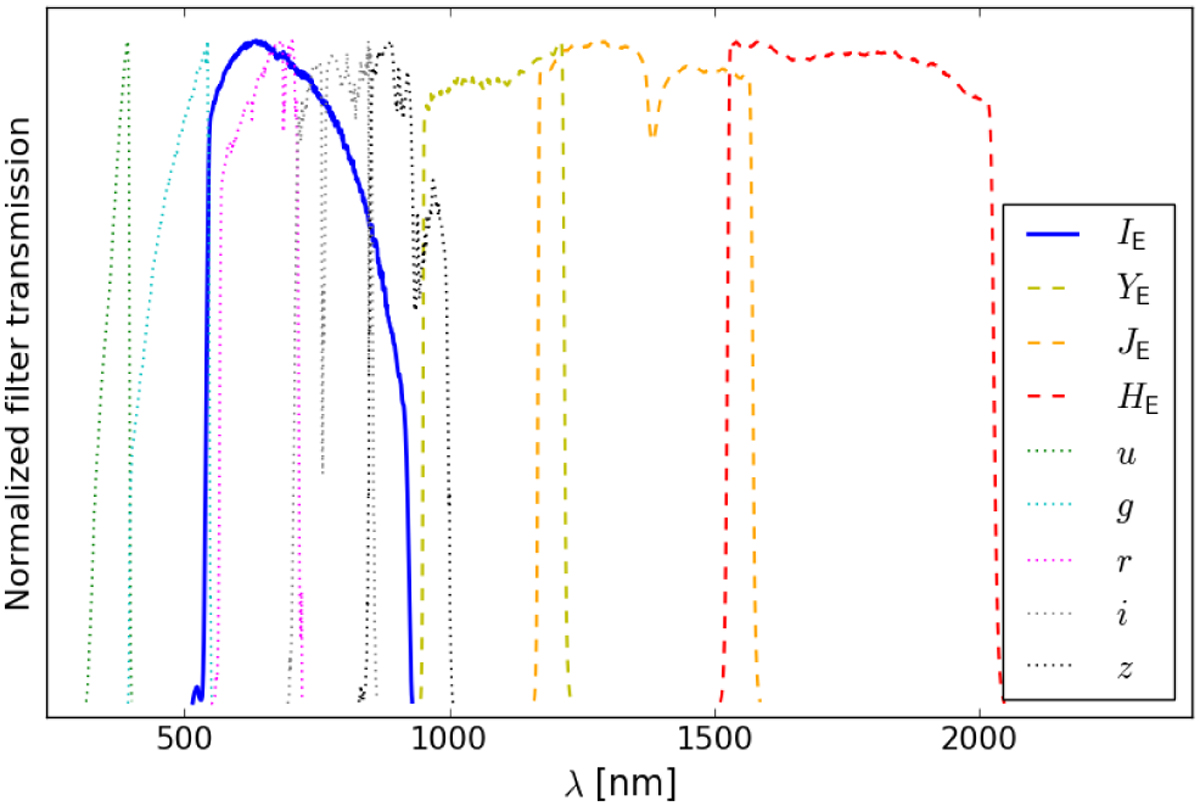
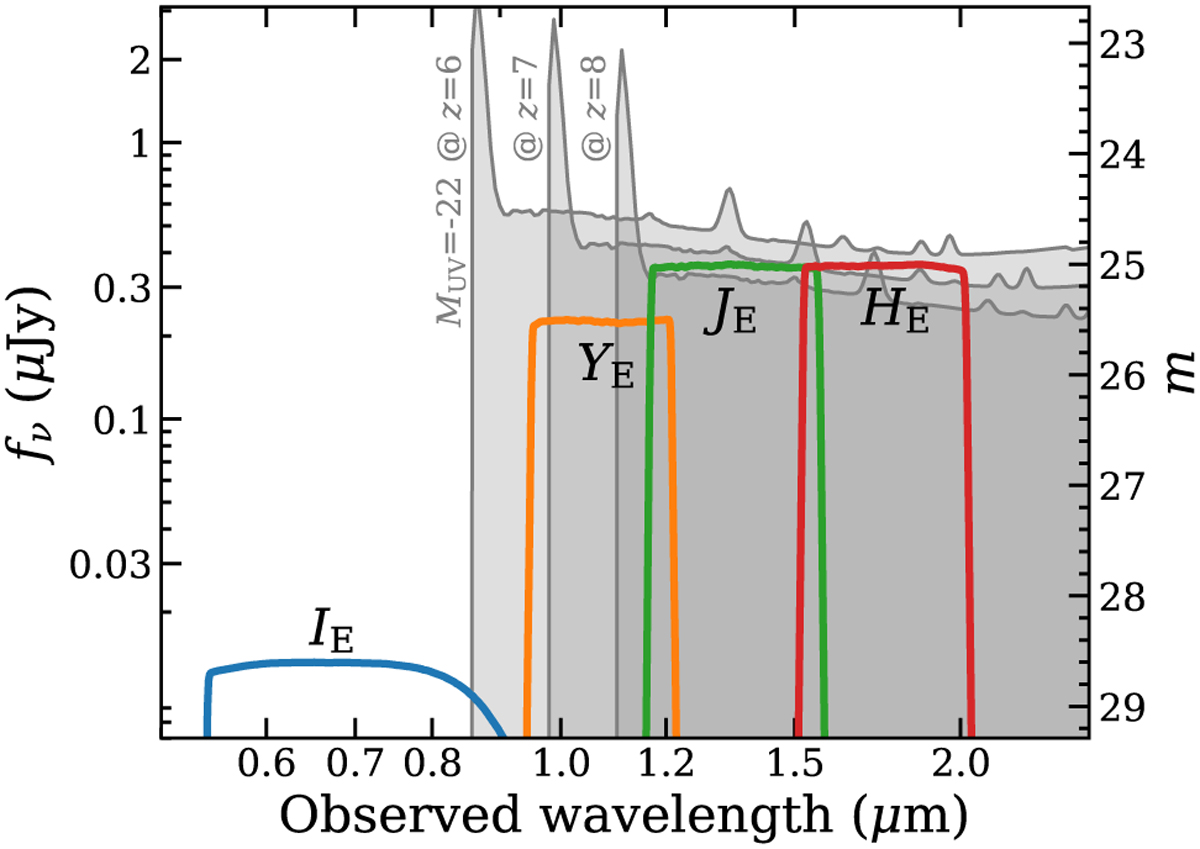
This paper presents a search for high redshift galaxies from the Euclid Early Release Observations program ’Magnifying Lens.’ The 1.5 deg^2 area covered by the twin Abell lensing cluster fields is comparable in size to the few other deep near-infrared surveys such as COSMOS, and so provides an opportunity to significantly increase known samples of rare UV-bright galaxies at z ≍ 6─8 (M_UV ≲ -22). Beyond their still uncertain role in reionisation, these UV-bright galaxies are ideal laboratories from which to study galaxy formation and constrain the bright- end of the UV luminosity function. Of the 501 994 sources detected from a combined Y_E, J_E, and H_E NISP detection image, 168 do not have any appreciable VIS/I_E flux. These objects span a range in spectral colours, separated into two classes: 139 extremely red sources; and 29 Lyman-break galaxy candidates. Best-fit redshifts and spectral templates suggest the former is composed of both z ≳ 5 dusty star-forming galaxies and z ≍ 1─3 quiescent systems. The latter is composed of more homogeneous Lyman-break galaxies at z ≍ 6─8. In both cases, contamination by L- and T-type dwarfs cannot be ruled out with Euclid images alone. Additional contamination from instrumental persistence is investigated using a novel time series analysis. This work lays the foundation for future searches within the Euclid Deep Fields, where thousands more z ≳ 6 Lyman-break systems and extremely red sources will be identified. ★This paper is published on behalf of the Euclid Consortium
- Euclid preparation: LXXXVI. Cosmic Dawn Survey: Evolution of the galaxy stellar mass function across 0.2 < z ≤ 6.5 measured over 10 square degreesEuclid Collaboration, L. Zalesky, J. R. Weaver, C. J. R. McPartland, G. Murphree, and 302 more authorsAstronomy & Astrophysics, Mar 2026
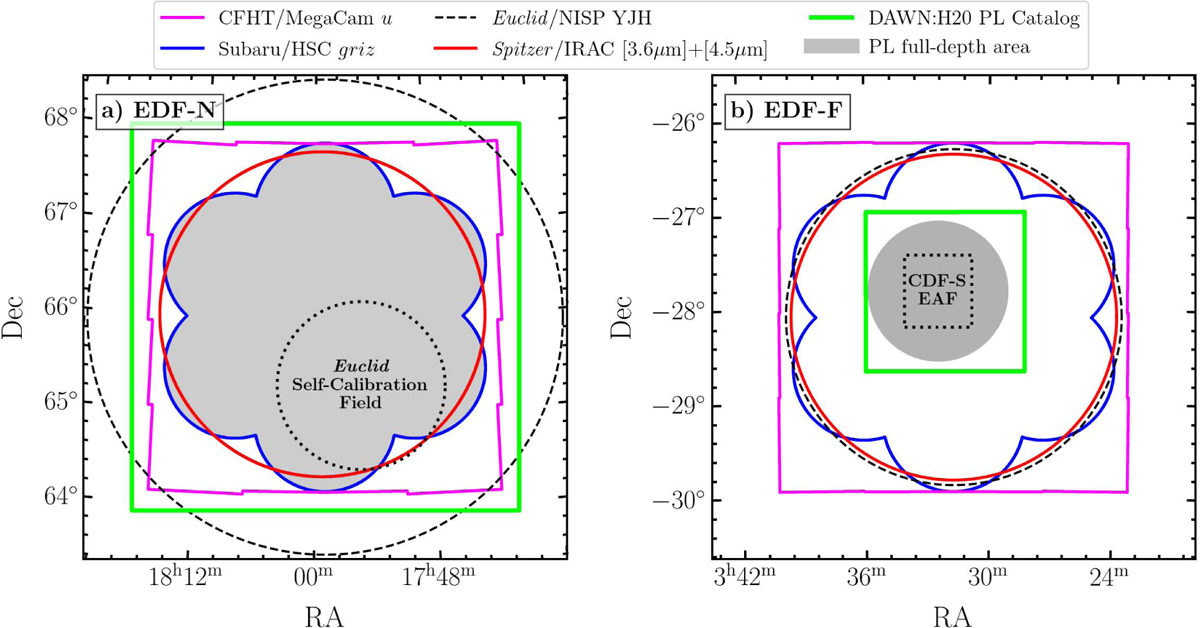
The Cosmic Dawn Survey Pre-launch (PL) catalogues cover an effective 10.13 deg^2 area with uniform deep Spitzer/IRAC data (m\sim25 mag, 5σ), the largest area covered to these depths in the infrared. These data are used to gain new insight into the growth of stellar mass across cosmic history by characterising the evolution of the galaxy stellar mass function (GSMF) through 0.2 < z ≤6.5. The total volume (0.62 Gpc^3) represents a tenfold increase compared to previous works that have explored z > 3 and significantly reduces cosmic variance, yielding strong constraints on the abundance of massive galaxies. Results are generally consistent with the literature but now provide firm estimates of number density where only upper limits were previously available. Contrasting the GSMF with the dark matter halo mass function suggests that massive galaxies (M rsim10^11 M_⊙) at z > 3.5 required integrated star-formation efficiencies of M/(M_\rm hf_\rm b) rsim 0.25–0.5, in excess of the commonly-held view of “universal peak efficiency” from studies on the stellar-to-halo mass relation (SHMR). Such increased efficiencies imply an evolving peak in the SHMR at z > 3.5 which can be maintained if feedback mechanisms from active galactic nuclei and stellar processes are ineffective at early times. In addition, a significant fraction of the most massive quiescent galaxies are observed to be in place already by z∼2.5–3. The apparent lack in change of their number density by z∼0.2 is consistent with relatively little mass growth from mergers. Utilising the unique volume, evidence for an environmental dependence of the galaxy stellar mass function is found all the way through z∼3.5 for the first time, though a more careful characterisation of the density field is ultimately required for confirmation.
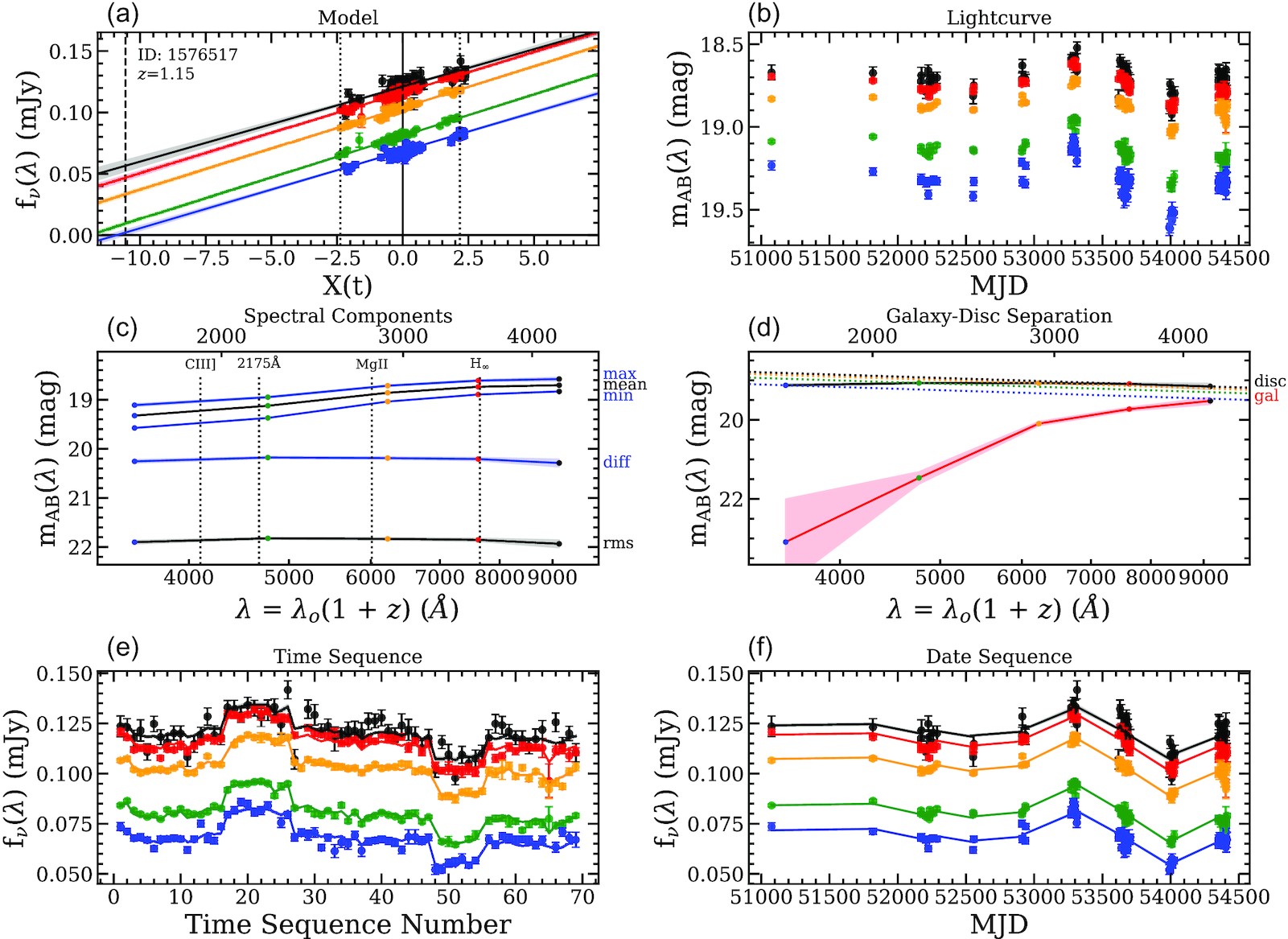
- Dust and the intrinsic spectral index of quasar variations: hints of finite stress at the innermost stable circular orbitJohn R. Weaver and Keith HorneMonthly Notices of the Royal Astronomical Society, May 2022
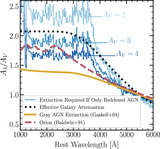
We present a study of 9 242 spectroscopically confirmed quasars with multiepoch ugriz photometry from the SDSS Southern Survey. By fitting a separable linear model to each quasar’s spectral variations, we decompose their five-band spectral energy distributions into variable (disc) and non-variable (host galaxy) components. In modelling the disc spectra, we include attenuation by dust on the line of sight through the host galaxy to its nucleus. We consider five commonly used attenuation laws, and find that the best description is by dust similar to that of the Small Magellanic Cloud, inferring a lack of carbonaceous grains from the relatively weak 2175-Å absorption feature. We go on to construct a composite spectrum for the quasar variations spanning 700-8000 Å. By varying the assumed power-law L_ν ∝ ν^α spectral slope, we find a best-fitting value α = 0.71 \pm 0.02, excluding at high confidence the canonical L_ν ∝ ν^1/3 prediction for a steady-state accretion disc with a T ∝ r^-3/4 temperature profile. The bluer spectral index of the observed quasar variations instead supports the model of Agol & Krolik, and Mummery & Balbus, in which a steeper temperature profile, T ∝ r^-7/8, develops as a result of finite magnetically induced stress at the innermost stable circular orbit extracting energy and angular momentum from the black hole spin.
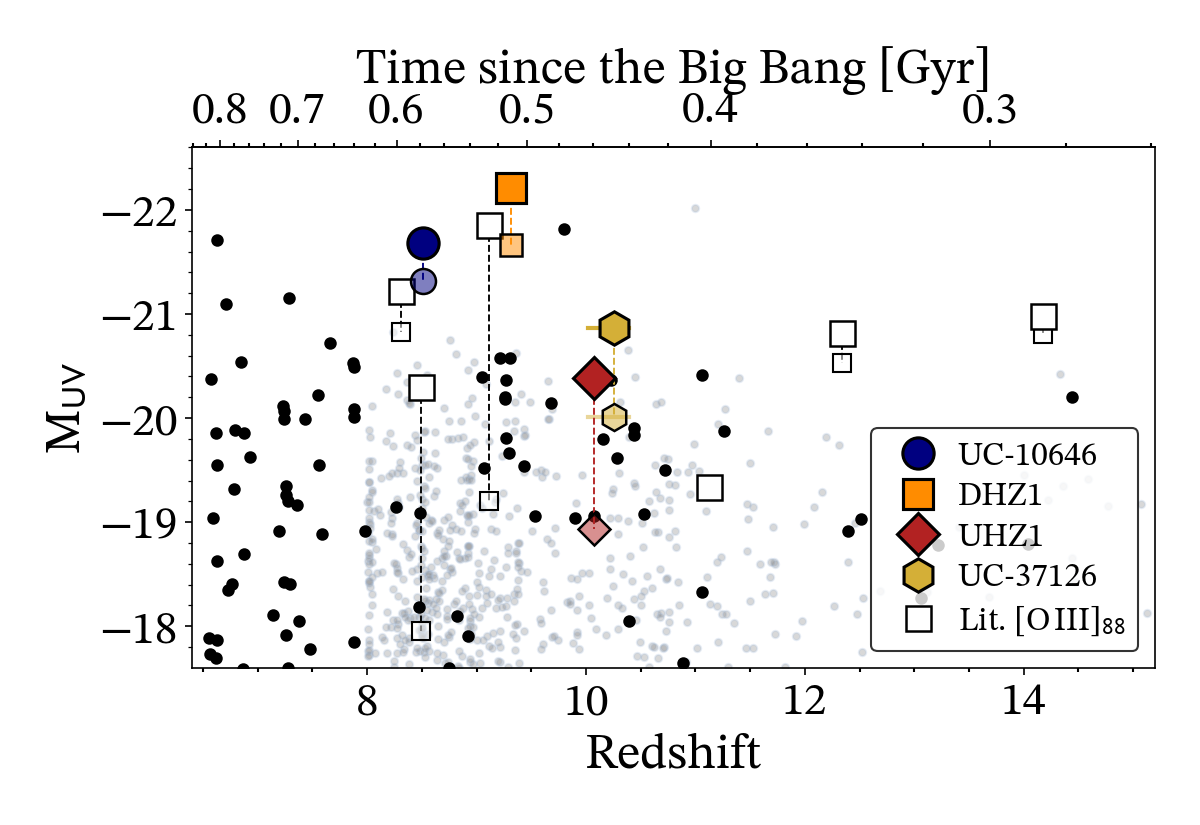
- A first systematic study of [OIII] 88 μ m at z > 8 : two luminous oxygen lines and a powerful ionized outflow in the first 600 million yearsHiddo Algera, John R. Weaver, Tom J. L. C. Bakx, Manuel Aravena, Rychard J. Bouwens, and 33 more authorsThe Open Journal of Astrophysics, Jul 2026
We present deep ALMA Band 7 observations of the [OIII] 88μm line and underlying dust continuum emission in four UV-bright, gravitationally lensed (magnification μ= 1.4-3.8), JWST- selected galaxies at z = 8.5 - 10.3, with observed magnitudes -22.5 ≲M_\mathrmUV ≲-20.5. [OIII] 88μm is confidently detected in UNCOVER-10646 at z=8.5080 \pm 0.0011 (15σ) and DHZ1 at z=9.3113 \pm 0.0005 (6σ), with both being intrinsically luminous systems [L_\mathrm[OIII] = (1.1 - 1.6) \times 10^9 L_⊙] that follow the local [OIII]-SFR relation. [OIII] 88μm remains undetected in the two z>10 targets, including in the z=10.07 X-ray AGN UHZ1, where we obtain a deep limit of L_\mathrm[OIII] < 6 \times 10^7 L_⊙. Dust emission is not detected in any individual source nor in a stack (<3σ). The high S/N [OIII] 88μm detection in UNCOVER-10646 uniquely reveals an additional broad component (\mathrmFWHM = 1366_-329^+473 \mathrmkm/s; ∆\mathrmBIC\approx20) indicative of an ionized outflow. We infer a high outflow rate of \dotM_\mathrmout = 128_-46^+80 M_⊙\mathrmyr^-1, corresponding to a mass loading factor η= \dotM_\mathrmout/\mathrmSFR = 2.9_-1.0^+1.8 that is broadly consistent with theoretical predictions and JWST-based studies of ionized outflows at high redshift. While high-resolution ALMA follow-up is required to confirm the outflow, this first systematic study at z>8 highlights the unique diagnostic power of [OIII] 88μm in characterizing galaxies in the early Universe.
- The Structure and Formation Histories of Low-mass Quiescent Galaxies in the A2744 Cluster EnvironmentSam E. Cutler, John R. Weaver, Katherine E. Whitaker, Jenny E. Greene, David J. Setton, and 19 more authorsThe Astrophysical Journal, Nov 2025
Low-mass quiescent galaxies are thought to predominantly reside in overdense regions, as environmental effects are often invoked to explain their shutdown of star formation. These longer-timescale quenching mechanisms—such as interactions with hot gas in the intracluster medium and dynamical encounters with other cluster galaxies—leave imprints on galaxy morphologies, emphasizing the importance of quantifying the structures of low-mass quiescent galaxies in galaxy clusters at z < 0.5. Using spectrophotometric data from the UNCOVER and MegaScience programs, we present the first measurement of the quiescent size─mass relation between 7log(M⋆/M⊙)10 using JWST imaging, based on a sample of 1531 galaxies in the z = 0.308 A2744 galaxy cluster. The resulting size─mass relation has a significantly higher scatter than similar-redshift field samples, despite comparable best-fit relations in both the dwarf and intermediate-mass regimes. Both “progenitor bias,” where larger, diskier low-mass galaxies enter the cluster at later epochs, and a general expansion of galaxy structure from dynamical interactions could be at play. This evolutionary framework is further supported by the tentative evidence that older low-mass quiescent galaxies in the cluster are more spheroidal. The star formation histories derived for our cluster sample imply their formation and quenching occurs relatively late, at z < 1.5. In this scenario, the progenitor population would have disky axis-ratio distributions at cosmic noon, in agreement with recent observations. While this leaves ample time for dynamical interactions to maintain quiescence and drive the observed subsequent morphological evolution postquenching, the data disfavor an onset of quenching due to the environment.
- The Spitzer-HETDEX Exploratory Large-Area Survey. IV. Model-based Multiwavelength Photometric CatalogGene C. K. Leung, Steven L. Finkelstein, John R. Weaver, Casey Papovich, Rebecca L. Larson, and 9 more authorsThe Astrophysical Journal Supplement Series, Dec 2023
We present a 0.3-4.5 μm 16-band photometric catalog for the Spitzer/HETDEX Exploratory Large-Area (SHELA) survey. SHELA covers an \raisebox-0.5ex\textasciitilde27 deg^2 field within the footprint of the Hobby-Eberly Telescope Dark Energy Experiment (HETDEX). Here we present new DECam imaging and an rizK _ s band-selected catalog of four million sources extracted using a fully model-based approach. We validate our photometry by comparing with the model-based DECam Legacy Survey. We analyze the differences between model-based and aperture photometry by comparing with the previous SHELA catalog, finding that our model-based photometry can measure point sources to fainter fluxes and better capture the full emission of resolved sources. The catalog is 80% (50%) complete at riz \raisebox-0.5ex~24.7 (25.1) AB mag, and the optical photometry reaches a 5σ depth of \raisebox-0.5ex\textasciitilde25.5 AB mag. We measure photometric redshifts and achieve a 1σ scatter of ∆z/(1 + z) of 0.04 with available spectroscopic redshifts at 0 ≤ z ≤ 1. This large-area, multiwavelength photometric catalog, combined with spectroscopic information from HETDEX, will enable a wide range of extragalactic science investigations.

2026
- ALMA observations of pre-JWSTz \raisebox-0.5ex~10 galaxy candidates: A CO(J = 9-8) line from a ULIRG at z = 2.54 and revisit of the photometric redshifts with JWST photometrySuzuka Arai, Yuma Sugahara, Akio K. Inoue, Takuya Hashimoto, Ken Mawatari, and 13 more authorsMonthly Notices of the Royal Astronomical Society, Sep 2026
- Toward Unbreaking the Universe: MINERVA Measurements of Color Gradients in Massive Quiescent Galaxies Can Help Ease Too-early Star Formation TensionsSam E. Cutler, Luke Robbins, Danilo Marchesini, Katherine A. Suess, Adam Muzzin, and 39 more authorsThe Astrophysical Journal Letters, Sep 2026
- Everything Every Band All at Once. I. A Global Morphology Catalog in A2744 Based on UNCOVER/MegaScienceYunchong Zhang, Tim B. Miller, Sedona H. Price, Katherine A. Suess, Rachel Bezanson, and 29 more authorsThe Astrophysical Journal Supplement Series, Aug 2026
We present spectrally-resolved structural parameter measurements of 29,608 sources from the legacy lensing field of Abell 2744, quantifying global structures from observed 0.7 μm - 4.8 μm and spanning rest-frame UV to NIR at R\sim15. These measurements are made on imaging mosaics mainly from the UNCOVER/MegaScience survey, including 20 JWST NIRCam broad and medium bands. We perform single-component Sérsic fitting to these galaxies using \textbackslashtexttt{pysersic}, a Bayesian structural fitting tool, to infer their structural parameters and associated random uncertainties from the posterior distributions. Through various quality evaluation criteria, we infer robust structural parameters among > 90% of the selected \rm SNR>10 sources. For each galaxy with reliable sizes in at least two bands and a high-quality redshift, we fit its observed size as a function of wavelength and infer rest-frame UV, optical, and near-infrared sizes where applicable. By performing injection-recovery tests on simulated galaxy cutouts in selected bands, we establish that our structural parameter measurements achieve fractional error < 10 -20% above \rm SNR>10. With this paper, all raw structural measurements and fitted rest-frame sizes are quality-flagged, cataloged, and released to the community. Finally, we demonstrate that this catalog enables the structural study of galaxies over an unprecedentedly wide parameter space of redshift (0.3<z<8), stellar mass (\rm 10^7 M_⊙<M_* <10^11.5 M_⊙), and rest-frame optical size (\rm 100 pc<R_e<10 kpc), after correcting for lensing magnification.
- Discovery of Red Galaxy Candidates at z ∼ 12: Early Dust Growth or Significant Nebular Emission with High-temperature Stars?Ikki Mitsuhashi, Katherine A. Suess, Joel Leja, Pratika Dayal, Robert Feldmann, and 17 more authorsThe Astrophysical Journal, Jul 2026
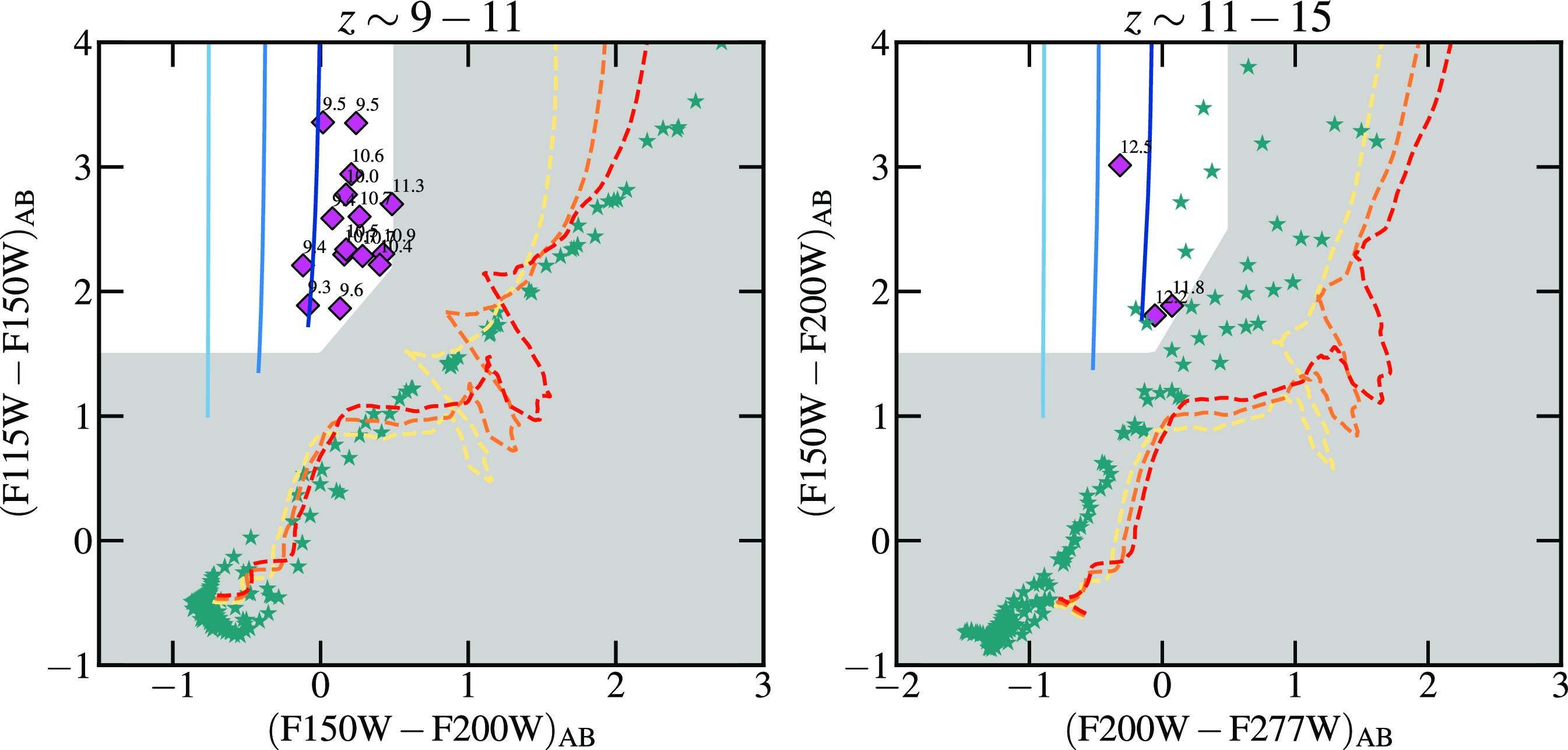
We report the discovery of two z \raisebox-0.5ex~12 galaxy candidates with unusually red UV slopes (betaUV \raisebox-0.5ex~> -1.5), and probe the origin of such colors at cosmic dawn. From Prospector fits to the UNCOVER/MegaScience dataset – deep JWST/NIRCam imaging of Abell 2744 in 20 broad- and medium-bands – we identify several new z > 10 galaxies. Medium-band data improve redshift estimates, revealing two lensed (mu \raisebox-0.5ex~3.3) z \raisebox-0.5ex~12 galaxies in a close pair with beta_UV \raisebox-0.5ex~> -1.5 at an UV absolute magnitude of M_UV \raisebox-0.5ex~-19 mag, lying away from typical scatter on previously known MUV- betaUV relations. SED fitting with Prospector, Bagpipes, and EAZY support their high-z nature, with probability of low-z interlopers of p(z < 7) < 10%. The potential low-z interlopers are z \raisebox-0.5ex~3 quiescent galaxies (QGs), but unexpected to be detected at the given field of view unless z \raisebox-0.5ex~3 QG stellar mass function has a strong turn up at log Mstar/Msun \raisebox-0.5ex~9. Unlike typical blue high- redshift candidates (beta_UV \raisebox-0.5ex~< -2.0), these red slopes require either dust or nebular continuum reddening. The dust scenario implies Av \raisebox-0.5ex~0.8 mag, which is larger than theoretical predictions, but is consistent with a dust-to- stellar mass ratio (log M_dust/M_star \raisebox-0.5ex~-3). The nebular scenario demands dense gas (log nH /cm\^3 \raisebox-0.5ex~4.0) around hot stars (log Teff [K] \raisebox-0.5ex~4.9). Spectroscopic follow- up is essential to determine their true nature and reveal missing galaxies at the cosmic dawn.
- Euclid Quick Data Release (Q1): XXXVIII. Euclid spectroscopy of quasars. 1. Identification and redshift determination of 3500 bright quasarsEuclid Collaboration, Y. Fu, R. Bouwens, K. I. Caputi, D. Vergani, and 352 more authorsAstronomy & Astrophysics, Jul 2026
The slitless spectroscopy mode of the NISP onboard Euclid has enabled efficient spectroscopy of objects within a large FoV. We present a large and homogeneous sample of bright quasars identified from the Euclid Quick Data Release (Q1) by combining high-purity candidate selections from Gaia and WISE with the NISP spectra. Through visual inspection of the Euclid spectra of these quasar candidates, we identify approximately 3500 quasars with reliable redshifts at 0<z≲4.8. Of these, 2686 are new spectroscopic identifications relative to existing public compilations. We generate the first Euclid composite spectrum of quasars covering rest-frame NUV to NIR wavelengths without telluric lines, which will be pivotal to NIR quasar spectral analysis. We obtain an empirical spectroscopic depth of J_\rm E≲21.5 and H_\rm E≲21.3 at the sensitivity of the Wide Field Survey, beyond which the number of securely identified quasars declines sharply. We analyse VIS morphologies using Sersic and CAS metrics, and a deep-learning PSF fraction to track nuclear dominance. At low redshift (z<0.5), obvious host structures are common and a single Sersic model fits about half of the sources; at intermediate redshift (0.5<z<2), the nuclear component dominates, with 90% of the Sersic fits saturating at the upper index limit. In this intermediate redshift regime, f_\rm PSF is available, and we use it as a more reliable compactness measure than the single-Sersic and CAS parameters to quantify nuclear versus host emission. We also explore the novel Euclid NIR colour space and discuss the role of these quasars in refining AGN selection techniques for future Euclid data releases. The spectroscopic bright quasar catalogue of this work, and the composite quasar spectrum, will be available at https://cdsarc.cds.unistra.fr/. (abridged)
- Characterising Lyα damping wings at the onset of reionisation: Evidence for highly efficient star formation driven by dense, neutral gas in UV-bright galaxies at z > 9Clara L. Pollock, Kasper E. Heintz, Joris Witstok, Rashmi Gottumukkala, Gabriel Brammer, and 21 more authorsAstronomy & Astrophysics, Jul 2026
One of the major conundrums in contemporary extragalactic astrophysics is the apparent overabundance of a remarkable population of UV- bright galaxies at redshifts zrsim 9. We analyse galaxies spectroscopically observed by JWST/NIRSpec Prism and confirmed to lie at z>9, with sufficient signal-to-noise to carefully model their rest-frame UV to optical continua and line emission. In particular, we model the damped Lyman-α (Lyα) absorption (DLA) features of each galaxy to place observational constraints on the gas assembly of neutral atomic hydrogen (HI) onto the galaxy halos at the onset of cosmic reionisation. Based on the derived HI column densities and star-formation rate (SFR) surface densities, we show that all galaxies are highly efficient at forming stars on rapid ∼10-100 Myr depletion timescales, greatly in excess compared to the canonical local universe Kennicutt-Schmidt relation and predictions from state- of-the-art galaxy formation simulations. The dense HI gas appears to also drive the offset from the fundamental- metallicity relation of these galaxies though its dust-to-gas ratio is seemingly consistent with values derived for local galaxies except for the lowest metallicity sight-lines. Our results provide the first robust observational constraints on the impact of pristine HI gas on early galaxy assembly, and imply that a combination of highly efficient star formation and low dust obscuration can likely explain the UV-brightness of galaxies at cosmic dawn.
- Euclid Quick Data Release (Q1): XXXVI. Galaxy shapes and alignments in the cosmic webEuclid Collaboration, C. Laigle, C. Gouin, F. Sarron, L. Quilley, and 340 more authorsAstronomy & Astrophysics, Jun 2026
Galaxy morphologies and shape orientations are expected to correlate with their large-scale environment, since they grow by accreting matter from the cosmic web and are subject to interactions with other galaxies. Cosmic filaments are extracted in projection from the Euclid Quick Data Release 1 (covering 63.1 \mathrmdeg^2) at 0.5<z<0.9 in tomographic slices of 170 comoving h^-1\mathrmMpc using photometric redshifts. Galaxy morphologies are accurately retrieved thanks to the excellent resolution of VIS data. The distribution of massive galaxies (M_* > 10^10 M_⊙) in the projected cosmic web is analysed as a function of morphology measured from VIS data. Specifically, the 2D alignment of galaxy shapes with large-scale filaments is quantified as a function of Sérsic indices and masses. We find the known trend that more massive galaxies are closer to filament spines. At fixed stellar masses, morphologies correlate both with densities and distances to large-scale filaments. In addition, the large volume of this data set allows us to detect a signal indicating that there is a preferential alignment of the major axis of massive early-type galaxies along projected cosmic filaments. Overall, these results demonstrate our capabilities to carry out detailed studies of galaxy environments with Euclid, which will be extended to higher redshift and lower stellar masses with the future Euclid Deep Survey.
- Euclid Quick Data Release (Q1): IV. From images to multi-wavelength catalogues: The Euclid MERge processing functionEuclid Collaboration, E. Romelli, M. Kümmel, H. Dole, J. Gracia-Carpio, and 343 more authorsAstronomy & Astrophysics, Jun 2026
The Euclid satellite is an ESA mission that was launched in July 2023. \textbackslashEuclid is working in its regular observing mode with the target of observing an area of 14 000 \textdeg^2 with two instruments, the Visible Camera (VIS) and the Near IR Spectrometer and Photometer (NISP) down to I_\rm E = 24.5 \textmag (10\,σ) in the Euclid Wide Survey. Ground- based imaging data in the \textbackslashtextit{ugriz} bands complement the \textbackslashEuclid data to enable photo-z determination and VIS PSF modeling for week lensing analysis. Euclid investigates the distance-redshift relation and the evolution of cosmic structures by measuring shapes and redshifts of galaxies and clusters of galaxies out to z∼2. Generating the multi-wavelength catalogues from \textbackslashEuclid and ground-based data is an essential part of the \textbackslashEuclid data processing system. In the framework of the \textbackslashEuclid Science Ground Segment (SGS), the aim of the MER Processing Function (PF) pipeline is to detect objects in the \textbackslashEuclid imaging data, measure their properties, and MERge them into a single multi- wavelength catalogue. The MER PF pipeline performs source detection on both visible (VIS) and near-infrared (NIR) images and offers four different photometric measurements: Kron total flux, aperture photometry on PSF-matched images, template fitting photometry, and Sérsic fitting photometry. Furthermore, the MER PF pipeline measures a set of ancillary quantities, spanning from morphology to quality flags, to better characterise all detected sources. In this paper, we show how the MER PF pipeline is designed, detailing its main steps, and we show that the pipeline products meet the tight requirements that Euclid aims to achieve on photometric accuracy. We also present the other measurements (e.g. morphology) that are included in the OU-MER output catalogues and we list all output products coming out of the MER PF pipeline.
- DeepDive: A deep dive into the physics of the first massive quiescent galaxies in the UniverseK. Ito, F. Valentino, G. Brammer, M. L. Hamadouche, K. E. Whitaker, and 24 more authorsAstronomy & Astrophysics, Jun 2026
We present the DeepDive program, in which we obtained deep (1-3 hours) JWST/NIRSpec G235M/F170LP spectra for 10 primary massive (\log(M_⋆/M_⊙)=10.8-11.5) quiescent galaxies at z\sim3-4. A novel reduction procedure extends the nominal wavelength coverage of G235M beyond Hα and [NII] at z\sim4, revealing weak, narrow Hα lines indicative of low star formation rates (\rm SFR\sim0-5 M_⊙ \rm yr^-1). Two out of 10 primary targets have broad Hα lines, indicating the presence of AGNs. We also conduct an archival search of quiescent galaxies observed with NIRSpec gratings in the DAWN JWST Archive, which provides a statistical context for interpreting the DeepDive targets. This archival search provides a spectroscopic sample of 140 quiescent galaxies spanning 1<z<5 and covering more than an order of magnitude in stellar mass. We revisit the selection of quiescent galaxies based on rest-frame UVJ colors, specific star formation rates, and the detection of the 4000Å spectral break, finding \sim90% overlap between these criteria. The sample of a total of 150 quiescent galaxies constructed in this study shows that those at z\sim3-5, including the DeepDive targets, typically exhibit weaker 4000Å breaks and bluer colors than their lower- redshift counterparts, indicating generally younger stellar populations. Stacked spectra of sources grouped by the D_n4000 index reveal faint Iron and Magnesium absorption line features in the stellar continuum even for the low D_n4000 (D_n4000<1.35) subsample at high redshift (z\sim3). In addition, higher D_n4000 subsamples show fainter nebular emission lines. These results demonstrate that medium-resolution NIRSpec spectroscopy is essential for robustly characterizing the diversity and evolution of early quiescent galaxies. All data from this study will be made publicly available.
- Euclid Quick Data Release (Q1): III. NIR processing and data productsEuclid Collaboration, G. Polenta, M. Frailis, A. Alavi, P. N. Appleton, and 365 more authorsAstronomy & Astrophysics, Jun 2026
This paper describes the near-infrared processing function (NIR PF) that processes near-infrared images from the Near-Infrared Spectrometer and Photometer (NISP) instrument onboard the Euclid satellite. NIR PF consists of three main components: (i) a common pre-processing stage for both photometric (NIR) and spectroscopic (SIR) data to remove instrumental effects; (ii) astrometric and photometric calibration of NIR data, along with catalogue extraction; and (iii) resampling and stacking. The necessary calibration products are generated using dedicated pipelines that process observations from both the early performance verification (PV) phase in 2023 and the nominal survey operations. After outlining the pipeline’s structure and algorithms, we demonstrate its application to Euclid Q1 images. For Q1, we achieve an astrometric accuracy of 9-15 mas, a relative photometric accuracy of 5 mmag, and an absolute flux calibration limited by the 1% uncertainty of the Hubble Space Telescope (HST) CALSPEC database. We characterise the point- spread function (PSF) that we find very stable across the focal plane, and we discuss current limitations of NIR PF that will be improved upon for future data releases.
- Euclid Quick Data Release (Q1): II. VIS processing and data productsEuclid Collaboration, H. J. McCracken, K. Benson, C. Dolding, T. Flanet, and 375 more authorsAstronomy & Astrophysics, Jun 2026
This paper describes the VIS Processing Function (VIS PF) of the Euclid ground segment pipeline, which processes and calibrates raw data from the VIS camera. We present the algorithms used in each processing element, along with a description of the on-orbit performance of VIS PF, based on Performance Verification (PV) and Q1 data. We demonstrate that the principal performance metrics (image quality, astrometric accuracy, photometric calibration) are within pre-launch specifications. The image-to- image photometric scatter is less than 0.8%, and absolute astrometric accuracy compared to Gaia is 5 mas Image quality is stable over all Q1 images with a full width at half maximum (FWHM) of 0.\!^\prime\prime16. The stacked images (combining four nominal and two short exposures) reach I_\mathrmE = 25.6 (10σ, measured as the variance of 1.\!^\prime\prime3 diameter apertures). We also describe quality control metrics provided with each image, and an appendix provides a detailed description of the provided data products. The excellent quality of these images demonstrates the immense potential of Euclid VIS data for weak lensing. VIS data, covering most of the extragalactic sky, will provide a lasting high-resolution atlas of the Universe.
- Euclid Quick Data Release (Q1): I. Data release overviewEuclid Collaboration, H. Aussel, I. Tereno, M. Schirmer, G. Alguero, and 405 more authorsAstronomy & Astrophysics, Jun 2026
The first Euclid Quick Data Release, Q1, comprises 63.1 sq deg of the Euclid Deep Fields (EDFs) to nominal wide-survey depth. It encompasses visible and near-infrared space-based imaging and spectroscopic data, ground-based photometry in the u, g, r, i and z bands, as well as corresponding masks. Overall, Q1 contains about 30 million objects in three areas near the ecliptic poles around the EDF-North and EDF-South, as well as the EDF-Fornax field in the constellation of the same name. The purpose of this data release – and its associated technical papers – is twofold. First, it is meant to inform the community of the enormous potential of the Euclid survey data, to describe what is contained in these data, and to help prepare expectations for the forthcoming first major data release DR1. Second, it enables a wide range of initial scientific projects with wide-survey Euclid data, ranging from the early Universe to the Solar System. The Q1 data were processed with early versions of the processing pipelines, which already demonstrate good performance, with numerous improvements in implementation compared to pre-launch development. In this paper, we describe the sky areas released in Q1, the observations, a top-level view of the data processing of Euclid and associated external data, the Q1 photometric masks, and how to access the data. We also give an overview of initial scientific results obtained using the Q1 data set by Euclid Consortium scientists, and conclude with important caveats when using the data. As a complementary product, Q1 also contains observations of a star-forming area in Lynd’s Dark Nebula 1641 in the Orion\raisebox-0.5ex\textasciitildeA Cloud, observed for technical purposes during Euclid’s performance-verification phase. This is a unique target, of a type not commonly found in Euclid’s nominal sky survey.
- Euclid Quick Data Release (Q1): V. Photometric redshifts and physical properties of galaxies through the PHZ processing functionEuclid Collaboration, M. Tucci, S. Paltani, W. G. Hartley, F. Dubath, and 342 more authorsAstronomy & Astrophysics, Jun 2026
The ESA Euclid mission will measure the photometric redshifts of billions of galaxies in order to provide an accurate 3D view of the Universe at optical and near-infrared wavelengths. Photometric redshifts are determined by the PHZ processing function on the basis of the multi-wavelength photometry of Euclid and ground-based observations. In this paper, we describe the PHZ processing used for the Euclid Quick Data Release, the output products, and their validation. The PHZ pipeline is responsible for the following main tasks: source classification into star, galaxy, and QSO classes based on photometric colours; determination of photometric redshifts and of physical properties of galaxies. The classification is able to provide a star sample with a high level of purity, a highly complete galaxy sample, and reliable probabilities of belonging to those classes. The identification of QSOs is more problematic: photometric information seems to be insufficient to accurately separate QSOs from galaxies. The performance of the pipeline in the determination of photometric redshifts has been tested using the COSMOS2020 catalogue and a large sample of spectroscopic redshifts. The results are in line with expectations: the precision of the estimates are compatible with Euclid requirements, while, as expected, a bias correction is needed to achieve the accuracy level required for the cosmological probes. Finally, the pipeline provides reliable estimates of the physical properties of galaxies, in good agreement with findings from the COSMOS2020 catalogue, except for an unrealistically large fraction of very young galaxies with very high specific star-formation rates. The application of appropriate priors is, however, sufficient to obtain reliable physical properties for those problematic objects. We present several areas for improvement for future Euclid data releases.
- Euclid Quick Data Release (Q1): XXIV. Extending the quest for little red dots to z < 4Euclid Collaboration, L. Bisigello, G. Rodighiero, S. Fotopoulou, F. Ricci, and 346 more authorsAstronomy & Astrophysics, Jun 2026
Recent James Webb Space Telescope (JWST) observations have revealed a population of sources with a compact morphology and a characteristic ‘v-shaped’ continuum, namely blue at rest-frame λ<4000A and red at longer wavelengths. The nature of these sources, called ‘little red dots’ (LRDs), is still debated, as it is unclear if they host active galactic nuclei (AGN) and their number seems to drastically drop at z<4. We take advantage of the 63 °^2 covered by the quick Euclid Quick Data Release (Q1) to extend the search for LRDs to brighter magnitudes and to lower redshifts than what has been possible with JWST. The selection is performed by fitting the available photometric data (Euclid, the Spitzer Infrared Array Camera (IRAC), and ground- based griz data) with two power laws, to retrieve both the rest-frame optical and UV slopes consistently over a large redshift range (i.e, z<7.6). We exclude extended objects and possible line emitters, and perform a careful visual inspection to remove any imaging artefacts. The final selection includes 3341 LRD candidates at z=0.33-3.6, with 29 detected also in IRAC. The resulting rest-frame UV luminosity function, in contrast with previous JWST studies, shows that the number density of LRD candidates increases from high-z down to z=1.5-2.5 and decreases at lower z. However, less evolution is apparent focusing on the subsample of more robust LRD candidates having IRAC detections, which however has low statistics and limited by the IRAC resolution. The comparison with previous quasar (QSO) UV luminosity functions shows that LRDs are not the dominant AGN population at z<4 and M_\rm UV<-21. Follow-up studies of these LRD candidates are pivotal to confirm their nature, probe their physical properties and check for their compatibility with JWST sources, given the different spatial resolution and wavelength coverage of Euclid and JWST.
- Euclid Quick Data Release (Q1): XXV. Hunting for luminous z > 6 galaxies in the Euclid Deep Fields ─ Forecasts and the first bright detectionsEuclid Collaboration, N. Allen, P. A. Oesch, R. A. A. Bowler, S. Toft, and 307 more authorsAstronomy & Astrophysics, Jun 2026
The evolution of the rest-frame ultraviolet luminosity function (UV LF) is a powerful probe of early star formation and stellar mass build-up. At z > 6, its bright end (MUV < -21) remains poorly constrained due to the small volumes of existing near-infrared (NIR) space-based surveys. The Euclid Deep Fields (EDFs) will cover 53 deg\^2 with NIR imaging down to 26.5 AB, increasing area by a factor of 100 over previous space-based surveys. They thus offer an unprecedented opportunity to select bright z > 6 Lyman break galaxies (LBGs) and constrain the UV LF’s bright end. With NIR coverage extending to 2um, Euclid can detect galaxies out to z = 13. We present forecasts for the number densities of z > 6 galaxies expected in the final EDF dataset. Using synthetic photometry from spectral energy distribution (SED) templates of z = 5–15 galaxies, z = 1–4 interlopers, and Milky Way MLT dwarfs, we explore optimal selection methods for high-z LBGs. A combination of S/N cuts with SED fitting (from optical to MIR) yields the highest-fidelity sample, recovering >76% of input z > 6 LBGs while keeping low-z contamination <10%. This excludes instrumental artefacts, which will affect early Euclid releases. Auxiliary data are critical: optical imaging from the Hyper Suprime-Cam and Vera C. Rubin Observatory distinguishes genuine Lyman breaks, while Spitzer/IRAC data help recover z > 10 sources. Based on empirical double power-law LF models, we expect >100,000 LBGs at z = 6-12 and >100 at z > 12 in the final Euclid release. In contrast, steeper Schechter models predict no z > 12 detections. We also present two ultra- luminous (MUV < -23.5) candidates from the EDF-N Q1 dataset. If their redshifts are confirmed, their magnitudes support a DPL LF model at z > 9, highlighting Euclid’s power to constrain the UV LF’s bright end and identify the most luminous early galaxies for follow-up.
- Euclid Quick Data Release (Q1): VII. Characteristics and limitations of the spectroscopic measurementsEuclid Collaboration, V. Le Brun, M. Bethermin, M. Moresco, D. Vibert, and 341 more authorsAstronomy & Astrophysics, Jun 2026
The SPE processing function (PF) of the \textbackslashEuclid pipeline is dedicated to the automatic analysis of one-dimensional spectra to determine redshifts, line fluxes, and spectral classifications. The first \textbackslashEuclid Quick Data Release (Q1) delivers these measurements for all H_\mathrmE<22.5 objects identified in the photometric survey. In this paper, we present an overview of the SPE PF algorithm and assess its performance by comparing its results with high-quality spectroscopic redshifts from the Dark Energy Spectroscopic Instrument (DESI) survey in the Euclid Deep Field North. Our findings highlight remarkable accuracy in successful redshift measurements, with a bias of less than 3 \times 10^-5 in (z_\rm SPE-z_\rm DESI)/(1+z_\rm DESI) and a high precision of approximately 10^-3. The majority of spectra have only a single spectral feature or none at all. To avoid spurious detections, where noise features are misinterpreted as lines or lines are misidentified, it is therefore essential to apply well-defined criteria on quantities such as the redshift probability or the \textbackslashha\flux and signal-to-noise ratio. Using a well-tuned quality selection, we achieve an 89\% redshift success rate in the target redshift range for cosmology (0.9<z<1.8), which is well covered by DESI for z<1.6. Outside this range where the \textbackslashha\line is observable, redshift measurements are less reliable, except for sources showing specific spectral features (e.g., two bright lines or strong continuum). Ongoing refinements along the entire chain of PFs are expected to enhance both the redshift measurements and the spectral classification, allowing us to define the large and reliable sample required for cosmological analyses. Overall, the Q1 SPE results are promising, demonstrating encouraging potential for cosmology.
- Euclid Quick Data Release (Q1): XV. A probabilistic classification of quenched galaxiesEuclid Collaboration, P. Corcho-Caballero, Y. Ascasibar, G. Verdoes Kleijn, C. C. Lovell, and 316 more authorsAstronomy & Astrophysics, Jun 2026
Investigating what drives the quenching of star formation in galaxies is key to understanding their evolution. The Euclid mission will provide rich data from optical to infrared wavelengths for millions of galaxies, and enable precise measurements of their star formation histories. Using the first Euclid Quick Data Release (Q1), we developed a probabilistic classification framework that combines the average specific star-formation rate inferred over two timescales (10^8,10^9 yr) to categorise galaxies as ‘ageing’ (secularly evolving), ‘quenched’ (recently halted star formation), or ‘retired’ (dominated by old stars). Two classification methods were employed: a probabilistic approach, which integrates posterior distributions, and a model- driven method, which optimises sample purity and completeness using IllustrisTNG. At z<0.1 and M_∗rsim 3\times10^8 M_⊙, we obtain Euclid class fractions of 68-72\%, 8-17\%, and 14-19\% for ageing, quenched, and retired populations, respectively. Ageing and retired galaxies dominate at the low- and high-mass end, respectively, while quenched galaxies surpass the retired fraction for M_∗≲10^10\,\rm M_⊙. The evolution with redshift shows increasing and decreasing fractions of ageing and retired galaxies, respectively. More massive galaxies usually undergo quenching episodes at earlier times than to their low-mass counterparts. In terms of the mass-size-metallicity relation, ageing galaxies generally exhibit disc morphologies and low metallicities. Retired galaxies show compact structures and enhanced chemical enrichment, while quenched galaxies form an intermediate population that is more compact and chemically evolved than ageing systems. This work demonstrates Euclid’s great potential for elucidating the physical nature of the quenching mechanisms that govern galaxy evolution.
- Large-scale Structure in COSMOS-Web: Tracing Galaxy Evolution in the Cosmic Web up to z ∼ 7 with the Largest JWST SurveyHossein Hatamnia, Bahram Mobasher, Sina Taamoli, Jeyhan S. Kartaltepe, Caitlin M. Casey, and 29 more authorsThe Astrophysical Journal, May 2026
We present a reconstruction of the large-scale structure using the James Webb Space Telescope’s (JWST) COSMOS-Web program to trace environmentally driven galaxy evolution up to z\sim7. We applied a weighted kernel density estimation method to 160,000 galaxies with robust photometric redshifts. We find that stellar mass has a positive correlation with density at all redshifts, stronger for quiescent galaxies (QGs) at z\lesssim2.5, while at higher redshifts (2.5≲z\lesssim5.5) this trend is confined to extreme overdense environments, consistent with early mass assembly in proto-clusters. The star-formation rate (SFR) shows a negative trend with density for QGs at z\lesssim1.2, reversing at zrsim1.8, while star-forming galaxies (SFGs) show a mild positive correlation up to z\sim5.5. The specific SFR remains nearly flat for SFGs and declines with density for QGs at z\lesssim1.2. Moreover, mass and environmental quenching efficiencies show that mass-driven processes dominate at zrsim2.5, the two processes act with comparable strength between 0.8≲z\lesssim2.5, and environmental quenching becomes stronger for low-mass galaxies (M_⋆\lesssim10^10 M_⊙) at z\lesssim0.8. These findings reveal that large-scale structure drives galaxy evolution by enhancing early mass assembly in dense regions and increasingly suppressing star formation in low-mass systems at later times, establishing the environmental role of the cosmic web across cosmic history. COSMOS-Web, the largest JWST survey, provides accurate and deep photometric redshifts, reaching 80% mass completeness at \log(M_⋆/M_⊙)\sim8.7 at z\sim7, enabling the first view of how environments shaped galaxy evolution from the epoch of reionization to the present day.
- COSMOS-Web: estimating physical parameters of galaxies using Self-Organizing MapsFatemeh Abedini, Ghassem Gozaliasl, Akram Hasani Zonoozi, Atousa Kalantari, Maarit Korpi-Lagg, and 36 more authorsMonthly Notices of the Royal Astronomical Society, May 2026
The COSMOS-Web survey, with its unparalleled combination of multiband data, notably, near-infrared imaging from JWST’s NIRCam (F115W, F150W, F277W, and F444W), provides a transformative dataset down to \raisebox-0.5ex\textasciitilde28 mag (F444W) for studying galaxy evolution. In this work, we employ Self-Organizing Maps (SOMs), an unsupervised machine learning method, to estimate key physical parameters of galaxies-redshift, stellar mass, star formation rate (SFR), specific SFR (sSFR), and age-directly from photometric data out to z = 3.5. SOMs efficiently project high- dimensional galaxy color information onto 2D maps, showing how physical properties vary among galaxies with similar spectral energy distributions. We first validate our approach using mock galaxy catalogs from the HORIZON-AGN simulation, where the SOM accurately recovers the true parameters, demonstrating its robustness. Applying the method to COSMOS-Web observations, we find that the SOM delivers robust estimates despite the increased complexity of real galaxy populations. Performance metrics (σ_NMAD typically between 0.1-0.3, and Pearson correlation between 0.7 and 0.9) confirm the precision of the method, with \raisebox-0.5ex~70% of predictions within 1σ dex of reference values. Although redshift estimation in COSMOS-Web remains challenging (median σ_NMAD = 0.04), the overall success of the highlights its potential as a powerful and interpretable tool for galaxy parameter estimation. A key advance of this work is the use of JWST/NIRCam photometry, particularly the F444W band, which enhances SOM training and allows more accurate estimation of stellar mass, SFR, and age compared to previous studies using IRAC/Spitzer filters.
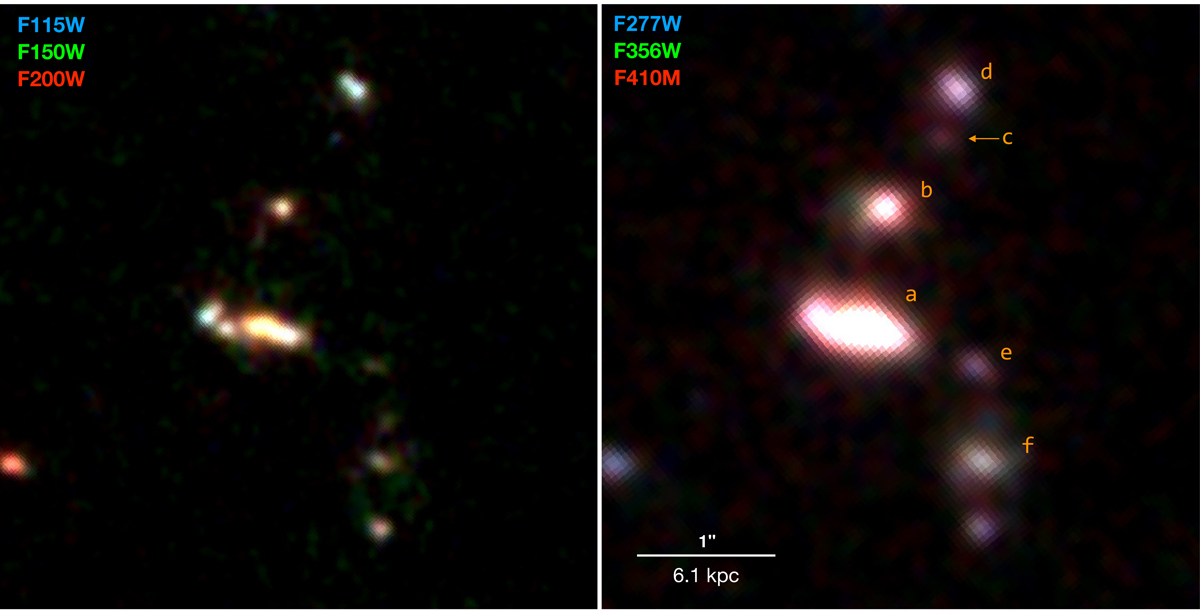
- Discovery of Ancient Globular Cluster Candidates in the Relic, a Quiescent Galaxy at z = 2.5Katherine E. Whitaker, Sam E. Cutler, Rupali Chandar, Richard Pan, David J. Setton, and 29 more authorsThe Astrophysical Journal, Apr 2026
Globular clusters (GCs) are some of the oldest bound structures in the Universe, holding clues to the earliest epochs of star formation and galaxy assembly. However, accurate age measurements of ancient clusters are challenging due to the age-metallicity degeneracy. Here, we report the discovery of 36 compact stellar systems within the ’Relic’, a massive, quiescent galaxy at z=2.53. The Relic resides in an overdensity behind the Abell\raisebox-0.5ex\textasciitilde2744 cluster, with a prominent tidal tail extending towards two low-mass companions. Using deep data from the UNCOVER/MegaScience JWST Surveys, we find that clusters formed in age intervals ranging from 8\raisebox-0.5ex\textasciitildeMyr up to \sim2\raisebox-0.5ex\textasciitildeGyr, suggesting a rich formation history starting at z\sim10. While the cluster-based star formation history is broadly consistent with the high past star formation rates derived from the diffuse host galaxy light, one potential discrepancy is a tentative \sim2-3\times higher rate in the cluster population for the past Gyr. Taken together with the spatial distribution and low inferred metallicities of these young-to-intermediate age clusters, we may be seeing direct evidence for the accretion of star clusters in addition to their early in-situ formation. The cluster masses are high, \sim10^6-10^7 M_⊙, which may explain why we are able to detect them around this likely post-merger galaxy. Overall, the Relic clusters are consistent with being precursors of the most massive present-day GCs. This unique laboratory enables the first connection between long-lived, high-redshift clusters and local stellar populations, offering insights into the early stages of GC evolution and the broader processes of galaxy assembly.
- Euclid: Early Release Observations ─ Weak gravitational lensing analysis of Abell 2390T. Schrabback, G. Congedo, R. Gavazzi, W. G. Hartley, H. Jansen, and 194 more authorsAstronomy & Astrophysics, Apr 2026
The Euclid space telescope of the European Space Agency (ESA) is designed to provide sensitive and accurate measurements of weak gravitational lensing distortions over wide areas on the sky. Here we present a weak gravitational lensing analysis of early Euclid observations obtained for the field around the massive galaxy cluster Abell 2390 as part of the Euclid Early Release Observations programme. We conduct galaxy shape measurements using three independent algorithms (LensMC, KSB+, and SourceXtractor++). Incorporating multi-band photometry from Euclid and Subaru/Suprime-Cam, we estimate photometric redshifts to preferentially select background sources from tomographic redshift bins, for which we calibrate the redshift distributions using the self-organising map approach and data from the Cosmic Evolution Survey (COSMOS). We quantify the residual cluster member contamination and correct for it in bins of photometric redshift and magnitude using their source density profiles, including corrections for source obscuration and magnification. We reconstruct the cluster mass distribution and jointly fit the tangential reduced shear profiles of the different tomographic bins with spherical Navarro–Frenk–White profile predictions to constrain the cluster mass, finding consistent results for the three shape catalogues and good agreement with earlier measurements. As an important validation test we compare these joint constraints to mass measurements obtained individually for the different tomographic bins, finding good consistency. More detailed constraints on the cluster properties are presented in a companion paper that additionally incorporates strong lensing measurements. Our analysis provides a first demonstration of the outstanding capabilities of Euclid for tomographic weak lensing measurements.
- An ultra-high-resolution map of (dark) matterDiana Scognamiglio, Gavin Leroy, David Harvey, Richard Massey, Jason Rhodes, and 36 more authorsNature Astronomy, Apr 2026
Ordinary matter—including particles such as protons and neutrons—accounts for only about one-sixth of all matter in the Universe. The rest is dark matter, which does not emit or absorb light but plays a fundamental role in galaxy and structure evolution. Because it interacts only through gravity, one of the most direct probes is weak gravitational lensing: the deflection of light from distant galaxies by intervening mass. Here we present an extremely detailed, wide-area weak-lensing mass map covering 0.77\textdegree \texttimes 0.70\textdegree, using high-resolution imaging from the James Webb Space Telescope as part of the COSMOS-Web survey. By measuring the shapes of 129 galaxies per square arcminute—many independently in the F115W and F150W bands—we achieve an angular resolution of 1.00 \pm0.0 1^’ . Our map has more than twice the resolution of earlier Hubble Space Telescope maps, revealing how dark and luminous matter co-evolve across filaments, clusters and underdensities. It traces mass features out to z ≈ 2, including the most distant structure at z ≈ 1.1. The sensitivity to high- redshift lensing constrains galaxy environments at the peak of cosmic star formation and sets a high-resolution benchmark for testing theories about the nature of dark matter and the formation of large-scale cosmic structure.
- Euclid preparation: LXXX. Overview of Euclid infrared detector performance from ground testsEuclid Collaboration, B. Kubik, R. Barbier, J. Clemens, S. Ferriol, and 339 more authorsAstronomy & Astrophysics, Mar 2026
This paper describes the objectives, design, and findings of the pre- launch ground characterisation campaigns of the Euclid infrared detectors. The aim of the ground characterisations is to evaluate the performance of the detectors, to calibrate the pixel response, and to derive the pixel response correction methods. The detectors have been tested and characterised in the facilities set up for this purpose. The pixel properties, including baseline, bad pixels, quantum efficiency, inter pixel capacitance, quantum efficiency, dark current, readout noise, conversion gain, response non-linearity, and image persistence were measured and characterised for each pixel. We describe in detail the test flow definition that allows us to derive the pixel properties and we present the data acquisition and data quality check software implemented for this purpose. We also outline the measurement protocols of all the pixel properties presented and we provide a comprehensive overview of the performance of the Euclid infrared detectors as derived after tuning the operating parameters of the detectors. The main conclusion of this work is that the performance of the infrared detectors Euclid meets the requirements. Pixels classified as non-functioning accounted for less than 0.2% of all science pixels. The interpixel capacitance (IPC) coupling is minimal, the cross-talk between adjacent pixels is less than 1% between adjacent pixels, and 95% of the pixels show a quantum efficienty (QE) greater than 80% across the entire spectral range of the Euclid mission. The conversion gain is approximately 0.52 ADU/e^-, with a variation of less than 1% between channels of the same detector. The reset noise is approximately equal to 23 ADU rms after reference pixel correction. The readout noise of a single frame is approximately 13 e^- rms while the signal estimator noise is measured at 7 e^- rms in photometric mode and 9 e^- rms in spectroscopic acquisition mode. The deviation from linear response at signal levels up to 80 ke^- is less than 5% for 95% of the pixels. Median persistence amplitudes are less than 0.3% of the signal, though persistence exhibits significant spatial variation and differences between detectors.
- Euclid: Discovery of bright z ≃ 7 Lyman-break galaxies in UltraVISTA and Euclid COSMOSR. G. Varadaraj, R. A. A. Bowler, M. J. Jarvis, J. R. Weaver, E. Bañados, and 161 more authorsAstronomy & Astrophysics, Mar 2026
We present a search for z ≃ 7 Lyman-break galaxies using the 1.72 deg^2 near-infrared (NIR) UltraVISTA survey in the COSMOS field, reaching 5σ depths in Y of 26.2. We incorporated deep Euclid optical and Euclid + Spitzer NIR imaging for a full spectral energy distribution (SED) fitting analysis. We found 289 candidate galaxies at 6.5 ≤ z ≤ 7.5 covering -22.6 ≤ M_UV ≤ -20.2, faint enough to overlap with Hubble Space Telescope studies. We conducted a separate selection by including complementary Euclid performance verification imaging (reaching 5σ depths of 26.3), yielding 140 galaxies in 0.65 deg^2, with 38 sources unique to this sample. We computed the rest-frame UV luminosity function (UV LF) from our samples, extending below the knee (M * = - 21 . 14 - 0.25 + 0.28). We find that the shape of the UV LF is consistent with both a Schechter function and a double power law (DPL) at the magnitudes probed by this sample, with a DPL preferred at M_UV < -22.5 when bright-end results are included. The UltraVISTA + Euclid sample provides a clean measurement of the LF due to the overlapping NIR filters identifying molecular absorption features in the SEDs of ultra- cool dwarf interlopers, and additional faint galaxies were recovered. A comparison with JWST LFs at z > 7 suggests a gentle evolution in the bright-end slope, although this is limited by a lack of robust bright-end measurements at z > 9. We forecast that in the Euclid Deep Fields, the removal of contaminant ultra-cool dwarfs as point sources will be possible at J_E < 24.5. Finally, we present a high-equivalent-width Lyman-α emitter candidate identified by combining HSC, VISTA, and Euclid broadband photometry, highlighting the synergistic power these instruments will have in the Euclid Auxiliary Fields for identifying extreme sources in the epoch of reionisation. ★ This paper is published on behalf of the Euclid Consortium.
- COSMOS-Web: Comprehensive Data Reduction for Wide-area JWST NIRCam ImagingMaximilien Franco, Caitlin M. Casey, Anton M. Koekemoer, Daizhong Liu, Micaela B. Bagley, and 35 more authorsThe Astrophysical Journal, Mar 2026
We present the data reduction methodology used for the COSMOS-Web survey JWST NIRCam data. Covering 0.54 deg^2 with four broadband filters (F115W, F150W, F277W, F444W) and a total exposure time of approximately 270 hr, COSMOS-Web represents the largest contiguous field surveyed during JWST Cycle 1, posing unique data reduction challenges due to its extensive scale. By combining the official JWST Calibration Pipeline with custom improvements for noise removal, background subtraction, and astrometric alignment, we achieve high-fidelity science-ready mosaics. We detail the systematic approach employed in the three stages of the JWST Calibration Pipeline. The data, collected in three epochs from 2023 January to 2024 January, encompass 152 visits and have been processed into 20 mosaic tiles to optimize computational efficiency and data processing. The final data products achieve 5σ depths of 26.7─28.3 AB mag in 0.″15 apertures. The processed and calibrated datasets are made available to the public.
- The stellar mass function of quiescent and star-forming galaxies and its dependence on morphology in COSMOS-WebMarko Shuntov, Olivier Ilbert, Claudia del P. Lagos, Sune Toft, Francesco Valentino, and 31 more authorsAstronomy & Astrophysics, Mar 2026
We study the stellar mass function (SMF) of quiescent and star-forming galaxies and its dependence on morphology in ten redshift bins at 0.2 < z < 5.5. We used the COSMOS2025 catalog, built from the 0.54 deg^2 JWST imaging from the COSMOS-Web survey, to select galaxies by type using the NUVrJ rest-frame color diagram and to classify them morphologically based on their bulge-to- total light ratio (B/T). The SMF of quiescent galaxies shows a rapid early build-up, with the most massive, log(M_★/M_⊙)≳11, being assembled by z ∼ 1 and evolving little since. The star-forming SMF evolves more slowly with redshift, following a mass-evolution scenario where galaxies grow in mass via star formation and quench once they reach the characteristic log(M^*/M_⊙) ∼ 10.6. Bulge systems (B/T > 0.6) dominate the quiescent SMF at log(M_★/M_⊙) > 10 at all redshifts, while disk systems (B/T < 0.2) dominate at log(M_★/M_⊙) < 9. However, most bulge-dominated galaxies in the Universe are star forming, with their fraction increasing with redshift and decreasing mass, consistent with them being progenitors of quiescent bulges. We find evidence for the onset of environmental quenching as early as z ∼ 3 from the upturn in the quiescent SMF at log(M_★/M_⊙) < 9.5. This upturn is contributed by disk-dominated galaxies, consistent with environmental quenching scenarios in which satellites are quenched, but retain their disk morphologies. The number densities of log(M_★/M_⊙) > 10 quiescent galaxies are lower than in the recent literature by 0.1 - 0.7 dex, but agree well with cosmological galaxy formation simulations at 2 < z < 3. However, at z > 3, simulations increasingly underpredict the observations. Finally, we built a simple empirical model to describe the redshift evolution of galaxy number densities by parameterizing the quenching rate of all and bulge-dominated galaxies, stellar fraction, and bulge formation function. Our model is consistent with an evolutionary scenario where star-forming galaxies grow a central bulge before permanently quenching in massive halos.
- Galaxy Zoo: Cosmic Dawn─morphological classifications for over 41 000 galaxies in the Euclid Deep Field North from the Hawaii Two-0 Cosmic Dawn surveyJames Pearson, Hugh Dickinson, Stephen Serjeant, Mike Walmsley, Lucy Fortson, and 20 more authorsMonthly Notices of the Royal Astronomical Society, Mar 2026
We present morphological classifications of over 41 000 galaxies out to across 6 deg^2 of the Euclid Deep Field North (EDFN) from the Hawaii Twenty Square Degree (H20) survey, a part of the wider Cosmic Dawn survey. Galaxy Zoo citizen scientists play a crucial role in the examination of large astronomical data sets through crowdsourced data mining of extragalactic imaging. This iteration, Galaxy Zoo: Cosmic Dawn (GZCD), saw tens of thousands of volunteers and the deep learning foundation model Zoobot collectively classify objects in ultra-deep multiband Hyper Suprime-Cam (HSC) imaging down to a depth of . Here, we present the details and general analysis of this iteration, including the use of Zoobot in an active learning cycle to improve both model performance and volunteer experience, as well as the discovery of 51 new gravitational lenses in the EDFN. We also announce the public data release of the classifications for over 45 000 subjects, including more than 41 000 galaxies (median of ), along with their associated image cut-outs. This data set provides a valuable opportunity for follow-up imaging of objects in the EDFN as well as acting as a truth set for training deep learning models for application to ground-based surveys like that of the Ultraviolet Near-Infrared Optical Northern Survey (UNIONS) collaboration and the newly operational Vera C. Rubin Observatory.
- Everything Every Band All at Once II: The Relationship Between Optical Size and Stellar Mass Over Eight Billion Years of Cosmic HistoryTim B. Miller, Yunchong Zhang, Sedona H. Price, Katherine A. Suess, Rachel Bezanson, and 22 more authorsarXiv, Mar 2026
While the size-mass relation provides insight into the structural evolution of galaxies, the data available and methods employed have hindered our ability to study a detailed and comprehensive description of this key relation across cosmic history. The first paper in this series presents a morphology catalog based on 20 band JWST data in the field of Abell 2744. In this paper we utilize this catalog to measure the size-mass relation from 0.5<z<8 and 0.5<z<3 for star-forming and quiescent galaxies respectively. We perform a global fit to our sample using B-splines to flexibly model the redshift evolution which enforces smooth evolution and can account for all observational uncertainties. Symbolic regression is used to derive simple and portable expressions that describe the redshift evolution of the size-mass relation. Analyzing the size evolution of star-forming galaxies in the context of previous work at z\sim0 and z>10, we discuss three distinct phases: Rapid growth at z>5, growth that mimics dark matter halos at 5< z <1 and a late plateau at 0.5<z<1. For quiescent galaxies we confirm previous findings that the size-mass relation flattens at \log M_*/M_⊙< 10, which inverts at z>1. Our results imply that quiescent galaxies are smaller than their star-forming counterparts only at around \log M_*/M_⊙= 10; the two populations have similar sizes at lower and higher masses.
- Taking a Break at Cosmic Noon: Continuum-selected Low-mass Galaxies Require Long Burst CyclesAbby Mintz, David J. Setton, Jenny E. Greene, Joel Leja, Bingjie Wang, and 23 more authorsThe Astrophysical Journal, Feb 2026
While bursty star formation in low-mass galaxies has been observed in local populations and reproduced in simulations, the dormant phase of the burst cycle has not been well studied beyond the local Universe due to observational limitations. We present a unique sample of 43 JWST PRISM spectra of low-mass galaxies (M_⋆ < 10^9.5 M_⊙) at cosmic noon (1 < z < 3), uniformly selected on F200W magnitude and precise photometric redshifts enabled by 20-band JWST photometry from the UNCOVER and MegaScience surveys. The spectra reveal numerous strong Balmer breaks, which are negatively correlated with the galaxies’ Hα equivalent width. By comparing these observations to synthetic samples of spectra generated using a simple parameterization of bursty star formation histories, we show that star formation in low-mass galaxies at cosmic noon is likely dominated by burst cycles with long timescales (≳100 Myr) and large deviations below the star-forming main sequence (≳0.8 dex). Our results suggest that galaxies in this population—at least those within our detection limits—should not be classified solely by their current star formation rates, but instead viewed as a unified population undergoing dynamic movement above and below the star- forming main sequence. The derived constraints demonstrate that long-timescale fluctuations are important for this class of galaxies, indicating that galaxy-scale gas cycles—rather than molecular-cloud-scale stochasticity—are the primary regulators of star formation variability in low-mass galaxies at cosmic noon.
- Euclid: The first statistical census of dusty and massive objects in the ERO/Perseus fieldG. Girardi, A. Grazian, G. Rodighiero, L. Bisigello, G. Gandolfi, and 173 more authorsAstronomy & Astrophysics, Feb 2026
Our comprehension of the history of star formation at z > 3 strongly relies on rest-frame ultraviolet observations. However, this selection systematically misses the dustiest and most massive sources, resulting in an incomplete census at earlier times. Infrared facilities such as Spitzer and the James Webb Space Telescope have shed light on a hidden population lying at z = 3 - 6 characterised by extreme red colours named HIEROs (HST-to-IRAC extremely red objects), identified by the colour criterion H_E - ch2 > 2.25. Recently, Euclid Early Release Observations (EROs) have opened the possibility to further study such objects, exploiting the comparison between Euclid and ancillary Spitzer/IRAC observations. The aim of this study was to investigate the effectiveness of this synergy in characterising the population of a small test area of 232 arcmin^2. We utilised catalogues in the Perseus field across the VIS and NISP bands, supplemented by data from the four Spitzer channels and several ground-based MegaCam bands (u, g, r, Hα, i, and z) already included in the ERO catalogue. We selected 121 HIEROs by applying the H_E - ch2 > 2.25 colour cut, cleaned this sample of globular clusters and brown dwarfs, and then inspected by eye the multi-band cutouts of each source, ending with 42 reliable HIEROs. Photometric redshifts and other physical properties of the final sample were estimated using the spectral-energy-distribution-fitting software Bagpipes. From the z_phot and M_* values, we computed the galaxy stellar mass function at 3.5 < z < 5.5. When we exclude all galaxies that could host an active galactic nucleus, or whose stellar masses might be overestimated, we still find that the high-mass end of the galaxy stellar mass function is similar to previous estimates, indicating that the true value could be even higher. This investigation highlights the importance of a deeper study of this still mysterious population, in particular to assess its contribution to the cosmic star-formation rate density and its agreement with current galaxy evolution and formation models. These early results demonstrate Euclid’s capabilities to push the boundaries of our understanding of obscured star formation across a wide range of epochs. ★ This paper is published on behalf of the Euclid Consortium.
- REBELS-IFU: evidence for metal-rich massive galaxies at z ∼ 6-8Lucie E. Rowland, Mauro Stefanon, Rychard Bouwens, Jacqueline Hodge, Hiddo Algera, and 30 more authorsMonthly Notices of the Royal Astronomical Society, Feb 2026
Metallicity is a crucial tracer of galaxy evolution, providing insights into gas accretion, star formation, and feedback. At high redshift, these processes reveal how early galaxies assembled and enriched their interstellar medium. In this work, we present rest-frame optical spectroscopy of 12 massive () galaxies at ─8 from the Reionization Era Bright Emission Line Survey (REBELS) Atacama Large Millimetre/submillimetre Array (ALMA) large program, observed with the James Webb Space Telescope (JWST) NIRSpec integral field unit spectroscopy in the prism mode. These observations span emission lines from [O II]3727,9 to [S II]6716,31, providing key information on nebular dust attenuation, ionization states, and chemical abundances. We find lower O32 ratios (average ) and [O III]5007 equivalent widths (median EW Å) than are generally found in existing large spectroscopic surveys at , indicating less extreme ionizing conditions. Strong-line diagnostics suggest that these systems are some of the most metal-rich galaxies observed at (average ), including sources with near-solar oxygen abundances, in line with their high stellar masses (average ). Supplementing with literature sources at lower masses, we investigate the mass─metallicity and fundamental metallicity relations (MZR and FMR, respectively) over a 4 dex stellar mass range at . In contrast to recent studies of lower mass galaxies, we find no evidence for negative offsets to the FMR for the REBELS galaxies. This work demonstrates the existence of chemically enriched galaxies just Gyr after the big bang, and indicates that the MZR is already in place at these early times, in agreement with other recent studies.
- The ionised interstellar medium of DSFGs revealed by JWST/NIRSpec and ALMA: Super-solar metallicity, low ionisation parameters and, typical electron densitiesSteven Gillman, Kei Ito, Francesco Valentino, Gabe Brammer, Pablo Araya Araya, and 22 more authorsarXiv, Feb 2026
We present a detailed study of near-infrared (2-4\rm μm) JWST/NIRSpec spectra of 48 high-redshift (z=2.53^+1.32_-0.70) galaxies detected with ALMA at >3σ. From a multi-wavelength SED analysis we establish the sample has a a median stellar mass of \rm\log_10(M_∗/M_⊙)=10.8\pm0.1 and dust mass of \rm\log_10(M_\rm d/M_⊙)=8.7\pm0.1, covering a broad range of far-infrared luminosity \rm (\log_10(L_FIR/L_⊙)=10.9-12.7). The majority of sources show no signs of AGN activity, with 40% having either X-ray counterparts (\rm L_Xc>10^42erg/s), elevated optical line ratios, or broad (FWHM>800 km/s) Hα profiles, although we note this is a lower limit due to the stochastic placement of NIRSpec slits. We establish the sample has a median gas-phase metallicity of 12+\log(\rm O/H)=8.71\pm0.02, as derived from the [NII]/Hα ratio, with the most FIR-luminous galaxies (\rm\log_10(L_\rm FIR/L_⊙)>12) falling 0.15\pm0.03dex above the fundamental metallicity relation. From the [SII] emission-line doublet ratio, we measure a median electron density of \log_10(n_\rm e/\rm cm^-3)=2.53\pm0.07 consistent with less-massive, star- forming, galaxies at the same epoch. For nine galaxies with [OII] and Hβ detections (median \rm\log_10(L_\rm FIR/L_⊙)=11.81\pm0.15), we derive a median observed (dust- uncorrected) ionisation parameter of \rm\log_10(U)=-2.84\pm0.06. Our results indicate that luminous far-infrared galaxies are massive, chemically evolved systems that appear to deviate from the standard dust and metal production equilibrium observed in less obscured galaxies. This study demonstrates the synergy of JWST and ALMA in unveiling the nature of DSFGs, and highlights the need for a NIRSpec survey of uniformly selected, massive, dust-obscured, galaxies to fully characterise their interstellar medium.
- Euclid: Early Release Observations ─ A combined strong and weak lensing solution for Abell 2390 beyond its virial radiusJ. M. Diego, G. Congedo, R. Gavazzi, T. Schrabback, H. Atek, and 181 more authorsAstronomy & Astrophysics, Feb 2026
Euclid is currently mapping the distribution of matter in the Universe in detail via the weak lensing signature of billions of distant galaxies. The weak lensing signal is most prominent around galaxy clusters and can extend up to distances well beyond their virial radius, thus constraining their total mass. Near the centre of clusters, where contamination by member galaxies is an issue, the weak lensing data can be complemented with strong lensing data. Strong lensing information can also diminish the uncertainty due to the mass-sheet degeneracy and provide high- resolution information about the distribution of matter in the centre of clusters. Here we present a joint strong and weak lensing analysis of the Euclid Early Release Observations of the cluster Abell 2390 at z = 0.228. Thanks to Euclid’s wide field of view of 0.5 deg^2, combined with its angular resolution in the visible band of 0.″13 and sampling of 0.″1 per pixel, we constrained the density profile in a wide range of radii, 30 kpc < r< 2000 kpc, from the inner region near the brightest cluster galaxy to beyond the virial radius of the cluster. We find relatively good consistency with earlier X-ray results based on assumptions of hydrostatic equilibrium and thus indirectly confirm the nearly relaxed state of this cluster. We also find consistency with previous results based on weak lensing data and ground-based observations of this cluster. From the combined strong + weak lensing profile, we derive the values of the viral mass M_200 = (1.48 \pm 0.29) \texttimes 10^15 M_⊙, and virial radius r_200 = (2.05 \pm 0.13 Mpc), with error bars representing one standard deviation. The profile is well described by a Navarro-Frenk-White model with a concentration c = 6.5 and a small-scale radius of 230 kpc in the 30 kpc < r< 2000 kpc range that is best constrained by strong lensing and weak lensing data. Abell 2390 is the first of many examples where Euclid data will play a crucial role in providing masses for clusters. The large coverage provided by Euclid, combined with the depth of the observations and high angular resolution, will allow us to produce similar results in hundreds of other clusters with rich strong lensing data that is already available.
- Water absorption confirms cool atmospheres in two little red dotsBingjie Wang, Joel Leja, Ivo Labbe, Jenny E. Greene, Hanpu Liu, and 33 more authorsarXiv, Feb 2026
Little red dots (LRDs) are an abundant population of compact high- redshift sources with red rest-frame optical continua, discovered by the James Webb Space Telescope (JWST). Their red colors and power sources have been attributed either to dust reddening of standard hot accretion disks or to intrinsically cool thermal emission from dense hydrogen envelopes, in both cases surrounding accreting supermassive black holes. These scenarios predict order-of-magnitude differences in emission temperature but have lacked decisive temperature diagnostics. Here we report a prominent absorption feature at rest-frame ∼1.4 \,μ\mathrmm in two out of four LRDs at z ∼2 with high signal-to-noise JWST spectra, among the coolest from a large LRD sample. The feature matches the shape and wavelength of the water absorption band seen in cool stars. Atmosphere models require T ≲3000 \mathrmK to reproduce it, confirming unambiguously the presence of a cool, dense gas component contributing 20-30% to the emergent continuum. A composite model reproduces both the absorption and the rest- frame optical-to-infrared continuum shape and suggests a temperature range (\sim2000 \mathrmK - 4000 \mathrmK) rather than a single blackbody predicted by some gas envelope models. Molecular absorption demonstrates that the red continua of some LRDs are intrinsic rather than dust-reddened, implying order-of-magnitude lower bolometric luminosities and black-hole masses, and providing a new diagnostic of the emitting gas.
- DeepDive: Tracing the early quenching pathways of massive quiescent galaxies at z>3 from their star-formation histories and chemical abundancesMassissilia L. Hamadouche, Katherine E. Whitaker, Francesco Valentino, Jacqueline Antwi-Danso, Kei Ito, and 19 more authorsarXiv, Feb 2026
We investigate the chemical abundances and star-formation histories (SFH) of ten massive (\mathrmlog_10 (M_⋆/\mathrmM_⊙)>10.5) quiescent galaxies at 3<z<4 using deep, medium-resolution spectroscopic data obtained as part of the \textbackslashtextit{JWST DeepDive} Cycle 2 GO program. Our \textbackslashtextit{DeepDive} sample demonstrates early formation and quenching times inferred from spectro-photometric fitting, with most galaxies having formed 50\% of their stellar mass by z ∼5, and quenching by z ∼4, showing good agreement across the various SFH parameterizations explored in this work. Though they differ slightly between SFH parameterizations, the inferred formation timescales for the {\textbackslashit DeepDive} sample span both rapid (≲100 Myr) and more extended (rsim 200 Myr) episodes, corresponding to star formation occurring over a few to several dynamical times given their compact sizes and high densities at z\sim3-4. On average, massive quiescent galaxies at 3<z<4 are α-enhanced (⟨[α/\mathrmFe]⟩= 0.22^+0.22_-0.17), although there is strong diversity (\sim0.3 dex in scatter) among individual [α/Fe] values. Our results for α-enhancement are consistent with lower-redshift studies, implying weak evolution in [α/Fe] from z ∼4 to z∼1. The SFH timescales associated with the low [α/Fe] measurements suggest longer formation timescales, potentially pointing to earlier enrichment by Type Ia supernovae, or metals preferentially being removed via outflows driven either by powerful early active galactic nuclei or supernovae. Overall, this work represents the first, statistically representative combined study of the star- formation histories and chemical abundances of massive quiescent galaxies at z>3.
- Evidence for Shallow Nebular Attenuation Curves and Patchy Dust Geometry at z\raisebox-0.5ex\textasciitilde2 with Pa-beta/H-alpha Measurements from JWST-MegaScience Medium Band PhotometryBrian Lorenz, Katherine A. Suess, Mariska Kriek, Sedona H. Price, Joel Leja, and 23 more authorsarXiv, Feb 2026
We constrain the nebular attenuation curve and investigate dust geometry in star-forming galaxies at cosmic noon using photometric medium-band emission line measurements. We measure H-alpha emission line fluxes for a sample of 209 star-forming galaxies at 1.2<z<2.4 in MegaScience/UNCOVER with stellar masses spanning 7.85<\log_10(M_*/M_⊙)<11.0. For 66 of these galaxies, we also measure a Pa-beta flux. We find that the Pa-beta/H-alpha line ratio increases strongly with stellar mass and star- formation rate (SFR) across our full mass range, indicating that more massive galaxies are dustier. We compare our results with a mass-, SFR-, and redshift-matched sample of galaxies from the MOSDEF survey with spectroscopic measurements of H-alpha/H-beta, finding that a shallow Reddy et al. (2025) nebular attenuation curve is more consistent with our observations than the typically assumed Cardelli et al. (1989) attenuation curve, especially for massive galaxies. This shallow attenuation curve could be explained by low dust covering fractions in star- forming regions. Through comparison to other studies, we show that assuming this shallower attenuation curve can increase the inferred A_Halpha,neb by up to 1 magnitude at high masses. We observe no trend between A_Halpha,neb and axis ratio, indicating that nebular attenuation is likely localized to small clumps. Altogether, our results strongly suggest that dust geometry is patchy and non-uniform, especially in massive galaxies. Our results highlight the ability of JWST medium bands to probe emission lines for large samples of galaxies, and statistically constrain dust properties in upcoming large programs.
- Euclid: Galaxy SED reconstruction in the PHZ processing function: impact on the PSF and the role of medium-band filtersEuclid Collaboration, F. Tarsitano, C. Schreiber, H. Miyatake, A. J. Nishizawa, and 299 more authorsarXiv, Jan 2026
Weak lensing surveys require accurate correction for the point spread function (PSF) when measuring galaxy shapes. For a diffraction- limited PSF, as arises in space-based missions, this correction depends on each galaxy SED. In the Euclid mission, galaxy SED reconstruction, a tasks of the photometric-redshift processing function (PHZ PF), relies on broad- and medium-band ancillary photometry. The limited wavelength sampling of the Euclid VIS passband and signal-to-noise ratio may affect the reconstruction accuracy and translate into biases in the weak lensing measurements. In this study, we present the methodology, which is employed in the Euclid PHZ PF, for reconstructing galaxy SEDs at 55 wavelengths, sampling the VIS passband every 10 nm, and we assess whether it fulfils the accuracy requirements imposed on the Euclid PSF model. We employ both physics- and data-driven methods, focusing on a new approach of template-based flux correction and Gaussian processes, and we introduce an SED metric whose bias propagates into PSF quadrupole moment errors. Our findings demonstrate that Gaussian processes and template fitting meet the requirements only in specific, but complementary, redshift intervals. We therefore propose a hybrid approach, which leverages both methods. This solution proves to be effective in meeting the Euclid accuracy requirements for most of the redshift range of the survey. Finally, we investigate the impact on the SED reconstruction of a new set of 16 evenly-spaced medium-band filters for the Subaru telescope, providing quasi-spectroscopic coverage of the VIS passband. This study shows promising results, ensuring accurate SED reconstruction and meeting the mission PSF requirements. This work thus provides not only the methodological foundation of galaxy SED reconstruction in the Euclid PHZ PF, but also a roadmap for future improvements using a new medium-band survey.
- Euclid preparation. Decomposing components of the extragalactic background light using multi-band intensity mapping cross-correlationsEuclid Collaboration, Y. Cao, A. R. Cooray, T. Li, Y.-T. Cheng, and 267 more authorsarXiv, Jan 2026
The extragalactic background light (EBL) fluctuations in the optical/near-IR encode the cumulative integrated galaxy light (IGL), diffuse intra-halo light (IHL), and high-z sources from the epoch of reionisation (EoR), but they are difficult to disentangle with auto-spectra alone. We aim to decompose the EBL into its principal constituents using multi-band intensity mapping combined with cosmic shear and galaxy clustering. We develop a joint halo-model framework in which IHL follows a mass- and redshift-dependent luminosity scaling, IGL is set by an evolving Schechter luminosity function, and EoR emission is modelled with Pop II/III stellar emissivities and a binned star- formation efficiency. Using mock surveys in a flat ΛCDM cosmology with ten spectral bands spanning 0.75-5.0\rm μm in the NEP deep fields over about 100°^2 with source detections down to AB=20.5 for masking, and six redshift bins to z=2.5, we fit auto- and cross-power spectra using a MCMC method. The combined SPHEREx\timesEuclid analysis recovers all fiducial parameters within 1σ and reduces 1σ uncertainties on IHL parameters by 10-35% relative to SPHEREx EBL-only, while EoR star-formation efficiency parameters improve by 20-35%. Cross- correlations reveal a stronger coupling of IHL than IGL to the shear field, enhancing component separation; conversely, the EoR contribution shows negligible correlation with cosmic shear and galaxy clustering, aiding its isolation in the EBL. Relative to the SPHEREx EBL-only case, the inferred IHL fraction as a function of halo mass is significantly tightened over 10^11-10^14 M_⊙, with uncertainties reduced by 5-30%, and the resulting star-formation rate density constraints extend to z∼11, with uncertainty reductions of 22-31%.
- What You See Is What You Get: Empirically Measured Bolometric Luminosities of Little Red DotsJenny E. Greene, David J. Setton, Lukas J. Furtak, Rohan P. Naidu, Marta Volonteri, and 25 more authorsThe Astrophysical Journal, Jan 2026
New populations of red active galactic nuclei (known as “little red dots”) discovered by JWST exhibit remarkable spectral energy distributions. Leveraging X-ray through far-infrared observations of two of the most luminous known little red dots, we directly measure their bolometric luminosities. We find evidence that more than half of the bolometric luminosity likely emerges in the rest-frame optical, with L_bol/L_5100 = 5, roughly half the value for “standard” active galactic nuclei. Meanwhile, the X-ray emitting corona, UV-emitting blackbody, and reprocessed mid to far-infrared emission are all considerably subdominant, assuming that the far-infrared luminosity is well below current measured limits. We present new bolometric corrections that dramatically lower inferred bolometric luminosities by a factor of 10 compared to published values in the literature. These bolometric corrections are in accord with expectations from models in which gas absorption and reprocessing are responsible for the red rest-frame optical colors of little red dots. We discuss how this lowered luminosity scale suggests a lower mass scale for the population by at least an order of magnitude (e.g., ∼10^5─10^7 M_⊙ black holes, and ∼10^8 M_⊙ galaxies), alleviating tensions with clustering, overmassive black holes, and the integrated black hole mass density in the Universe.
- UNCOVER/MegaScience Finds Uniform and Highly Bursty Star Formation at 3 < z < 9, consistent with the High-Redshift UV Luminosity FunctionIkki Mitsuhashi, Katherine A. Suess, Joel Leja, Rachel Bezanson, Jenny E. Greene, and 22 more authorsarXiv, Jan 2026
Star formation timescales are key to understanding fundamental physics like feedback mechanisms, as well as the abundance of bright galaxies at z>10. We investigate galaxy star formation histories (SFHs) and their evolution across z\sim3–9 by measuring the line-to-UV ratio (\textbackslashrline) and line equivalent width (EW) of \textbackslashhanii\and \textbackslashoiiihb\directly from UNCOVER/MegaScience spectro-photometry without relying on a specific SFH or nebular line modeling. Our photometric measurements recover \textbackslashrline\and EW to <10% systematic accuracy compared to spectroscopy. This allows us to construct a large mass- (and flux-) complete sample and quantitatively examine how \textbackslashrline\evolves with redshift and stellar mass. We find that the intrinsic scatter in \textbackslashrline\does not significantly evolve with redshift across 3<z<7, though it may increase at zrsim8. We build population-level toy models using \textbackslashtexttt{fsps} to help interpret our observations, and find that scatter in \textbackslashrline\primarily reflects the amplitude of SFH fluctuations; this implies that our observed lack of evolution in the scatter of \textbackslashrline\is due to similar star formation burstiness from z\sim3 to z\sim7. Our observations are best reproduced by a set of SFHs with rising, long-duration, and large-amplitude bursts. Finally, we demonstrate that the toy model that best describes our z\sim6 data can boost UV brightness by up to ∆M_\rm UV∼-2.0\,\rm mag compared with a 200 Myr constant SFH, and naturally produces a large number of galaxies at z>10. This suggests that no significant evolution in star formation burstiness is required to explain the abundance of UV-bright galaxies at high redshift.
- Galaxy Protoclusters as Drivers of Cosmic Reionization: I. Bubble Overlap at Redshift z ∼ 7 in LAGER-z7OD1Crystal L. Martin, Weida Hu, Isak G. B. Wold, Andreas Faisst, Cristóbal Moya-Sierralta, and 15 more authorsThe Astrophysical Journal, Jan 2026
Since the launch of JWST, the sample size of reionization-era Lyα emitters (LAEs) has been steadily growing; yet inferences about the neutral hydrogen fraction in the intergalactic medium exhibit increasing variance at redshift z ≍ 7, possibly indicating significant field-to-field fluctuations in the progression of cosmic reionization. In this paper, we present new JWST/NIRSpec and Keck/LRIS spectra of nine LAEs in the redshift z ∼ 7 protocluster LAGER-z7OD1. Measurements of Lyα transmission and Lyα velocity offset along multiple sight lines map the Lyα damping wing optical depth across the galaxy overdensity. In the standard context of inside-out ionization, we estimate the radii of ionized bubbles, Rimin=0.07-0.69 Mpc (physical), based on the distance from each LAE to the first neutral patch along the sight line. The resulting 3D topology reveals three distinct subclusters where the ionized bubbles are approaching overlap. Five of the nine LAEs plausibly ionized their bubbles, where a few bursts of star formation and a modest escape fraction are sufficient. We demonstrate, however, that the actual ionized volumes are likely larger, at least Riism = 0.42─1.29 Mpc (physical), based on an empirical model for interstellar attenuation of Lyα. Modeling galactic attenuation of Lyα significantly increases the inferred intergalactic transmission (thus enlarging the ionized path length). The error bars on the reddening correction allow fully overlapping bubbles, and our results are consistent with accelerated reionization in the protocluster.
- A Cosmic Miracle: A Remarkably Luminous Galaxy at zspec = 14.44 Confirmed with JWSTRohan P. Naidu, Pascal A. Oesch, Gabriel Brammer, Andrea Weibel, Yijia Li, and 41 more authorsThe Open Journal of Astrophysics, Jan 2026
JWST has revealed a stunning population of bright galaxies at surprisingly early epochs, z>10, where few such sources were expected. Here we present the most distant example of this class yet ─ MoM-z14, a luminous () source in the COSMOS legacy field at that expands the observational frontier to a mere 280 million years after the Big Bang. The redshift is confirmed with NIRSpec/prism spectroscopy through a sharp Lyman- α break and ≍3σ detections of five rest-UV emission lines. The number density of bright sources implied by our “Mirage or Miracle” survey spanning ≍350 arcmin is >100\texttimes larger ( 182-105+329\texttimes) than pre-JWST consensus models. The high EWs of UV lines ( ≍15-35) signal a rising star-formation history, with a ≍10\texttimes increase in the last 5 Myr (). The source is extremely compact (circularized pc), and yet elongated ( b/a=0.25-0.06+0.11), suggesting an AGN is not the dominant source of UV light. The steep UV slope ( β=-2.5-0.2+0.2) implies negligible dust attenuation and a young stellar population. The absence of a strong damping wing provides tentative evidence that the immediate surroundings of MoM-z14 may be partially ionized at a redshift where virtually every reionization model predicts a ≍100% neutral fraction. The nitrogen emission and highly super-solar [N/C] >1 hint at an abundance pattern similar to local globular clusters that may have once hosted luminous supermassive stars. Since this abundance pattern is also common among the most ancient stars born in the Milky Way, we may be directly witnessing the formation of such stars in dense clusters, connecting galaxy evolution across the entire sweep of cosmic time.
- A spectroscopically confirmed, strongly lensed, metal-poor Type II supernova at z = 5.13David A. Coulter, Conor Larison, Justin D. R. Pierel, Seiji Fujimoto, Vasily Kokorev, and 86 more authorsarXiv, Jan 2026
Observing supernovae (SNe) in the early Universe (z > 3) provides a window into how both galaxies and individual stars have evolved over cosmic time, yet a detailed study of high-redshift stars and SNe has remained difficult due to their extreme distances and cosmological redshifting. To overcome the former, searches for gravitationally lensed sources allow for the discovery of magnified SNe that appear as multiple images - further providing the opportunity for efficient follow-up. Here we present the discovery of “SN Eos”: a strongly lensed, multiply-imaged, SN II at a spectroscopic redshift of z = 5.133 +/- 0.001. SN Eos exploded in a Lyman-α emitting galaxy when the Universe was only \raisebox-0.5ex\textasciitilde1 billion years old, shortly after it reionized and became transparent to ultraviolet radiation. A year prior to our discovery in JWST data, archival HST imaging of SN Eos reveals rest-frame far ultraviolet (\raisebox-0.5ex\textasciitilde1,300Å) emission, indicative of shock breakout or interaction with circumstellar material in the first few (rest-frame) days after explosion. The JWST spectroscopy of SN Eos, now the farthest spectroscopically confirmed SN ever discovered, shows that SN Eos’s progenitor star likely formed in a metal-poor environment (<= 0.1 Z_{\textbackslashodot}), providing the first direct evidence of massive star formation in the metal-poor, early Universe. SN Eos would not have been detectable without the extreme lensing magnification of the system, highlighting the potential of such discoveries to eventually place constraints on the faint end of the cosmic star-formation rate density in the very early Universe.
- COSMOS Spectroscopic Redshift Compilation (First Data Release): 488,000 Redshifts Encompassing Two Decades of SpectroscopyAli Ahmad Khostovan, Jeyhan S. Kartaltepe, Mara Salvato, Olivier Ilbert, Caitlin M. Casey, and 52 more authorsThe Astrophysical Journal Supplement Series, Jan 2026
We present the COSMOS Spectroscopic Redshift Compilation encompassing ∼20 yr of spectroscopic redshifts within a 10 deg^2 area centered on the 2 deg^2 COSMOS legacy field. This compilation contains 487,666 redshifts of 266,284 unique objects from 138 individual programs up to z ∼ 8 with median stellar mass ∼10^8.4─10^10 M_⊙ (redshift dependent). Rest-frame NUVrJ colors and star formation rate─stellar mass correlations show that the compilation primarily contains low-to- intermediate-mass star-forming and massive, quiescent galaxies at z < 1.25 and mostly low-mass bursty star-forming galaxies at z > 2. Sources in the compilation cover a diverse range of environments, including protoclusters such as “Hyperion.” The full compilation is 50% spectroscopically complete by i ∼ 23.4 mag and K_s ∼ 21.6 mag; however, this is redshift dependent. Spatially, the compilation is >50% (>30%) complete within the central (outer) region limited to i < 24 mag and K_s < 22.5 mag, separately. We demonstrate how the compilation can be used to validate photometric redshifts and investigate calibration metrics. By training self-organizing maps on COSMOS2020/Classic and projecting the compilation onto it, we find key subpopulations currently lacking spectroscopic coverage, including z < 1 intermediate-mass quiescent and low-/intermediate-mass bursty star-forming galaxies, z ∼ 2 massive quiescent galaxies, and z > 3 massive star-forming galaxies. This highlights how combining self-organizing maps with our compilation can provide guidance for future spectroscopic observations to get a complete spectroscopic view of galaxy populations. Lastly, the compilation will undergo periodic data releases incorporating new spectroscopic redshifts and providing a lasting legacy resource for the community.
- Euclid preparation: LXXXVI. Cosmic Dawn Survey: Evolution of the galaxy stellar mass function across 0.2 < z ≤ 6.5 measured over 10 square degreesEuclid Collaboration, L. Zalesky, J. R. Weaver, C. J. R. McPartland, G. Murphree, and 302 more authorsAstronomy & Astrophysics, Mar 2026
The Cosmic Dawn Survey Pre-launch (PL) catalogues cover an effective 10.13 deg^2 area with uniform deep Spitzer/IRAC data (m\sim25 mag, 5σ), the largest area covered to these depths in the infrared. These data are used to gain new insight into the growth of stellar mass across cosmic history by characterising the evolution of the galaxy stellar mass function (GSMF) through 0.2 < z ≤6.5. The total volume (0.62 Gpc^3) represents a tenfold increase compared to previous works that have explored z > 3 and significantly reduces cosmic variance, yielding strong constraints on the abundance of massive galaxies. Results are generally consistent with the literature but now provide firm estimates of number density where only upper limits were previously available. Contrasting the GSMF with the dark matter halo mass function suggests that massive galaxies (M rsim10^11 M_⊙) at z > 3.5 required integrated star-formation efficiencies of M/(M_\rm hf_\rm b) rsim 0.25–0.5, in excess of the commonly-held view of “universal peak efficiency” from studies on the stellar-to-halo mass relation (SHMR). Such increased efficiencies imply an evolving peak in the SHMR at z > 3.5 which can be maintained if feedback mechanisms from active galactic nuclei and stellar processes are ineffective at early times. In addition, a significant fraction of the most massive quiescent galaxies are observed to be in place already by z∼2.5–3. The apparent lack in change of their number density by z∼0.2 is consistent with relatively little mass growth from mergers. Utilising the unique volume, evidence for an environmental dependence of the galaxy stellar mass function is found all the way through z∼3.5 for the first time, though a more careful characterisation of the density field is ultimately required for confirmation.
- A first systematic study of [OIII] 88 μ m at z > 8 : two luminous oxygen lines and a powerful ionized outflow in the first 600 million yearsHiddo Algera, John R. Weaver, Tom J. L. C. Bakx, Manuel Aravena, Rychard J. Bouwens, and 33 more authorsThe Open Journal of Astrophysics, Jul 2026
We present deep ALMA Band 7 observations of the [OIII] 88μm line and underlying dust continuum emission in four UV-bright, gravitationally lensed (magnification μ= 1.4-3.8), JWST- selected galaxies at z = 8.5 - 10.3, with observed magnitudes -22.5 ≲M_\mathrmUV ≲-20.5. [OIII] 88μm is confidently detected in UNCOVER-10646 at z=8.5080 \pm 0.0011 (15σ) and DHZ1 at z=9.3113 \pm 0.0005 (6σ), with both being intrinsically luminous systems [L_\mathrm[OIII] = (1.1 - 1.6) \times 10^9 L_⊙] that follow the local [OIII]-SFR relation. [OIII] 88μm remains undetected in the two z>10 targets, including in the z=10.07 X-ray AGN UHZ1, where we obtain a deep limit of L_\mathrm[OIII] < 6 \times 10^7 L_⊙. Dust emission is not detected in any individual source nor in a stack (<3σ). The high S/N [OIII] 88μm detection in UNCOVER-10646 uniquely reveals an additional broad component (\mathrmFWHM = 1366_-329^+473 \mathrmkm/s; ∆\mathrmBIC\approx20) indicative of an ionized outflow. We infer a high outflow rate of \dotM_\mathrmout = 128_-46^+80 M_⊙\mathrmyr^-1, corresponding to a mass loading factor η= \dotM_\mathrmout/\mathrmSFR = 2.9_-1.0^+1.8 that is broadly consistent with theoretical predictions and JWST-based studies of ionized outflows at high redshift. While high-resolution ALMA follow-up is required to confirm the outflow, this first systematic study at z>8 highlights the unique diagnostic power of [OIII] 88μm in characterizing galaxies in the early Universe.
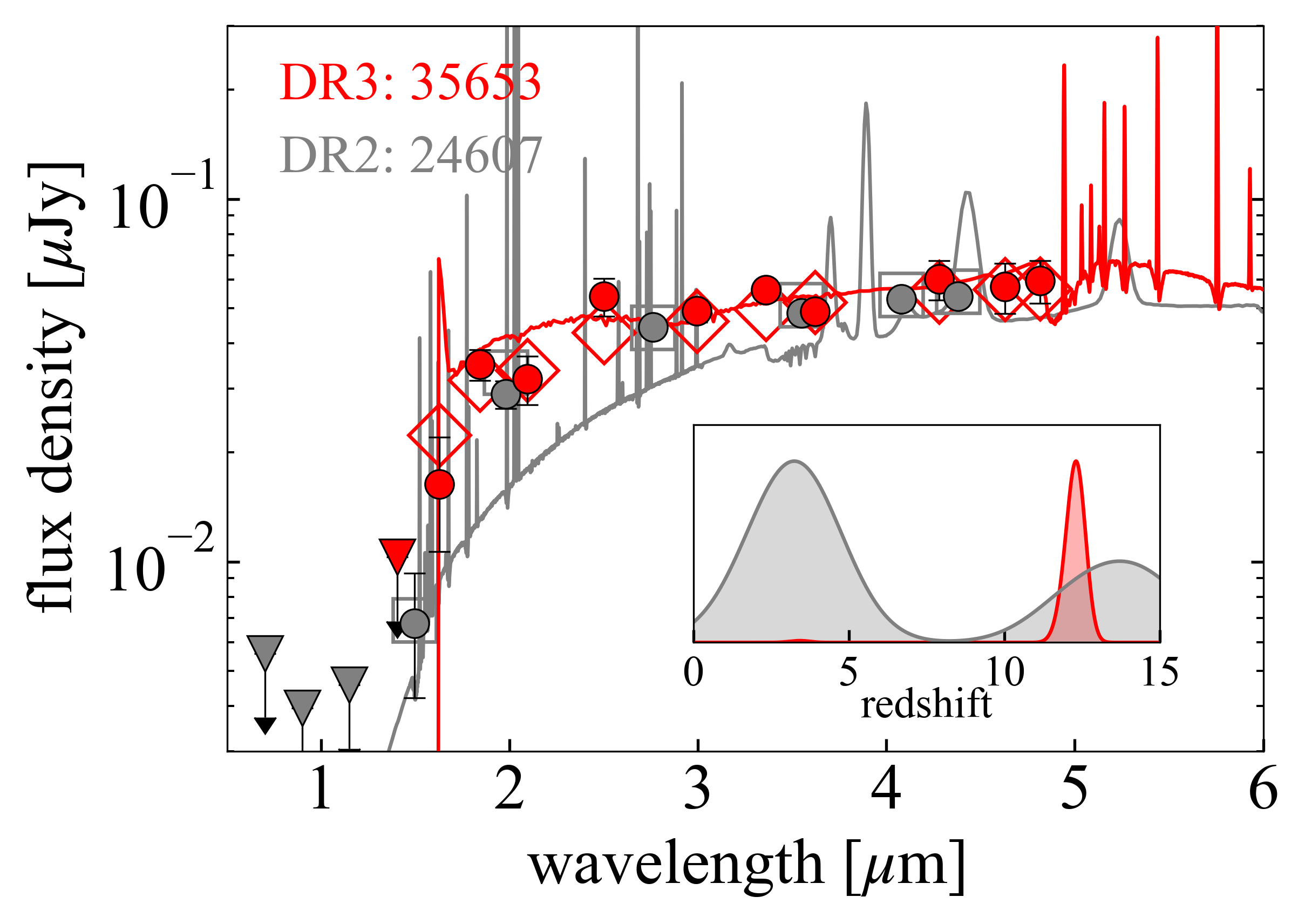
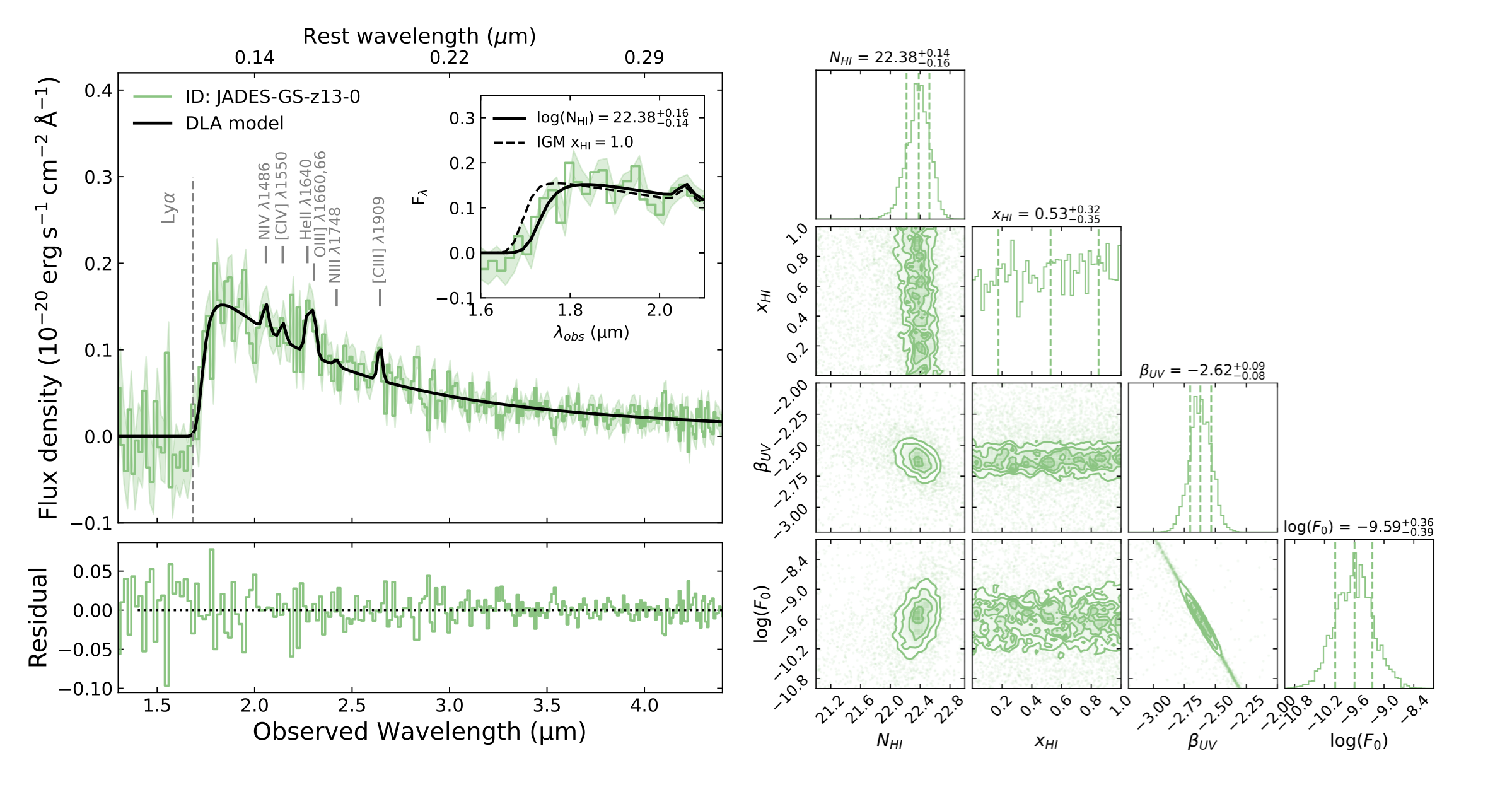
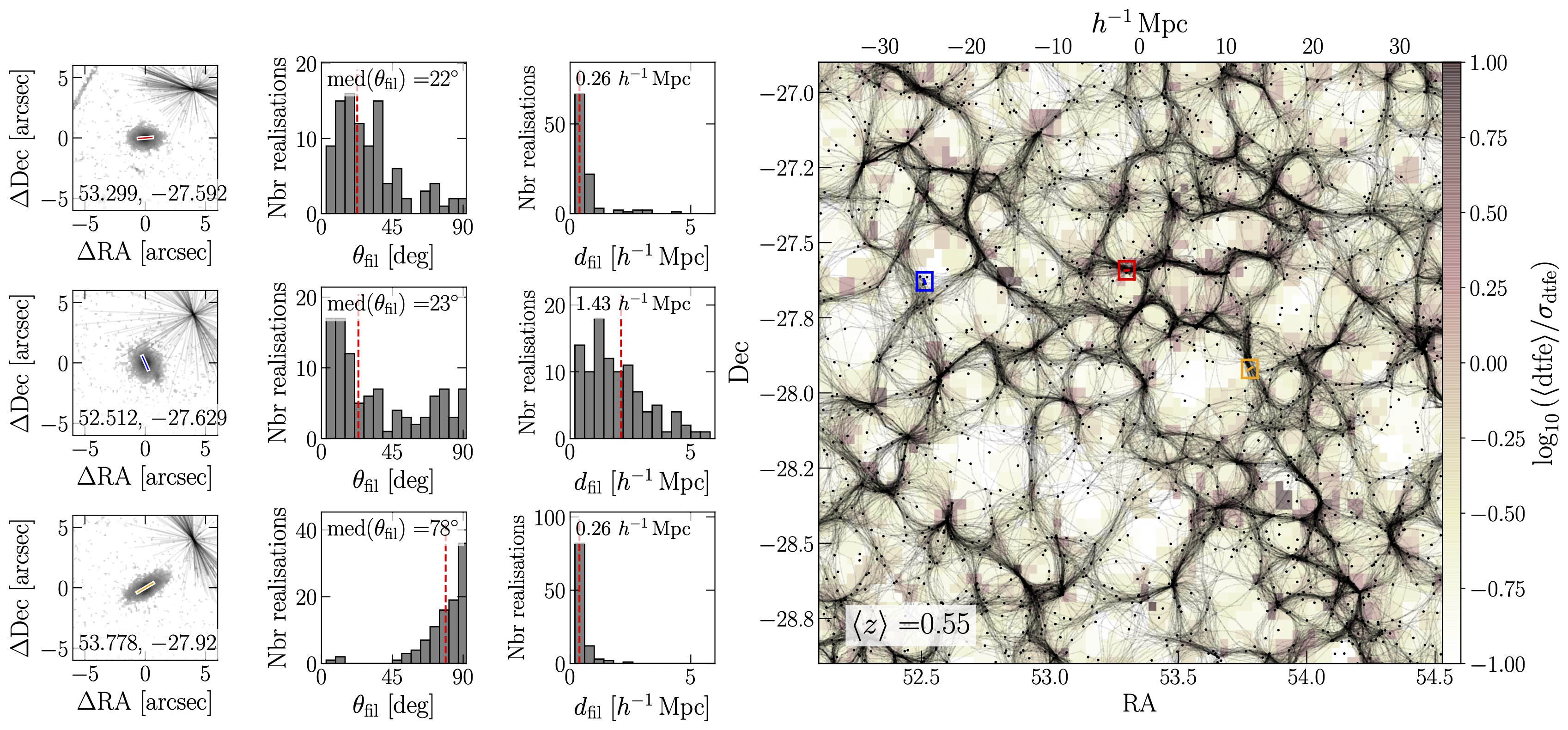
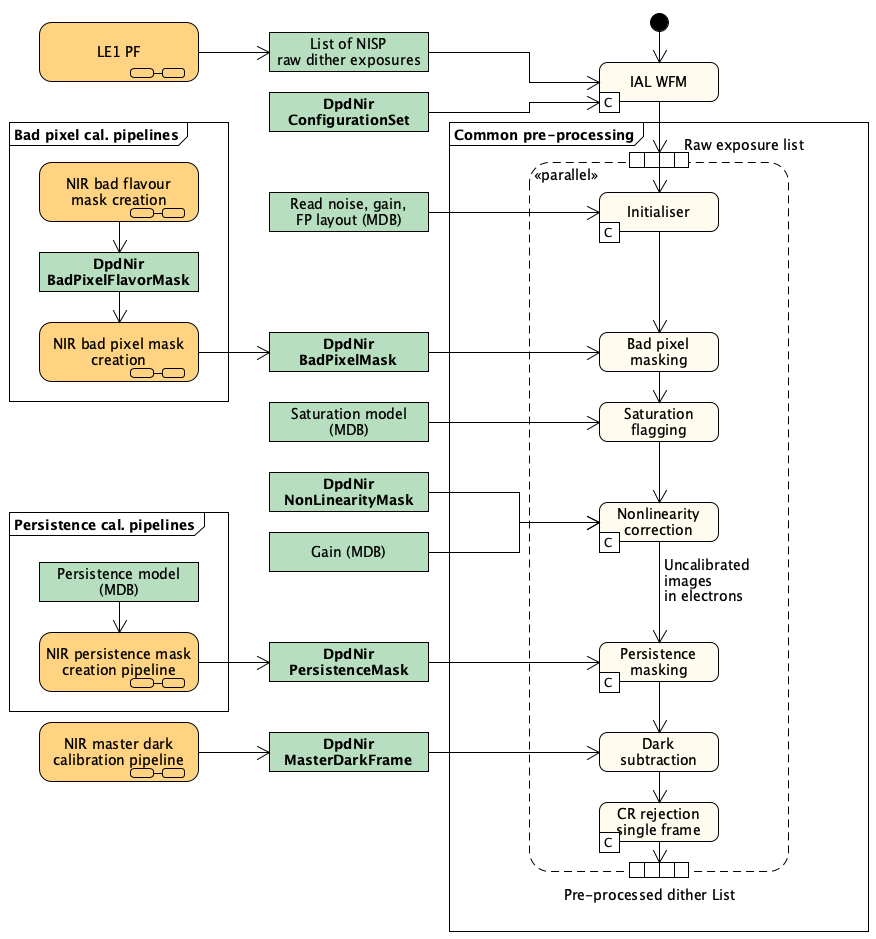
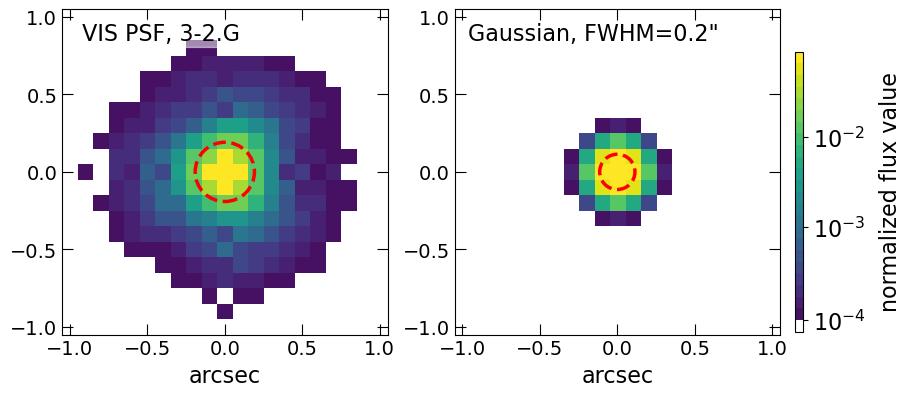
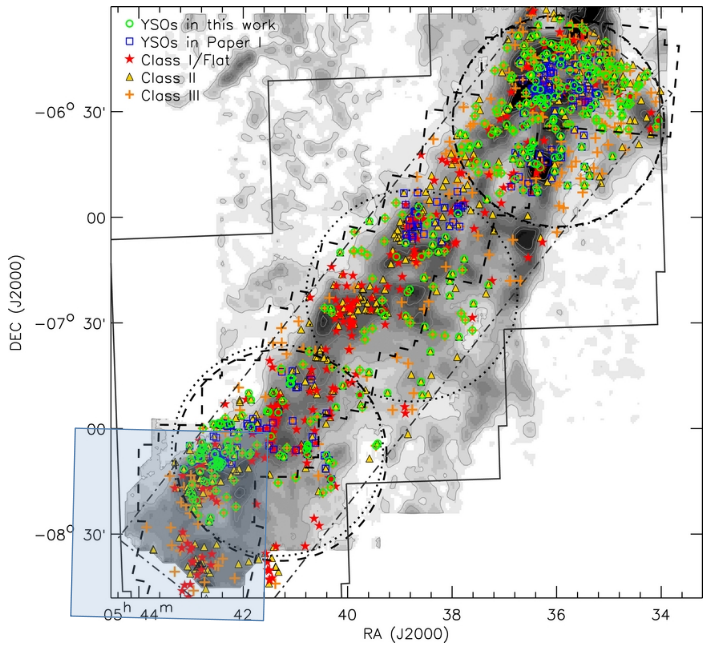
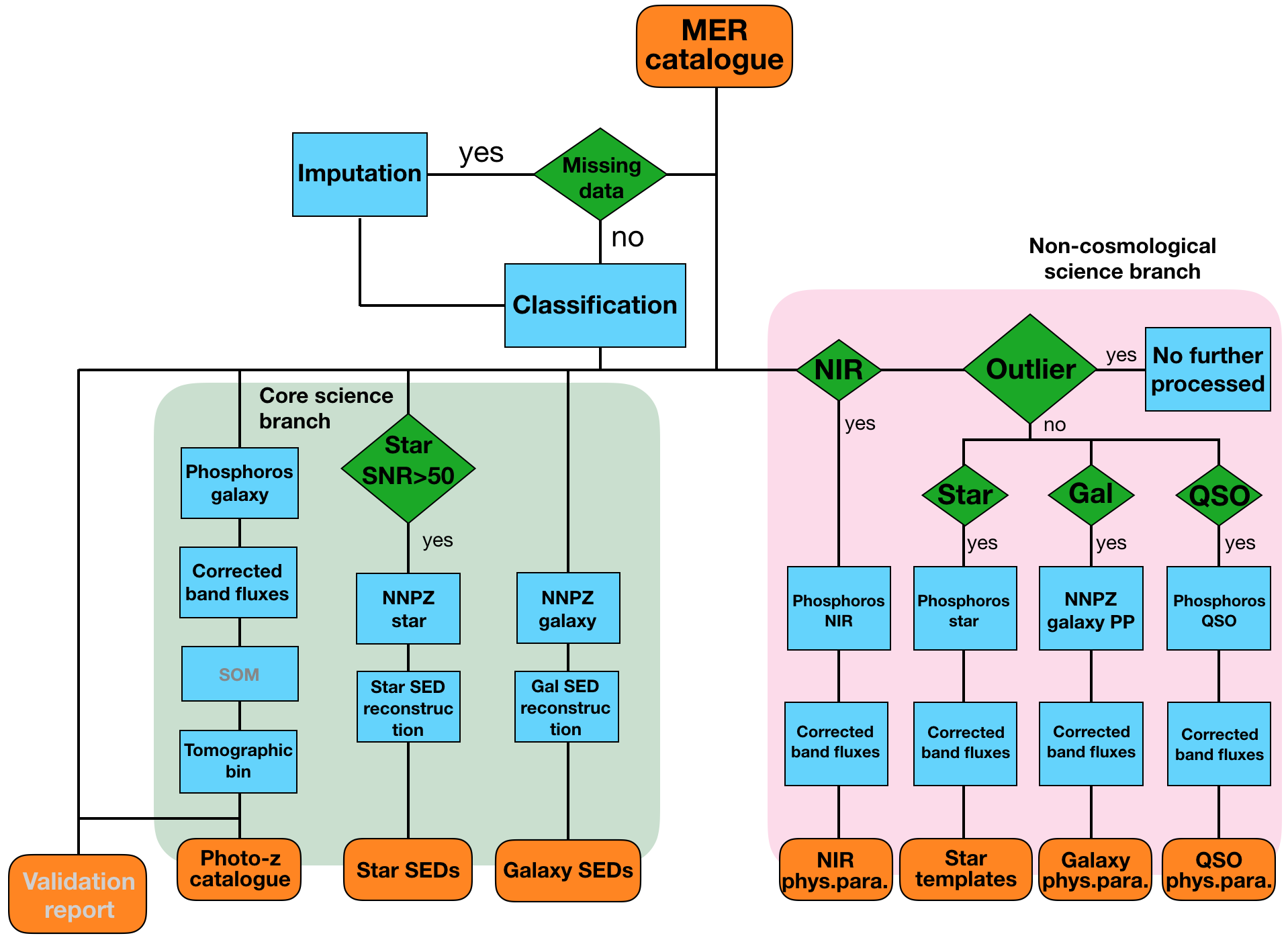
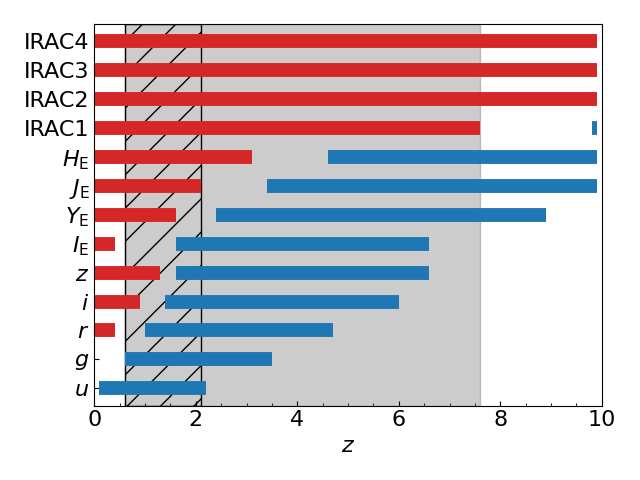
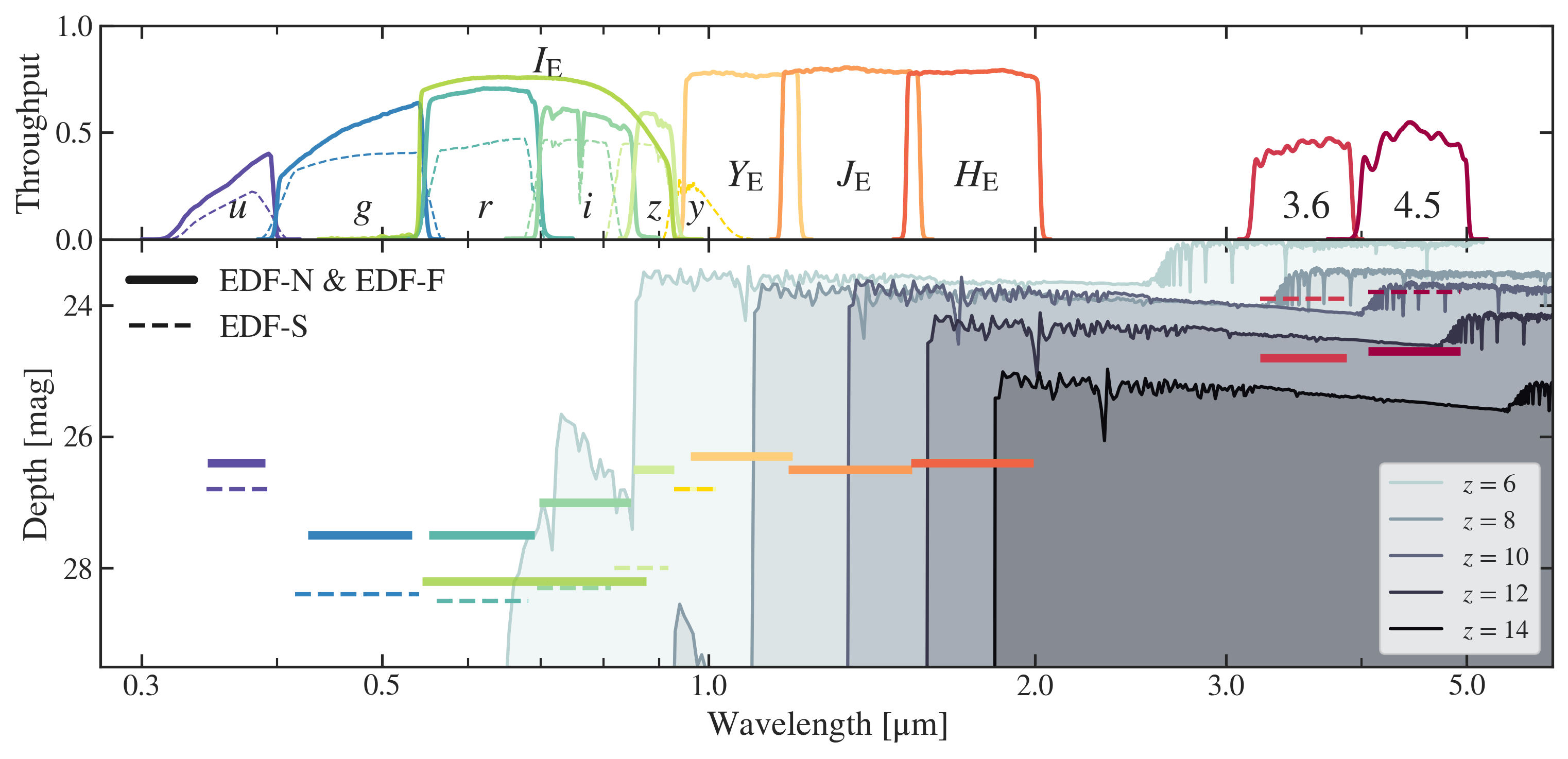
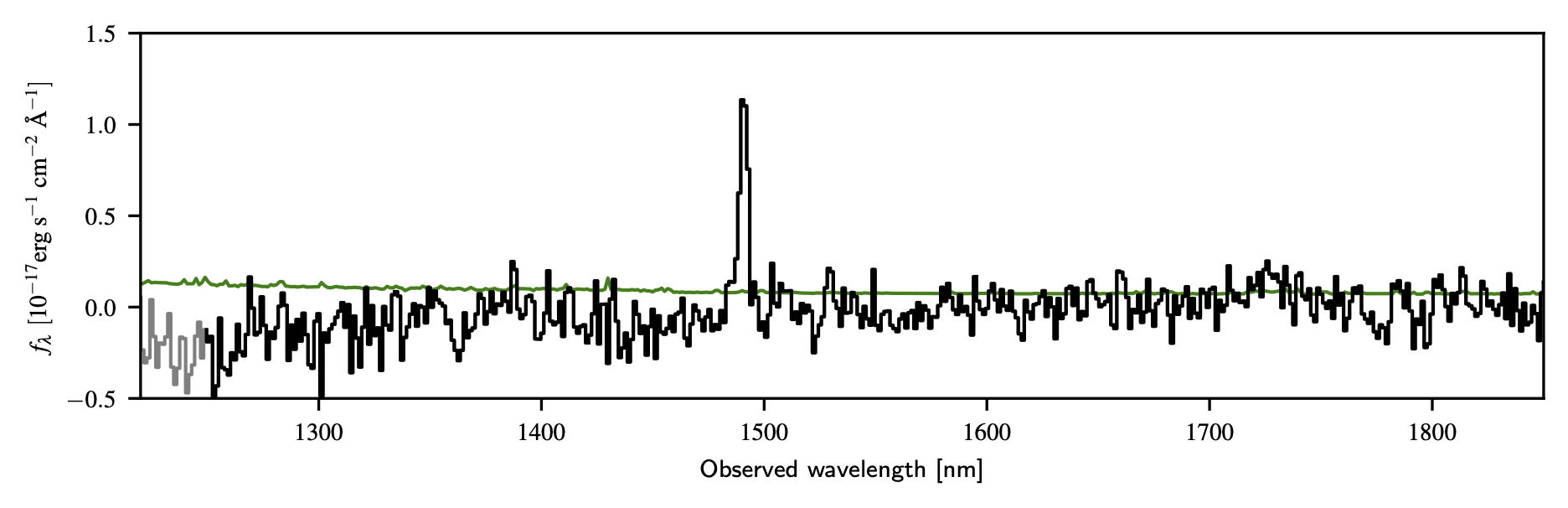
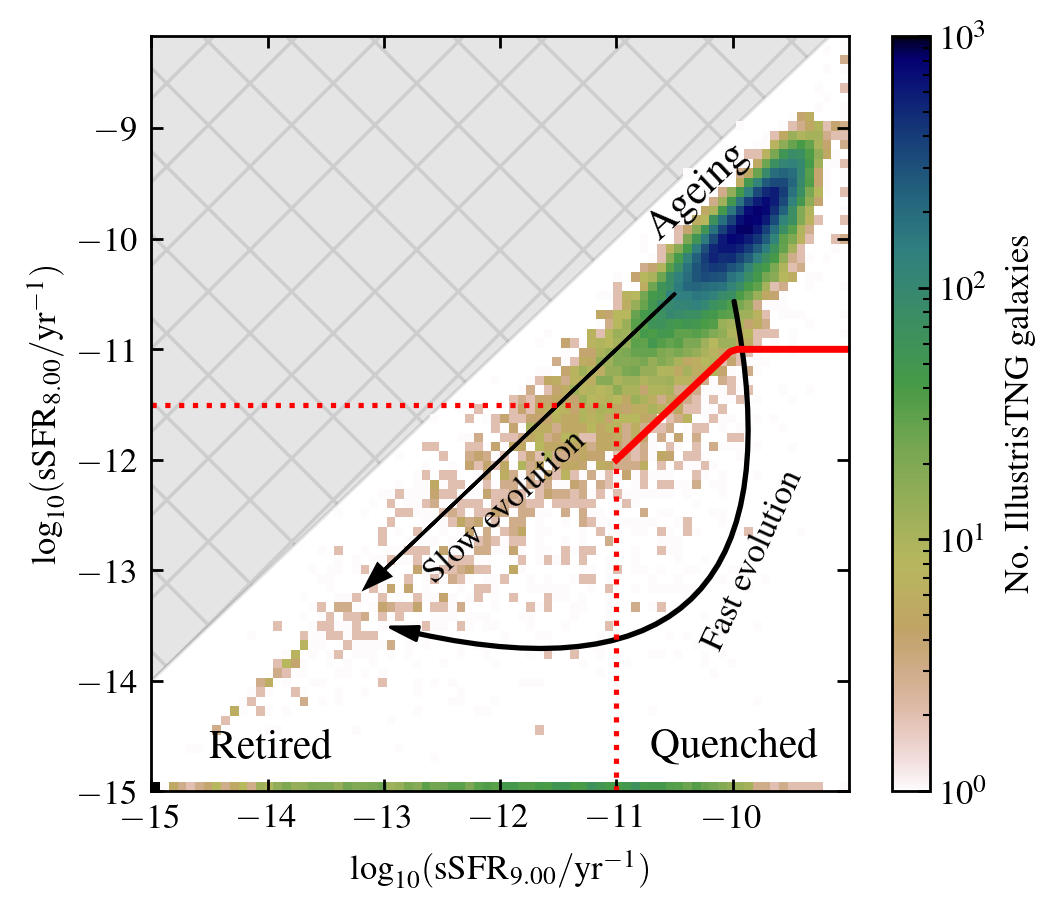
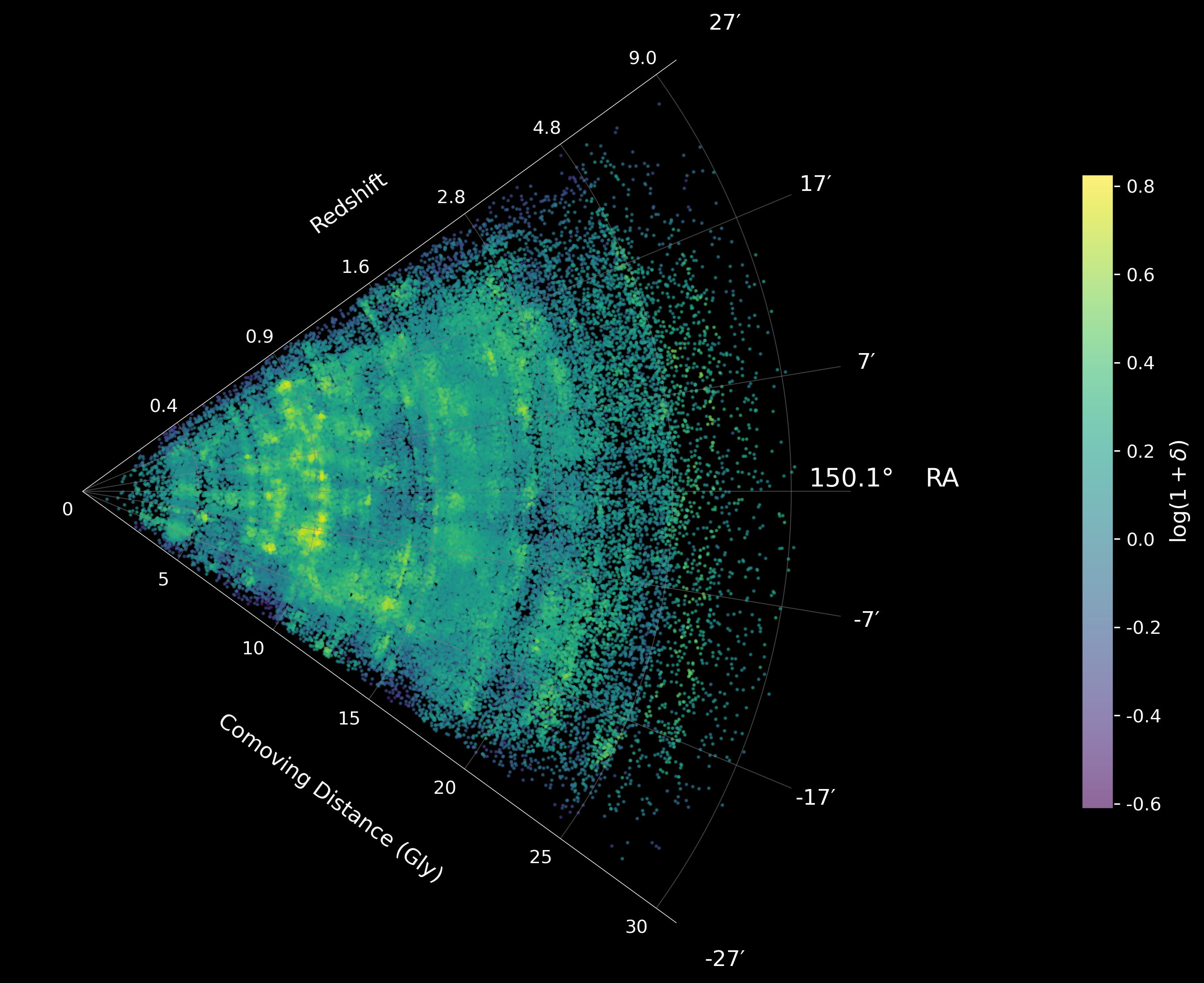
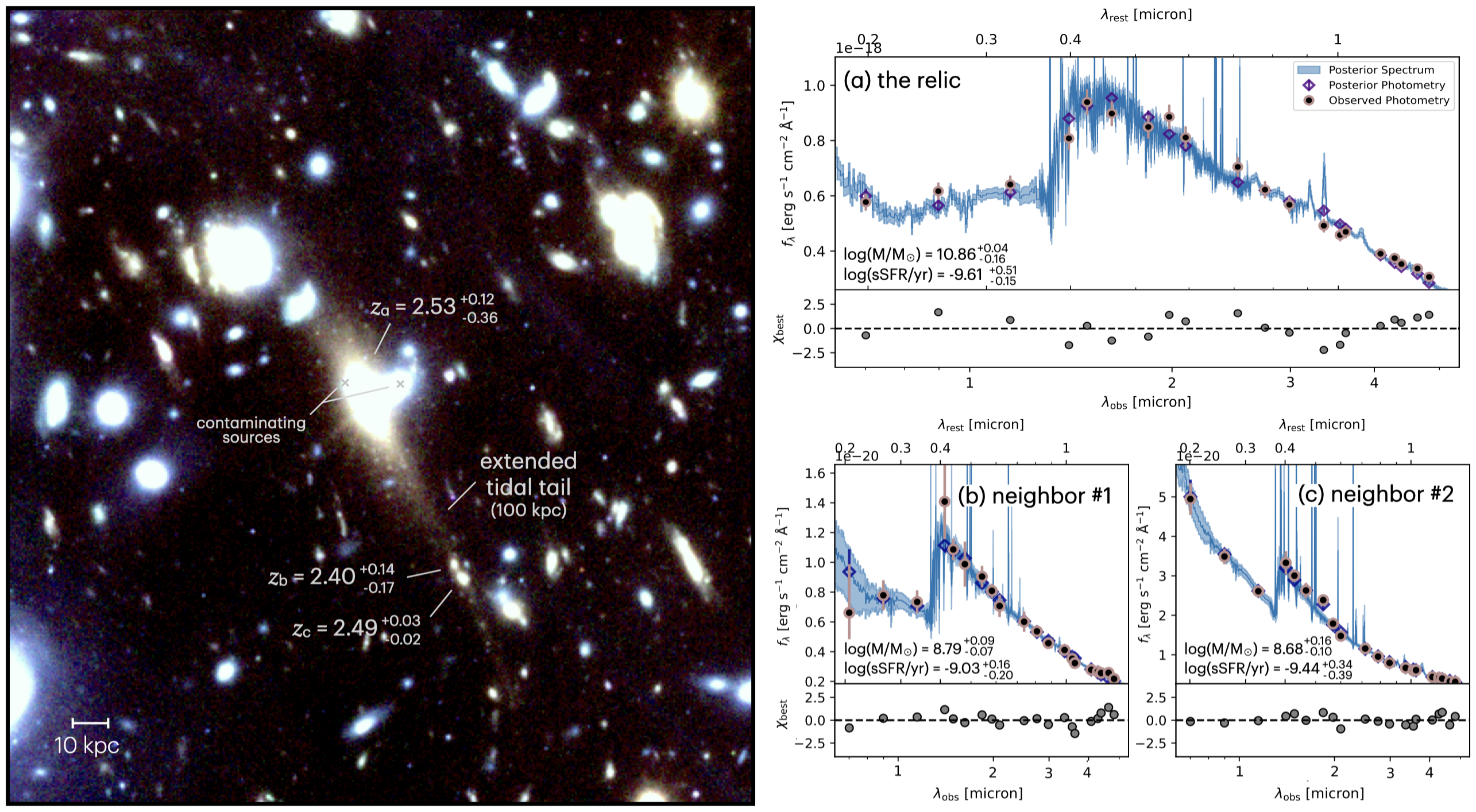
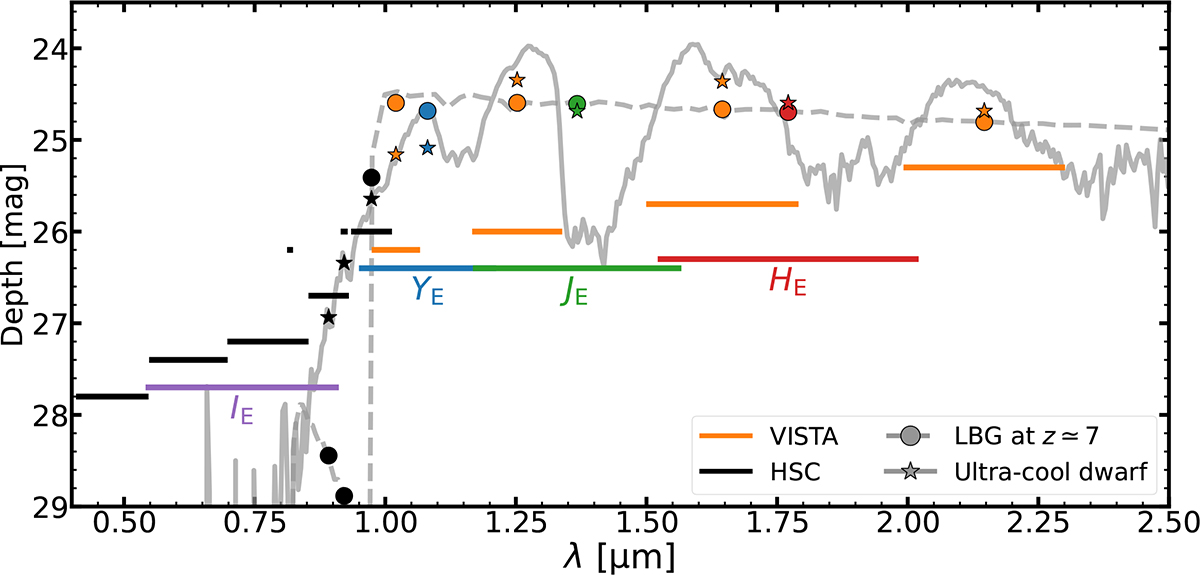
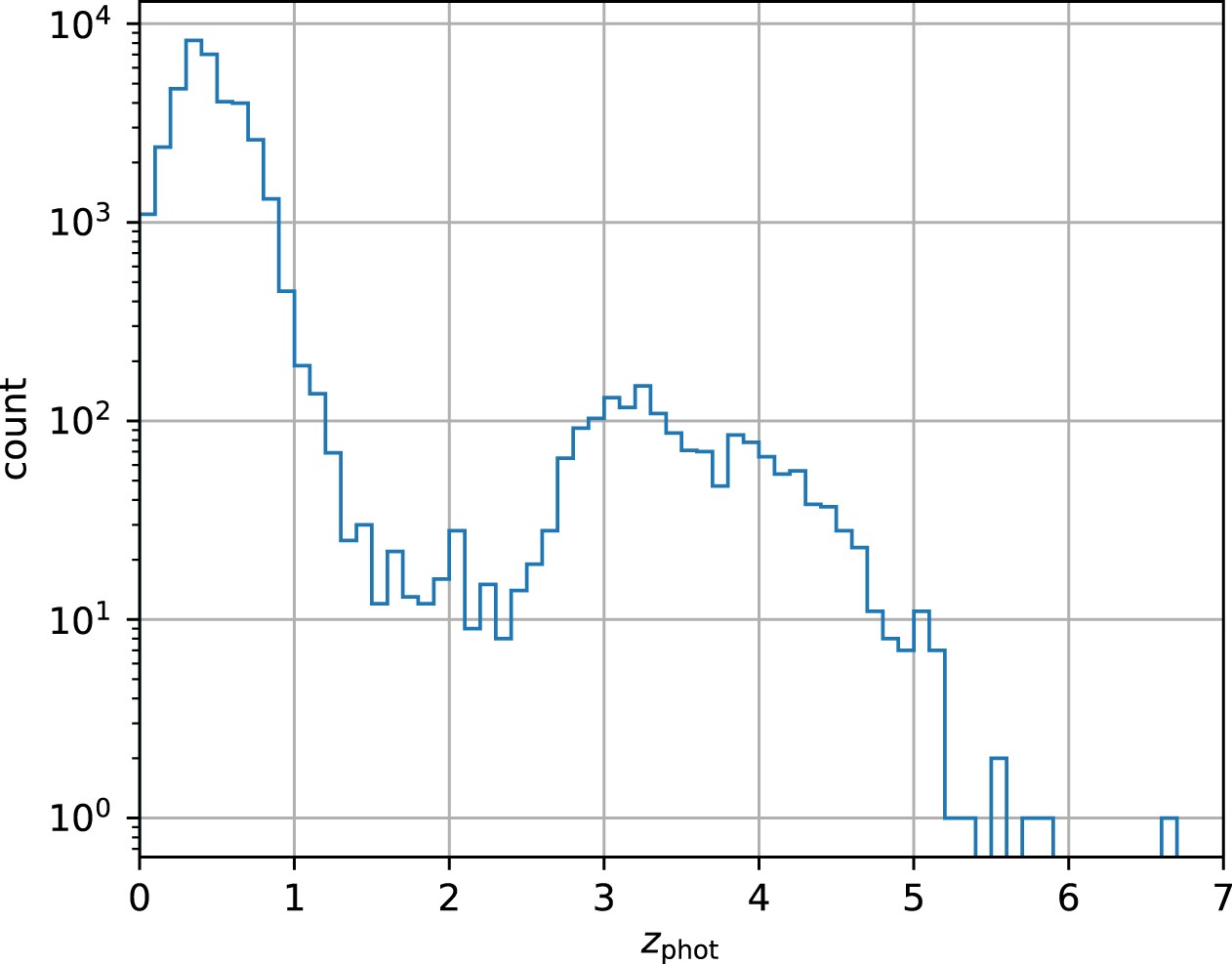
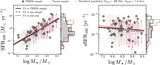
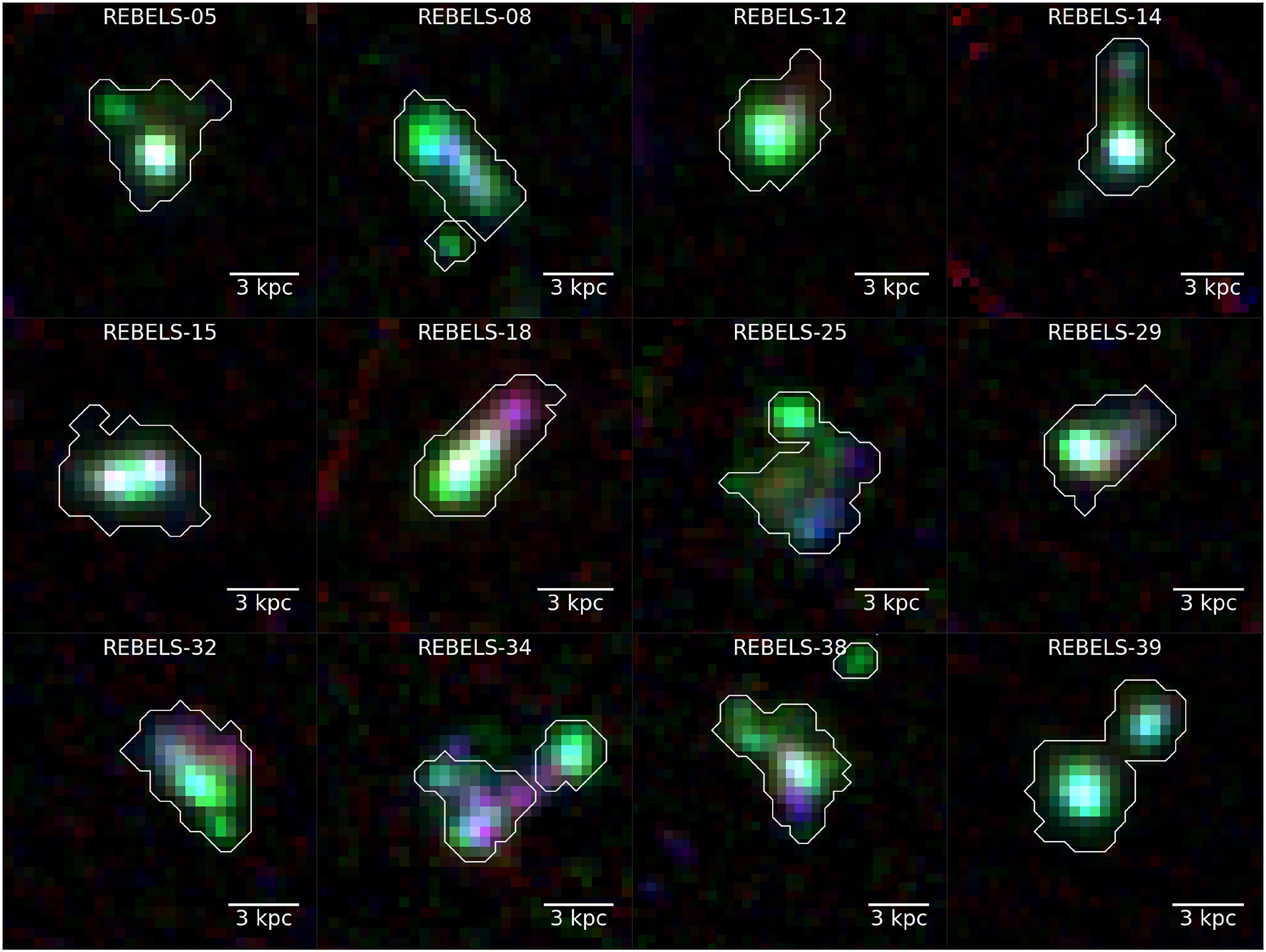
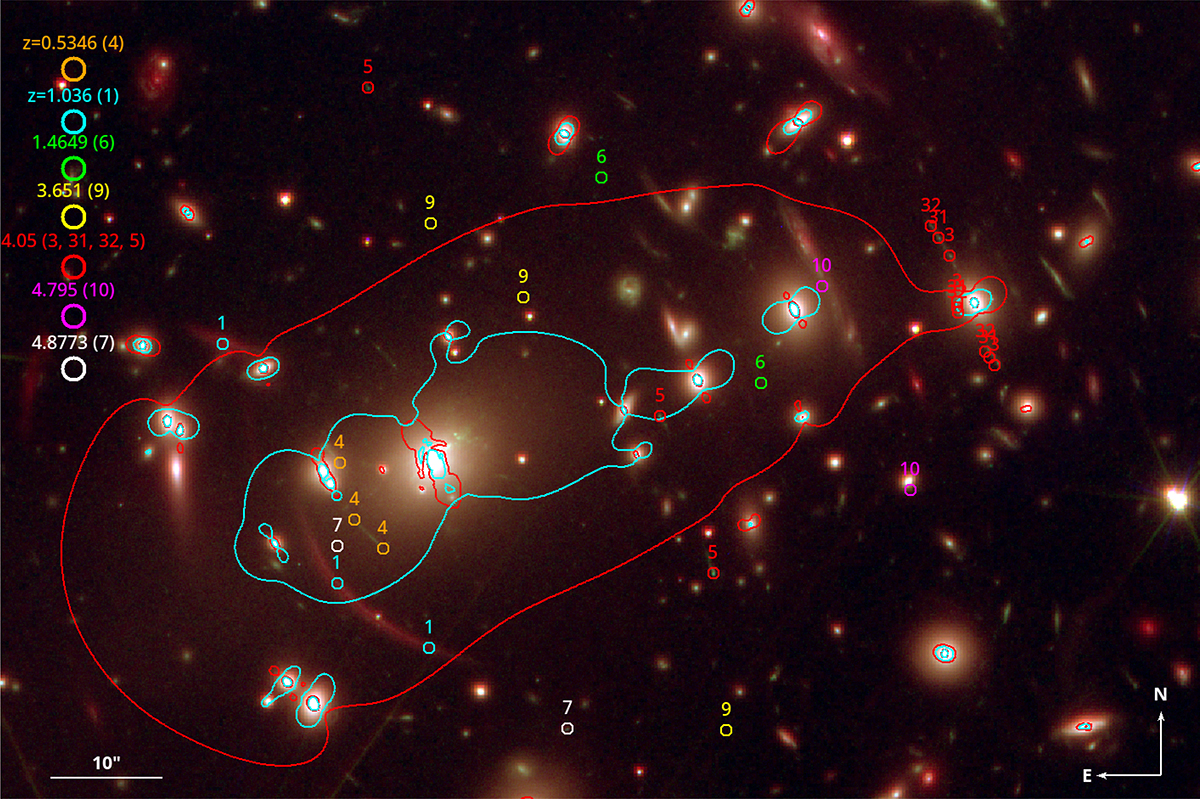
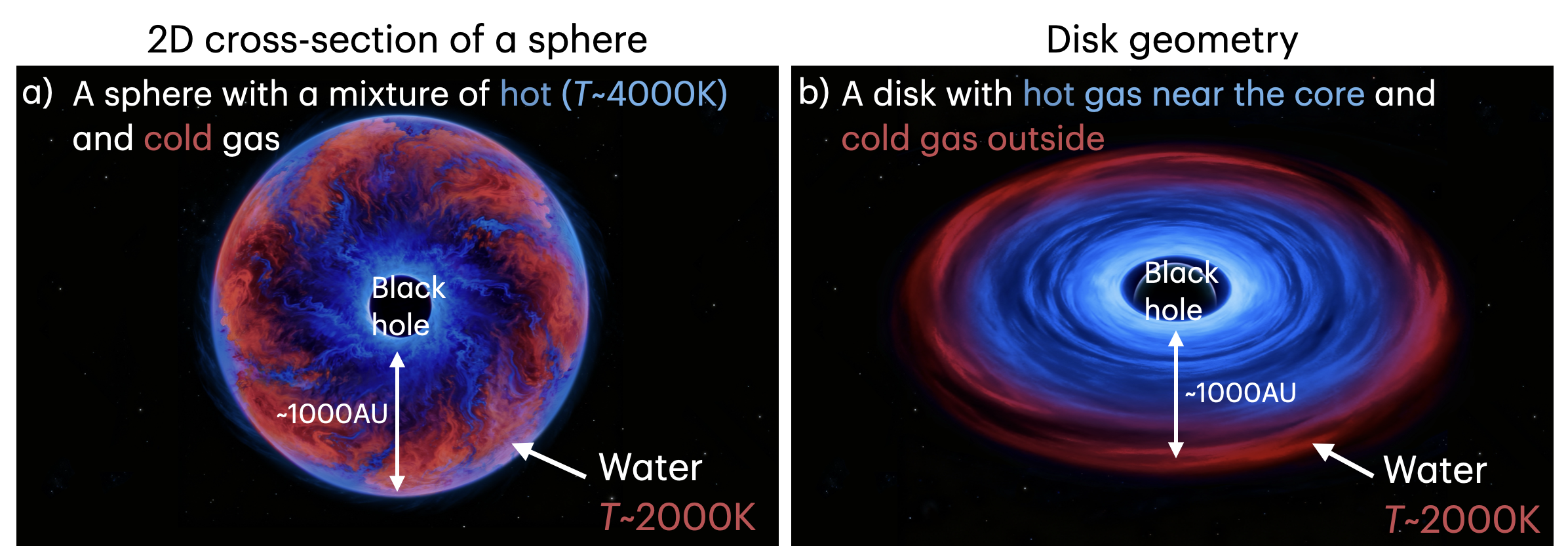
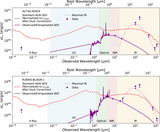
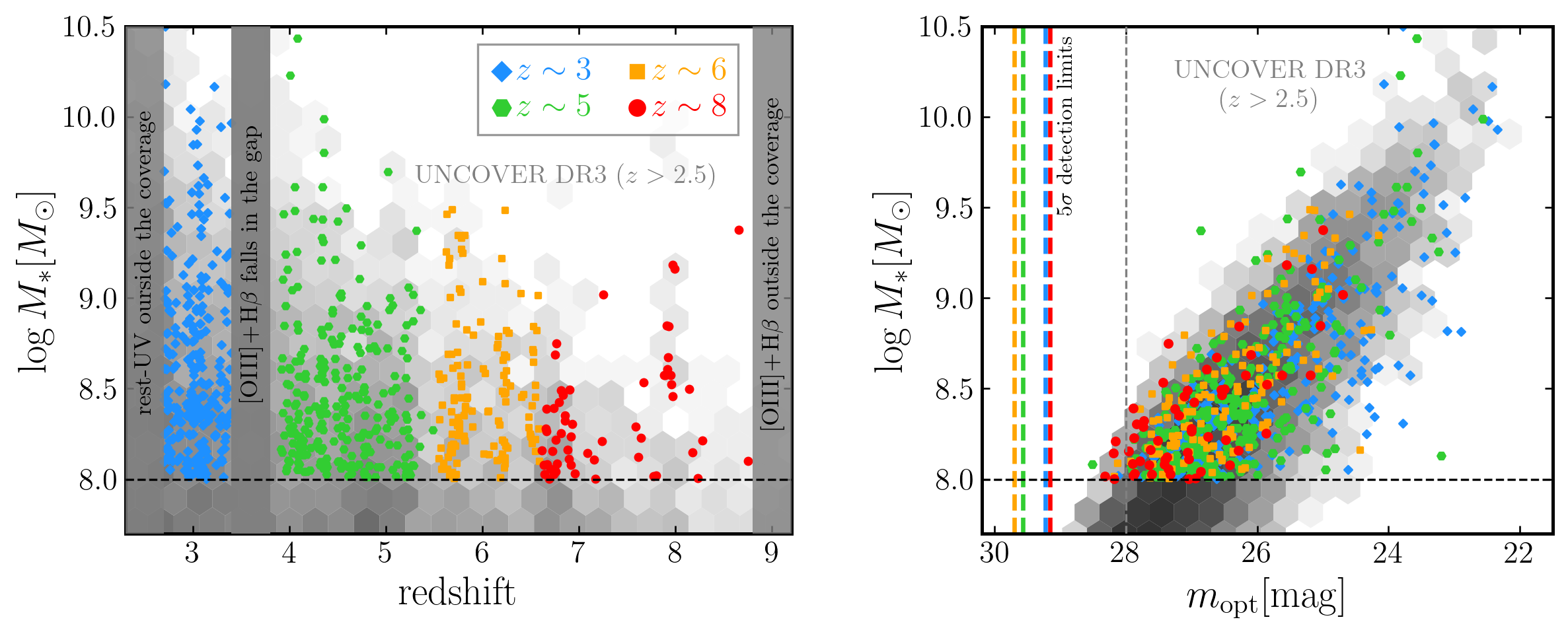
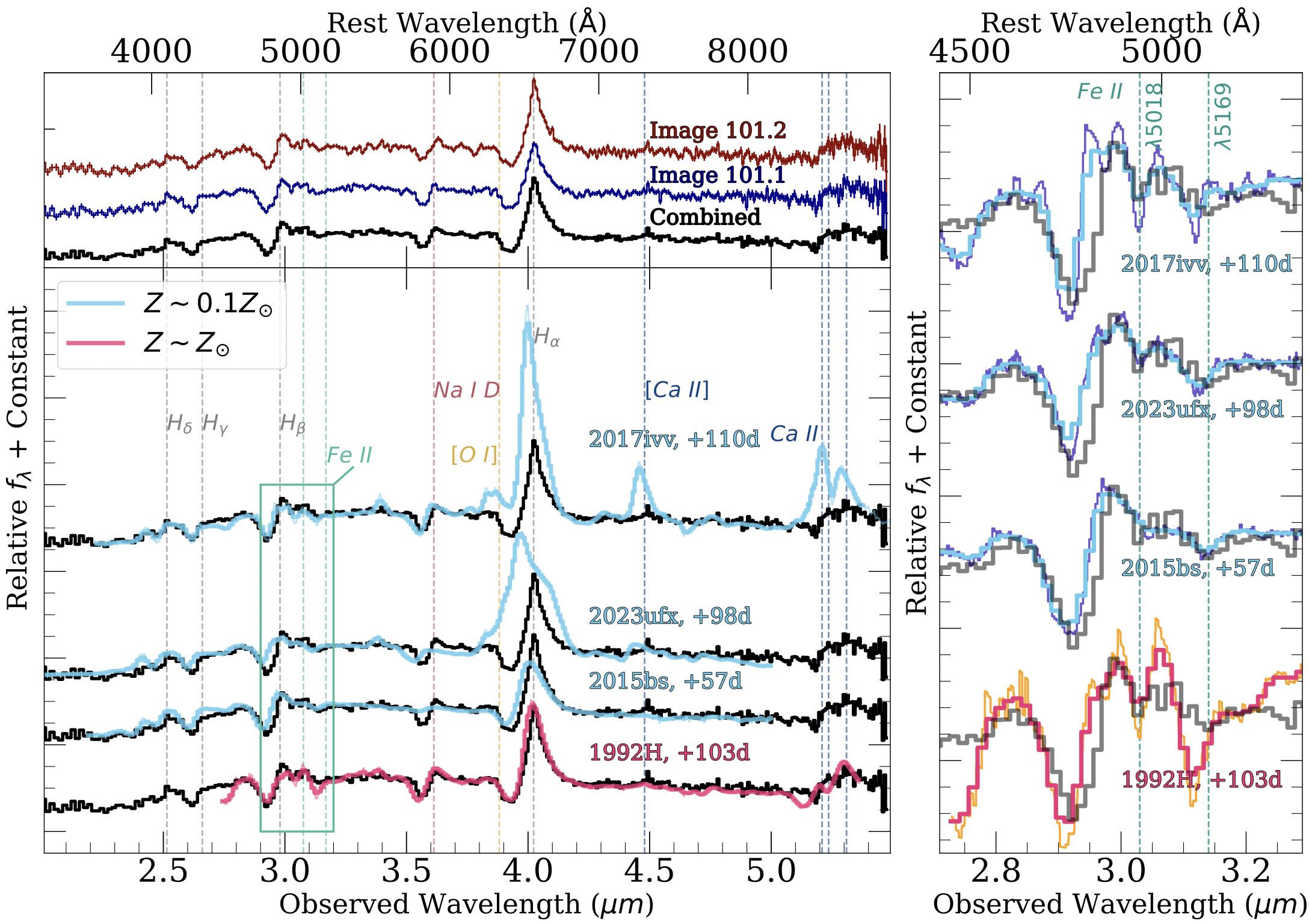
2025
- COSMOS2025: The COSMOS-Web galaxy catalog of photometry, morphology, redshifts, and physical parameters from JWST, HST, and ground-based imagingMarko Shuntov, Hollis B. Akins, Louise Paquereau, Caitlin M. Casey, Olivier Ilbert, and 55 more authorsAstronomy & Astrophysics, Dec 2025
We present COSMOS2025, the COSMOS-Web catalog of photometry, morphology, photometric redshifts, and physical parameters for more than 700 000 galaxies in the Cosmic Evolution Survey (COSMOS) field. This catalog is based on our James Webb Space Telescope 255 h COSMOS- Web program, which provides deep near-infrared imaging in four NIRCam (F115W, F150W, F277W, F444W) and one MIRI (F770W) filter over the central \raisebox-0.5ex\textasciitilde0.54 deg^2 (\raisebox-0.5ex\textasciitilde0.2 deg^2 for MIRI) in COSMOS. These data are combined with ground- and space-based data to derive photometric measurements of NIRCam-detected sources using both fixed-aperture photometry (on the space-based bands) and a profile-fitting technique on all 37 bands spanning 0.3 μm to 8 μm. We provide morphology for all sources from complementary techniques including profile fitting and machine-learning classification. We derive photometric redshifts, physical parameters, and non- parametric star formation histories from spectral energy distribution (SED) fitting. The catalog has been extensively validated against previous COSMOS catalogs and other surveys. Photometric redshift accuracy measured using spectroscopically confirmed galaxies out to z \raisebox-0.5ex~9 reaches σ_MAD = 0.012 at m_F444W < 28 and remains at σ_MAD ≲ 0.03 as a function of magnitude, color, and galaxy type. This represents a factor of \raisebox-0.5ex\textasciitilde2 improvement at 26 AB mag compared to COSMOS2020. The catalog is approximately 80% complete at log(M_⋆/M_⊙) \raisebox-0.5ex~9 at z \raisebox-0.5ex~10 and at log(M_⋆/M_⊙) \raisebox-0.5ex~7 at z \raisebox-0.5ex~0.2, representing a gain of 1 dex compared to COSMOS2020. COSMOS2025 represents the definitive COSMOS-Web catalog. It is provided with complete documentation, together with redshift probability distributions, and it is ready for scientific exploitation today.
- Euclid Quick Data Release (Q1): Identification of massive galaxy candidates at the end of the Epoch of ReionisationEuclid Collaboration, R. Navarro-Carrera, K. I. Caputi, C. J. R. McPartland, J. R. Weaver, and 293 more authorsarXiv, Nov 2025
Probing the presence and properties of massive galaxies at high redshift is one of the most critical tests for galaxy formation models. In this work, we search for galaxies with stellar masses M* > 10\^10.25 Msun at z in [5,7], i.e., towards the end of the Epoch of Reionisation, over a total of \raisebox-0.5ex\textasciitilde23 deg\^2 in two of the Euclid Quick Data Release (Q1) fields: the Euclid Deep Field North and Fornax (EDF-N and EDF-F). In addition to the Euclid photometry, we incorporate Spitzer Infrared Camera (IRAC) and ground-based optical data to perform spectral energy distribution (SED) fitting, obtaining photometric redshifts and derived physical parameters. After applying rigorous selection criteria, we identify a conservative sample of 145 candidate massive galaxies with M* > 10\^10.25 Msun at z in [5,7], including 5 objects with M* > 10\^11 Msun. This makes for a surface density of about 6.3 deg\^-2 at z in [5,7], which should be considered a lower limit because of the current depth of the Euclid data (H_E < 24, 5 sigma in Q1). We find that the inferred stellar masses are consistent with galaxy formation models with standard star- formation efficiencies. These massive galaxies have colour excess E(B-V) values up to 0.75, indicating significant dust attenuation in some of them. In addition, half of the massive galaxies have best-fit ages comparable to the age of the Universe at those redshifts, which suggests that their progenitors were formed very early in cosmic time. About 78% of the massive galaxies lie on the star-forming main sequence (MS) in the SFR-M* plane, \raisebox-0.5ex\textasciitilde12% are found in the starburst region, and 10% in the transition zone between the MS and starbursts. We find no significant evidence for outshining or AGN contamination that could account for the elevated specific star-formation rates (sSFR) observed in the \raisebox-0.5ex\textasciitilde12% of galaxies classified as starbursts.
- Inefficient dust production in a massive, metal-rich galaxy at z=7.13 uncovered by JWST and ALMAKasper E. Heintz, Darach Watson, Francesco Valentino, Rashmi Gottumukkala, Desika Narayanan, and 15 more authorsarXiv, Oct 2025
Recent observations have revealed a remarkably rapid buildup of cosmic dust in the interstellar medium (ISM) of high redshift galaxies, with complex dust compositions and large abundances already appearing at redshifts z>6. Here we present a comprehensive, joint analysis of observations taken with the {\textbackslashem James Webb Space Telescope} (JWST) and the Atacama Large Millimetre/sub-millimetre Array (ALMA) of the highly magnified, dusty ‘normal’ galaxy, A1689-zD1 at z=7.13. We perform detailed spectro-photometric modeling of the rest-frame UV to far-infrared spectral energy distribution (SED) based on archival photometry of the source and report new rest-frame optical strong-line measurements and metallicity estimates from recent JWST/NIRSpec IFU data. We find that despite its substantial dust mass, M_\rm dust∼1.5\times 10^7 M_⊙, A1689-zD1 has remarkably low dust-to-gas and dust-to-metal mass ratios, \rm DTG = (5.1^+3.0_-1.9)\times 10^-4 and \rm DTM = (6.1^+3.6_-2.3)\times 10^-2, respectively, due to its high metallicity 12+\log(\rm O/H) = 8.36\pm 0.10 and substantial gas mass, M_\rm gas = (2.8^+0.2_-1.7)\times 10^10 M_⊙. The DTG and DTM mass ratios are an order of magnitude lower than expected for galaxies in the local universe with similar chemical enrichment. These low relative measurements are also corroborated by the deficit observed in the A_V/N_\rm HI ratio of A1689-zD1 in the line-of-sight. We find that this deviation in the DTG and DTM mass ratios appears to be ubiquitous in other metal-rich galaxies at similar redshifts, zrsim 6. This suggests that the processes that form and destroy dust at later times, or the dust emissivity itself, are drastically different for galaxies in the early Universe.
- Tracing the galaxy-halo connection with galaxy clustering in COSMOS-Web from z = 0.1 to z ∼ 12L. Paquereau, C. Laigle, H. J. McCracken, M. Shuntov, O. Ilbert, and 29 more authorsAstronomy & Astrophysics, Oct 2025
We explore the evolving relationship between galaxies and their dark matter halos from z ∼ 0.1 to z ∼ 12 using mass-limited angular clustering measurements in the 0.54 deg^2 of the COSMOS-Web survey, the largest contiguous JWST extragalactic survey. This study provides the first measurements of the mass-limited two-point correlation function at z ≥ 10 and a consistent analysis spanning 13.4 Gyr of cosmic history, setting new benchmarks for future simulations and models. Using a halo occupation distribution (HOD) framework, we derived characteristic halo masses and the stellar-to-halo mass ratio (SHMR) across redshifts and stellar mass bins. Our results first indicate that HOD models fit data at z ≥ 2.5 best when incorporating a nonlinear scale-dependent halo bias, boosting clustering at nonlinear scales (r = 10 - 100 kpc). We find that galaxies at z ≥ 10.5 with log(M_⋆/M_⊙) ≥8.85 are predominantly central galaxies in halos with M_h ∼ 10^10.5 M_⊙, achieving a star formation efficiency (SFE) of ∈_SF = M_⋆/(f_bM_h) up to 1 dex higher than at z ≤ 1. The high galaxy bias at z ≥ 8 suggests that these galaxies reside in massive halos with an intrinsic high SFE, challenging stochastic SHMR scenarios. Our SHMR evolves significantly with redshift, starting very high at z ≥ 10.5, decreasing until z ∼ 2 - 3, then increasing again until the present. Current hydrodynamical simulations fail to reproduce both massive high-z galaxies and this evolution, while semi-empirical models linking SFE to halo mass, accretion rates, and redshift align with our findings. We propose that early galaxies (z > 8) experience bursty star formation without significant feedback altering their growth, driving the rapid growth of massive galaxies observed by JWST. Over time, the increasing feedback efficiency and the exponential halo growth end up suppressing star formation. At z ∼ 2 - 3 and later, the halo growth slows down, while star formation continues, supported by gas reservoirs in halos.
- A Confirmed Deficit of Hot and Cold Dust Emission in the Most Luminous Little Red DotsDavid J. Setton, Jenny E. Greene, Justin S. Spilker, Christina C. Williams, Ivo Labbé, and 31 more authorsThe Astrophysical Journal Letters, Sep 2025
Luminous broad Hα emission and red rest-optical spectral energy distributions (SEDs) are the hallmark of compact little red dots (LRDs), implying highly attenuated dusty starbursts and/or obscured active galactic nuclei (AGN). However, the lack of observed far-infrared (FIR) emission has proved difficult to reconcile with the implied attenuated luminosity in these models. Here, we utilize deep new Atacama Large Millimeter/submillimeter Array imaging, new and existing JWST/MIRI imaging, and archival Spitzer/Herschel imaging of two of the rest-optically brightest LRDs (z = 3.1 and z = 4.47) to place the strongest constraints on the IR luminosity in LRDs to date. The detections at λ_rest = 1─4 μm imply flat slopes in the rest-IR, ruling out a contribution from hot (T ≳ 500 K) dust. Similarly, FIR nondetections rule out any appreciable cold (T ≲ 75 K) dust component. Assuming energy balance, these observations are inconsistent with the typical FIR dust emission of dusty starbursts and quasar tori, which usually show a mixture of cold and hot dust. Additionally, our [C II] nondetections rule out typical dusty starbursts. We compute empirical maximum IR SEDs and find that both LRDs must have log(LIR/L⊙)≲12.2 at the 3σ level. These limits are in tension with the predictions of rest-optical spectrophotometric fits, be they galaxy-only, AGN-only, or composite. It is unlikely that LRDs are highly dust-reddened intrinsically blue sources with a dust temperature distribution that conspires to avoid current observing facilities. Rather, we favor an intrinsically redder LRD SED model that alleviates the need for strong dust attenuation.
- Euclid: the potential of slitless infrared spectroscopy: a z = 5.4 quasar and new ultracool dwarfsE. Bañados, V. Le Brun, S. Belladitta, I. Momcheva, D. Stern, and 224 more authorsMonthly Notices of the Royal Astronomical Society, Sep 2025
We demonstrate the potential of Euclid ’s slitless spectroscopy to discover high-redshift () quasars and their main photometric contaminant, ultracool dwarfs. Sensitive infrared spectroscopy from space is able to efficiently identify both populations, as demonstrated by Euclid Near-Infrared Spectrometer and Photometer Red Grism (NISP ) spectra of the newly discovered quasar EUCL J181530.01652054.0, as well as several ultracool dwarfs in the Euclid Deep Field North and the Euclid Early Release Observation field Abell 2764. The ultracool dwarfs were identified by cross- correlating their spectra with templates. The quasar was identified by its strong and broad and emission lines in the NISP 1206─1892 nm spectrum, and confirmed through optical spectroscopy from the Large Binocular Telescope. The NISP Blue Grism (NISP ) 926─1366 nm spectrum confirms and emission. NISP can find bright quasars at and , redshift ranges that are challenging for photometric selection due to contamination from ultracool dwarfs. EUCL J181530.01652054.0 is a high-excitation, broad absorption line quasar detected at 144 MHz by the LOw- Frequency Array (W Hz). The quasar has a bolometric luminosity of and is powered by a black hole. The discovery of this bright quasar is noteworthy as fewer than one such object was expected in the 20 deg surveyed. This finding highlights the potential and effectiveness of NISP spectroscopy in identifying rare, luminous high-redshift quasars, previewing the census of these sources that Euclid’s slitless spectroscopy will deliver over about deg of the sky.
- UNCOVER/MegaScience: No Evidence of Environmental Quenching in a z ∼ 2.6 ProtoclusterRichard Pan, Katherine A. Suess, Danilo Marchesini, Bingjie Wang, Joel Leja, and 20 more authorsThe Astrophysical Journal Letters, Sep 2025
Environmental quenching—where interactions with other galaxies and/or the intracluster medium suppress star formation in low-mass galaxies—has been well established as the primary driver behind the formation of the red sequence for low-mass galaxies within clusters at low redshift (z < 1). However, it remains unclear whether these mechanisms are active at higher redshifts in protocluster environments that are not yet fully virialized. In large part, this regime has remained unexplored due to observational limitations; however, JWST has recently opened a new window into the role of environmental quenching on low-mass (log(M_⋆/M_⊙) < 9.0) galaxies at cosmic noon (2 < z < 3). Here, we leverage the deep imaging and R ∼ 15 spectrophotometry enabled by the 20 band JWST/NIRCam data from the UNCOVER and MegaScience programs to examine environmental quenching in a newly discovered z ≍ 2.58 protocluster. We compare the star formation histories of 19 low-mass quiescent galaxies in the protocluster to a matched sample of 18 in the field and find no significant differences. This similarity extends to galaxy sizes and quenched fractions, which also show no significant differences between the two environments across the full stellar mass range (8.5 < log(M_⋆/M_⊙) ≤ 11.0). This indicates that the protocluster has not yet accelerated quenching relative to the field and is consistent with expectations that z > 2 protoclusters have yet to virialize and develop a dense enough environment required to efficiently quench low-mass galaxies.
- JWST UNCOVERs the Optical Size─Stellar Mass Relation at 4 < z < 8: Rapid Growth in the Sizes of Low-mass Galaxies in the First Billion Years of the UniverseTim B. Miller, Katherine A. Suess, David J. Setton, Sedona H. Price, Ivo Labbe, and 19 more authorsThe Astrophysical Journal, Aug 2025
We study the rest-frame optical and ultraviolet (UV) morphology of galaxies in the first billion years of the Universe. Using James Webb Space Telescope data from the UNCOVER and MegaScience surveys targeting the lensing cluster A2744, we present multiband morphological measurements for a sample of 995 galaxies selected using 20-band NIRCam photometry and 35 using NIRSpec Prism spectroscopy over the redshift range of 4 < z < 8. The wavelength-dependent morphology is measured using pysersic by simultaneously modeling the images in six NIRCam wide filters covering the rest-frame UV to optical. The joint modeling technique increases the precision of measured radii by 50%. Galaxies in our sample show a wide range of Sérsic indices, with no systematic difference between optical and UV morphology. We model the size─mass relation in a Bayesian manner using a continuity model to directly fit the redshift evolution while accounting for observational uncertainties. We find the average size of galaxies at logM*/M⊙=8.5 grows rapidly, from 400 pc at z = 8 to 830 pc at z = 4. This is faster evolution than expected from power-law scalings of the Hubble parameter or scale factor that describe well previous results at z < 2. This suggests that different and/or much stronger processes affect low-mass systems during the epoch of reionization. The measured logarithmic slope (0.25) and scatter (0.23 dex) are nonevolving. We discuss the remarkable consistency of the slope and scatter over cosmic time in the context of the galaxy─halo connection.
- Physical properties of galaxies and the UV Luminosity Function from z\sim6 to z\sim14 in COSMOS-WebMaximilien Franco, Caitlin M. Casey, Hollis B. Akins, Olivier Ilbert, Marko Shuntov, and 35 more authorsarXiv, Aug 2025
We present measurements of the rest-frame ultraviolet luminosity function (UVLF) in three redshift bins over z\sim5.5-14 from the JWST COSMOS-Web survey. Our samples, selected using the dropout technique in the HST/ACS F814W, JWST/NIRCam F115W, and F150W filters, contain a total of 3099 galaxies spanning a wide luminosity range from faint (M_\rm UV∼-19 mag) to bright (M_\rm UV∼-22.5 mag). The galaxies are undergoing rapid star formation, with blue stellar populations. Surprisingly, their median UV spectral slope β does not evolve at z>8, suggesting minimal dust, or physical separation of dust and star formation at early epochs. The measured UVLF exhibits an excess at the bright-end (M_\rm UV<-21 mag) compared to pre-JWST empirical results and theoretical predictions of an evolving Schechter function, with the excess beginning at z\sim9 and becoming increasingly prominent toward z\sim12. Our analysis suggests that reproducing the observed abundance of UV-bright galaxies at high redshift requires a combination of physical processes, including elevated star formation efficiencies, moderate levels of stochasticity in galaxy luminosities, and minimal dust attenuation.
- MINERVA: A NIRCam Medium Band and MIRI Imaging Survey to Unlock the Hidden Gems of the Distant UniverseAdam Muzzin, Katherine A. Suess, Danilo Marchesini, Luke Robbins, Chris J. Willott, and 79 more authorsarXiv, Jul 2025
We present an overview of the MINERVA survey, a 259.8 hour (prime) and 127 hour (parallel) Cycle 4 treasury program on the James Webb Space Telescope (JWST). MINERVA is obtaining 8 filter NIRCam medium band imaging (F140M, F162M, F182M, F210M, F250M, F300M, F360M, F460M) and 2 filter MIRI imaging (F1280W, F1500W) in four of the five CANDELS Extragalactic fields: UDS, COSMOS, AEGIS and GOODS-N. These fields were previously observed in Cycle 1 with 7 - 9 NIRCam filters by the PRIMER, CEERS and JADES programs. MINERVA reaches a 5σ depth of 28.1 mag in F300M and covers ∼542 arcmin^2, increasing the area of existing JWST medium-band coverage in at least 8 bands by ∼7\times. The MIRI imaging reaches a 5σ depth of 23.9 mag in F1280W and covers ∼275 arcmin^2 in at least 2 MIRI filters. When combined with existing imaging, these data will provide a photometric catalog with 20-26 JWST filters (depending on field) and 26-35 filters total, including HST. This paper presents a detailed breakdown of the filter coverage, exposure times, and field layout relative to previous observations, as well as an overview of the primary science goals of the project. These include uncovering the physics of enigmatic sources hiding in current broadband catalogs, improving systematics on stellar mass functions and number densities by factors of rsim 3, and resolved mapping of stellar mass and star formation at 1 < z < 6. When complete, MINERVA will become an integral part of the treasury deep field imaging datasets, significantly improving population studies with well-understood completeness, robust photometric redshifts, stellar masses, and sizes, and facilitating spectroscopic follow up for decades to come.
- Population Models for Star Formation Timescales in Early Galaxies: The First Step toward Solving Outshining in Star Formation History InferenceBingjie Wang, Joel Leja, Hakim Atek, Rachel Bezanson, Emilie Burnham, and 11 more authorsThe Astrophysical Journal, Jul 2025
James Webb Space Telescope (JWST) has revealed temporarily quenched and ultraviolet-luminous galaxies in the early Universe, suggesting enhanced star formation stochasticity. Verifying this hypothesis is critical yet challenging. Outshining, wherein light from young stars dominates the spectral energy distribution, represents perhaps the greatest challenge in inferring the formation histories of unresolved galaxies. In this paper, we take a simple model of burstiness and show that state-of-the-art inference methods with flexible star formation histories (SFHs) and neutral priors, while recovering average star formation rates (SFRs; ∼0.1 dex median offset), fail to recover the complexities of fluctuations on tens of Myr timescales, and typically underestimate masses in bursty systems (∼0.15 dex). Surprisingly, detailed SFH recovery is still sensitive to priors even when data quality is optimal, e.g., including high signal-to-noise (20 pixel^-1) spectroscopy with wide coverage (rest-frame 0.12─1.06 μm). Crucially, however, refitting the same data with a prior correctly encoding the bursty expectation eliminates these biases: median offsets in mass and SFRs decrease to ∼0.04 dex and ∼0.05 dex, respectively. Under the assumption that current population burstiness predicts past SFH, the solution to outshining in modeling statistical samples is empirically measuring recent galaxy SFHs with population modeling. A prototype is Hα/UV: while helpful, it is insufficient to constrain the expected complex burstiness. To this end, we introduce a more complete, quantitative population-level approach and demonstrate that it promises to recover the typical amplitude, timescale, and slope of the recent SFH to high accuracy. This approach thus has the strong potential to solve outshining using observations from JWST.
- Joint Survey Processing. III. Compact Oddballs in the COSMOS Field—Little Red Dots and TransientsYu-Heng Lin, Andreas L. Faisst, Ranga-Ram Chary, Anton M. Koekemoer, Joseph Masiero, and 5 more authorsThe Astrophysical Journal, Jul 2025
We present the Hubble Space Telescope (HST) Advanced Camera for Surveys (ACS) G800L grism spectroscopy observation of the faint active galactic nuclei (AGN) candidates in the Cosmic Evolution Survey field at redshift of 6 selected by the point-source morphology and the photometry drop-off at 8000 Å. Among the sample of seven objects, only one is detected by multiple bands and has a similar shape of spectral energy distribution as the so-called “little red dots” of James Webb Space Telescope (JWST)─selected AGN candidates, but our object is 3 mag brighter than the JWST sample. We draw the upper limit of the AGN luminosity function Φ = 1.1 \texttimes 10^-7 Mpc^3 mag^-1 for M_UV = -21 at redshift of 6. The rest of the sample shows inconsistent flux density when comparing magnitudes of HST ACS F814W to the Subaru i-band and z-band magnitudes combined. The HST ACS G800L grism observation shows that this inconsistency cannot be created from an emission line. Therefore, we speculate that these objects are transients with the light-curve decay timescale of at most 6 yr in the observed frame.
- Measuring Emission Lines with JWST MegaScience Medium Bands: A New Window into Dust and Star Formation at Cosmic NoonBrian Lorenz, Katherine A. Suess, Mariska Kriek, Sedona H. Price, Joel Leja, and 21 more authorsThe Astrophysical Journal Letters, Jul 2025
We demonstrate the power of JWST-NIRCam medium-band photometry to measure emission line fluxes and study the dust and star formation properties of galaxies at cosmic noon. In this work, we present photometric emission line measurements and spatially resolved maps of Hα and Paβ for 14 galaxies at 1.3 ≤ z ≤ 2.4, observed by the MegaScience medium-band survey and the UNCOVER spectroscopic survey. We measure line fluxes directly from medium-band photometry and compare with spectroscopic measurements from UNCOVER. We find reasonable agreement between the photometric and spectroscopic emission line fluxes for both Hα and Paβ, with scatter <0.15 dex down to emission line equivalent widths of 10 Å. We also make a nebular dust measurement from the ratio Paβ/Hα, finding an average nebular attenuation in the V band, A_V, of 1.4 with a standard deviation of 0.8. Our photometric A_V measurements show a slightly larger scatter of 0.5 mag when compared to spectroscopic measurements; however, this scatter may be partially caused by aperture effects. Finally, we produce spatially resolved maps of Hα emission, Paβ emission, and the stellar continuum. We find offsets between Hα and Paβ emission, especially for galaxies with high A_V, indicating dusty substructures. Furthermore, the correlation between Hα and continuum emission decreases with increasing A_V, suggesting that the dustiest objects have clumpy dust and star formation distributions. Our study demonstrates the power of medium-band photometry to directly probe emission line strengths, star formation, and dust attenuation for hundreds of galaxies in UNCOVER and thousands of galaxies in upcoming JWST medium-band surveys.
- Galaxy size and mass build-up in the first 2 Gyr of cosmic history from multi-wavelength JWST NIRCam imagingNatalie Allen, Pascal A. Oesch, Sune Toft, Jasleen Matharu, Conor J. R. McPartland, and 10 more authorsAstronomy & Astrophysics, Jun 2025
The evolution of galaxy sizes in different wavelengths provides unique insights on galaxy build-up across cosmic epochs. Such measurements can now finally be done at z > 3 thanks to the James Webb Space Telescope’s (JWST) exquisite spatial resolution and multi-wavelength capability. With the public data from the CEERS, PRIMER-UDS, and PRIMER-COSMOS surveys, we measure the sizes of ∼3500 star-forming galaxies at 3 ≤ z < 9, in seven NIRCam bands using the multi-wavelength model fitting code GalfitM. The size─mass relation is measured in four redshift bins, across all NIRCam bands. We find that the slope and intrinsic scatter of the rest- optical size─mass relation are constant across this redshift range and consistent with previous studies at low-z with the Hubble Space Telescope. When comparing the relations across different wavelengths, the average rest-optical and rest-UV relations are consistent with each other up to z = 6, but the intrinsic scatter is largest in rest-UV wavelengths compared to rest-optical and redder bands. This behaviour is independent of redshift and we speculate that it is driven by bursty star formation in z > 4 galaxies. Additionally, for 3 ≤ z < 4 star-forming galaxies at M_* > 10^10 M_⊙, we find smaller rest-1 μm sizes in comparison to rest-optical (and rest-UV) sizes, suggestive of colour gradients. When comparing to simulations, we find agreement over M_* ≍ 10^9 - 10^10 M_⊙ but beyond this mass, the observed size─mass relation is significantly steeper. Our results show the power of JWST/NIRCam to provide new constraints on galaxy formation models.
- DUALZ—Deep UNCOVER-ALMA Legacy High-Z SurveySeiji Fujimoto, Rachel Bezanson, Ivo Labbe, Gabriel Brammer, Sedona H. Price, and 27 more authorsThe Astrophysical Journal Supplement Series, Jun 2025
We present the survey design and initial results of the Atacama Large Millimeter/submillimeter Array (ALMA) Cycle 9 program of DUALZ, which aims to establish a joint ALMA and JWST public legacy field targeting the massive galaxy cluster A2744. DUALZ features a contiguous 4’\texttimes6’ ALMA 30 GHz-wide mosaic in Band 6, covering areas of μ > 2 down to a sensitivity of σ = 32.7 μJy. Through a blind search, we identified 69 dust continuum sources at a signal-to-noise ratio (SNR) ≳ 5.0 with median redshift and intrinsic 1.2 mm flux of z = 2.30 and S1.2mmint=0.24 mJy. Of these, 27 have been spectroscopically confirmed, leveraged by the latest NIRSpec observations, while photometric redshifts are also constrained by the comprehensive Hubble Space Telescope (HST), NIRCam, and ALMA data sets for the remaining sources. With priors, we further identify a [C II]158 μm line emitter at z = 6.3254 \pm 0.0004, confirmed by the latest NIRSpec spectroscopy. The NIRCam counterparts of the 1.2 mm continuum exhibit undisturbed morphologies, denoted either by disk or spheroid, implying the triggers for the faint millimeter emission are less catastrophic than mergers. We have identified eight HST-dark galaxies (F150W > 27 mag, F150W - F444W > 2.3) and two JWST-dark (F444W > 30 mag) galaxy candidates among the ALMA continuum sources. The former includes face-on disk galaxies, hinting that substantial dust obscuration does not always result from inclination. We also detect a marginal dust emission from an X-ray-detected galaxy at z_spec = 10.07, suggesting an active coevolution of the central black hole and its host. We assess the infrared luminosity function up to z ∼ 10 and find it is consistent with predictions from galaxy formation models. To foster diverse scientific outcomes from the community, we publicly release reduced ALMA mosaic maps, cubes, and the source catalog at https://jwst-uncover.github.io/DR2.html#DUALZ.
- Investigating photometric and spectroscopic variability in the multiply imaged little red dot A2744-QSO1Lukas J. Furtak, Amy R. Secunda, Jenny E. Greene, Adi Zitrin, Ivo Labbé, and 23 more authorsAstronomy & Astrophysics, Jun 2025
JWST observations have uncovered a new population of red, compact objects at high redshifts dubbed “little red dots” (LRDs), which typically show broad emission lines and are thought to be dusty active galactic nuclei (AGNs). Some of their other features, however, challenge the AGN explanation, such as prominent Balmer breaks and extremely faint or even missing metal high-ionization lines, X-ray, or radio emission, including in deep stacks. Time variability is another robust test of AGN activity. Here, we exploit the z = 7.045 multiply imaged LRD A2744-QSO1, which offers a particularly unique test of variability due to lensing-induced time delays between the three images spanning 22 yr (2.7 yr in the rest-frame), to investigate its photometric and spectroscopic variability. We find the equivalent widths (EWs) of the broad Hα and Hβ lines, which are independent of magnification and other systematics, to exhibit significant variations, of up to 18 \pm 3% for Hα and up to 22 \pm 8% in Hβ, on a timescale of 875 d (2.4 yr) in the rest-frame. This suggests that A2744-QSO1 is indeed an AGN. We find no significant photometric variability beyond the limiting systematic uncertainties, so it currently cannot be determined whether the EW variations are due to line-flux or continuum variability. These results are consistent with a typical damped random walk variability model for an AGN such as A2744-QSO1 (M_BH = 4 \texttimes 10^7 M_⊙) given the sparse sampling of the light curve with the available data. Our results therefore support the AGN interpretation of this LRD, and highlight the need for further photometric and spectroscopic monitoring in order to build a detailed and reliable light curve.
- Time-scales for the effects of interactions on galaxy properties and SMBH growthDavid O’Ryan, Brooke D. Simmons, Andreas L. Faisst, Izzy L. Garland, Tobias Géron, and 13 more authorsMonthly Notices of the Royal Astronomical Society, Jun 2025
Galaxy interaction and merging have clear effects on the systems involved. We find an increase in the star formation rate (SFR), potential ignition of active galactic nuclei (AGNs), and significant morphology changes. However, at what stage during interactions or mergers these changes begin to occur remains an open question. With a combination of machine learning and visual classification, we select a sample of 3162 interacting and merging galaxies in the Cosmic Evolutionary Survey (COSMOS) field across a redshift range of 0.0─1.2. We divide this sample into four distinct stages of interaction based on their morphology, each stage representing a different phase of the dynamical time-scale. We use the rich ancillary data available in COSMOS to probe the relation between interaction stage, stellar mass, SFR, and AGN fraction. We find that the distribution of SFRs rapidly changes with stage for mass distributions consistent with being drawn from the same parent sample. This is driven by a decrease in the fraction of red sequence galaxies (from 17 per cent as close pairs to 1.4 per cent during merging) and an increase in the fraction of starburst galaxies (from 7 per cent to 32 per cent). We find that the AGN fraction increases by a factor of 1.2 only at coalescence. We find that the effects of interaction peak at the point of closest approach and coalescence of the two systems. We show that the point in time of the underlying dynamical time- scale ─ and its related morphology ─ is as important to consider as its projected separation.
- Euclid: II. The VIS instrumentEuclid Collaboration, M. S. Cropper, A. Al-Bahlawan, J. Amiaux, S. Awan, and 430 more authorsAstronomy & Astrophysics, May 2025
This paper presents the specification, design, and development of the Visible Camera (VIS) on the European Space Agency’s Euclid mission. VIS is a large optical-band imager with a field of view of 0.54 deg^2 sampled at 0″.1 with an array of 609 Megapixels and a spatial resolution of 0″.18. It will be used to survey approximately 14 000 deg^2 of extragalactic sky to measure the distortion of galaxies in the redshift range z = 0.1─1.5 resulting from weak gravitational lensing, one of the two principal cosmology probes leveraged by Euclid. With photometric redshifts, the distribution of dark matter can be mapped in three dimensions, and the extent to which this has changed with look-back time can be used to constrain the nature of dark energy and theories of gravity. The entire VIS focal plane will be transmitted to provide the largest images of the Universe from space to date, specified to reach m_AB ≥ 24.5 with a signal-to-noise ratio S/N ≥ 10 in a single broad I_E ≃ (r + i + z) band over a six-year survey. The particularly challenging aspects of the instrument are the control and calibration of observational biases, which lead to stringent performance requirements and calibration regimes. With its combination of spatial resolution, calibration knowledge, depth, and area covering most of the extra-Galactic sky, VIS will also provide a legacy data set for many other fields. This paper discusses the rationale behind the conception of VIS and describes the instrument design and development, before reporting the prelaunch performance derived from ground calibrations and brief results from the inorbit commissioning. VIS should reach fainter than m_AB = 25 with S/N ≥ 10 for galaxies with a full width at half maximum of 0″. 3 in a 1″.3 diameter aperture over the Wide Survey, and m_AB ≥ 26.4 for a Deep Survey that will cover more than 50 deg^2. The paper also describes how the instrument works with the Euclid telescope and survey, and with the science data processing, to extract the cosmological information.
- Euclid: V. The Flagship galaxy mock catalogue: A comprehensive simulation for the Euclid missionEuclid Collaboration, F. J. Castander, P. Fosalba, J. Stadel, D. Potter, and 365 more authorsAstronomy & Astrophysics, May 2025
We present the Flagship galaxy mock, a simulated catalogue of billions of galaxies designed to support the scientific exploitation of the Euclid mission. Euclid is a medium-class mission of the European Space Agency optimised to determine the properties of dark matter and dark energy on the largest scales of the Universe. It probes structure formation over more than 10 billion years primarily from the combination of weak gravitational lensing and galaxy clustering data. The breadth of Euclid’s data will also foster a wide variety of scientific analyses. The Flagship simulation was developed to provide a realistic approximation to the galaxies that will be observed by Euclid and used in its scientific exploitation. We ran a state- of-the-art N-body simulation with four trillion particles, producing a lightcone on the fly. From the dark matter particles, we produced a catalogue of 16 billion haloes in one octant of the sky in the lightcone up to redshift z = 3. We then populated these haloes with mock galaxies using a halo occupation distribution and abundance-matching approach, calibrating the free parameters of the galaxy mock against observed correlations and other basic galaxy properties. Modelled galaxy properties include luminosity and flux in several bands, redshifts, positions and velocities, spectral energy distributions, shapes and sizes, stellar masses, star formation rates, metallicities, emission line fluxes, and lensing properties. We selected a final sample of 3.4 billion galaxies with a magnitude cut of H_E < 26, where we are complete. We have performed a comprehensive set of validation tests to check the similarity to observational data and theoretical models. In particular, our catalogue is able to closely reproduce the main characteristics of the weak lensing and galaxy clustering samples to be used in the mission main cosmological analysis. Moreover, given its depth and completeness, this new galaxy mock also provides the community with a powerful tool for developing a wide range of scientific analyses beyond the Euclid mission.
- Euclid: III. The NISP InstrumentEuclid Collaboration, K. Jahnke, W. Gillard, M. Schirmer, A. Ealet, and 436 more authorsAstronomy & Astrophysics, May 2025
The Near-Infrared Spectrometer and Photometer (NISP) on board the Euclid satellite provides multiband photometry and R ≳ 450 slitless grism spectroscopy in the 950─2020 nm wavelength range. In this reference article, we illuminate the background of NISP’s functional and calibration requirements, describe the instrument’s integral components, and provide all its key properties. We also sketch the processes needed to understand how NISP operates and is calibrated as well as its technical potentials and limitations. Links to articles providing more details and the technical background are included. The NISP’s 16 HAWAII-2RG (H2RG) detectors with a plate scale of 0″.3 pixel^-1 deliver a field of view of 0.57 deg^2. In photometric mode, NISP reaches a limiting magnitude of \raisebox-0.5ex\textasciitilde24.5 AB mag in three photometric exposures of about 100 s in exposure time for point sources and with a S/N of five. For spectroscopy, NISP’s pointsource sensitivity is a signal-to-noise ratio = 3.5 detection of an emission line with flux \raisebox-0.5ex\textasciitilde2 \texttimes 10^-16 erg s^-1 cm^-2 integrated over two resolution elements of 13.4 Å in 3 \texttimes 560 s grism exposures at 1.6 \textmum (redshifted Hα). Our calibration includes on-ground and in-flight characterisation and monitoring of the pixel-based detector baseline, dark current, non- linearity, and sensitivity to guarantee a relative photometric accuracy better than 1.5% and a relative spectrophotometry better than 0.7%. The wavelength calibration must be accurate to 5 Å or better. The NISP is the state-of-the-art instrument in the near-infrared for all science beyond small areas available from HST and JWST ─ and it represents an enormous advance from any existing instrumentation due to its combination of field size and high throughput of telescope and instrument. During Euclid’s six-year survey covering 14 000 deg^2 of extragalactic sky, NISP will be the backbone in determining distances of more than a billion galaxies. Its near- infrared data will become a rich reference imaging and spectroscopy data set for the coming decades.
- Euclid: Early Release Observations ─ Programme overview and pipeline for compact- and diffuse-emission photometryJ.-C. Cuillandre, E. Bertin, M. Bolzonella, H. Bouy, S. Gwyn, and 259 more authorsAstronomy & Astrophysics, May 2025
The Euclid Early Release Observations (ERO) showcase Euclid’s capabilities in advance of its main mission by targeting 17 astronomical objects, including galaxy clusters, nearby galaxies, globular clusters, and star-forming regions. A total of 24 hours of observing time was allocated in the early months of operation, and the scientific community was engaged through an early public data release. We describe the development of the ERO pipeline to create visually compelling images while simultaneously meeting the scientific demands within months of launch by leveraging a pragmatic data-driven development strategy. The pipeline’s key requirements are to preserve the image quality and to provide flux calibration and photometry for compact and extended sources. The pipeline’s five pillars are removal of instrumental signatures, astrometric calibration, photometric calibration, image stacking, and the production of science-ready catalogues for both the VIS and NISP instruments. We report a point spread function (PSF) with a full width at half maximum of 0ʺ.16 in the optical I_E-band and 0ʺ.49 in the near-infrared (NIR) bands Y_E, J_E, and H_E. Our VIS mean absolute flux calibration is accurate to about 1%, and the accuracy is 10% for NISP due to a limited calibration set; both instruments have considerable colour terms for individual sources. The median depth is 25.3 and 23.2 AB mag with a signal- to-noise ratio (S/N) of ten for galaxies, while it is 27.1 and 24.5 AB mag at an S/N of five for point sources for VIS and NISP, respectively. Euclid’s ability to observe diffuse emission is exceptional due to its extended PSF nearly matching a pure diffraction halo, the best ever achieved by a wide-field high- resolution imaging telescope. Euclid offers unparalleled capabilities for exploring the low-surface brightness (LSB) Universe across all scales, providing high precision within a wide field of view (FoV), and opening a new observational window in the NIR. Median surface-brightness levels of 29.5 and 27.9, AB mag arcsec^-2 are achieved for VIS and NISP, respectively, for detecting a 10ʺ \texttimes 10ʺ extended feature at the 1 σ level. ★This paper is published on behalf of the Euclid Consortium.
- Euclid: I. Overview of the Euclid missionEuclid Collaboration, Y. Mellier, Abdurro’uf, J. A. Acevedo Barroso, A. Achúcarro, and 1132 more authorsAstronomy & Astrophysics, May 2025
The current standard model of cosmology successfully describes a variety of measurements, but the nature of its main ingredients, dark matter and dark energy, remains unknown. Euclid is a medium- class mission in the Cosmic Vision 2015─2025 programme of the European Space Agency (ESA) that will provide high-resolution optical imaging, as well as near-infrared imaging and spectroscopy, over about 14 000 deg^2 of extragalactic sky. In addition to accurate weak lensing and clustering measurements that probe structure formation over half of the age of the Universe, its primary probes for cosmology, these exquisite data will enable a wide range of science. This paper provides a high- level overview of the mission, summarising the survey characteristics, the various data-processing steps, and data products. We also highlight the main science objectives and expected performance.
- UNCOVERing the contribution of black holes to reionizationPratika Dayal, Marta Volonteri, Jenny E. Greene, Vasily Kokorev, Andy D. Goulding, and 12 more authorsAstronomy & Astrophysics, May 2025
Context. With its sensitivity in the rest-frame optical, the James Webb Space Telescope (JWST) has uncovered active galactic nuclei (AGN), which comprise intrinsically faint and heavily reddened sources, well into the first billion years of the Universe, at z ∼ 4 - 11. Aims. We revisit the AGN contribution to reionization given the high number densities associated with these objects. Methods. We used the DELPHI semi- analytic model, which we base-lined against the latest high- redshift datasets from the JWST and the Atacama Large millimetre Array (ALMA) to model early star-forming galaxies and AGN. We calculated the escape fractions of ionizing radiation from star formation and AGN and included the impact of reionization feeback in suppressing the baryonic content of low-mass galaxies in ionized regions. This model was validated against the key observables for star-forming galaxies, AGN, and reionization. Results. In our fiducial model, reionization reaches its mid- point at z ∼ 6.9 and ends by z ∼ 5.9. Low stellar mass (M_* ≲ 10^9 M_⊙) star-forming galaxies are found to be the key drivers of the reionization process. They provide about 77% of the total photon budget. Despite their high numbers, high accretion rates, and higher escape fractions than star-forming galaxies at z ∼ 5, AGN only provide about 23% of the total reionization budget, which is dominated by black holes in high stellar mass systems (with M_* ≳ 10^9 M_⊙). This is because AGN number densities become relevant only at z ≲ 7, and as a result, AGN contribute as much as galaxies as late as z ∼ 6.2, when reionization is already in its end stages. Finally, we find that even contrasting models of the AGN ionizing photon escape fraction (increasing or decreasing with stellar mass) do not qualitatively change our results.
- UNCOVER: Significant Reddening in Cosmic Noon Quiescent GalaxiesJared C. Siegel, David J. Setton, Jenny E. Greene, Katherine A. Suess, Katherine E. Whitaker, and 17 more authorsThe Astrophysical Journal, May 2025
We explore the physical properties of five massive quiescent galaxies at z ∼ 2.5, revealing the presence of nonnegligible dust reservoirs. JWST NIRSpec observations were obtained for each target, finding no significant line emission; multiple star formation tracers independently place upper limits between 0.1 and 10 M_⊙ yr^-1. Spectral energy distribution modeling with Prospector infers stellar masses of log10[M/M\ odot]∼10-11 and stellar-mass- weighted ages between 1 and 2 Gyr. The inferred mass-weighted effective radii (r_eff ∼ 0.4─1.4 kpc) and inner 1 kpc stellar surface densities (log10[Σ1kpc/M⊙kpc2]≳9) are typical of quiescent galaxies at z ≳ 2. The galaxies predominately display negative color gradients (redder core and bluer outskirts); for one galaxy, this effect results from a dusty core. Unlike local quiescent galaxies, we identify significant reddening in these typical cosmic noon passive galaxies; all but one require A_V ≳ 0.4. This finding is in qualitative agreement with previous studies, but our deep 20-band NIRCam imaging is able to significantly suppress the dust─age degeneracy and confidently determine that these galaxies are reddened. We speculate about the physical effects that may drive the decline in dust content in quiescent galaxies over cosmic time.
- SCUBADive II: Searching for z>4 Dust-Obscured Galaxies via F150W-Dropouts in COSMOS-WebSinclaire M. Manning, Jed McKinney, Katherine E. Whitaker, Arianna S. Long, Olivia R. Cooper, and 22 more authorsarXiv, May 2025
The relative fraction of obscured galaxies at z>4 compared to lower redshifts remains highly uncertain as accurate bookkeeping of the dust-obscured component proves difficult. We address this shortcoming with SCUBADive, a compilation of the JWST counterparts of (sub-)millimeter galaxies in COSMOS-Web, in order to further analyze the distribution and properties of massive dust-obscured galaxies at early times. In this paper, we present a subset of SCUBADive, focusing on 60 “dark” galaxies that dropout at 1.5\textbackslashmicron. Motivated by JWST observations of AzTECC71, a far-infrared bright F150W-dropout with z_\rm phot=5.7^+0.8_-0.7, we complete a systematic search of F150W-dropouts with SCUBA-2 and ALMA detections to find more candidate high redshift dusty galaxies. Within our subsample, 16 are most similar to AzTECC71 due to fainter F444W magnitudes (>24 mag) and lack of counterparts in COSMOS2020. Despite high star formation rates (\langleSFR\ran gle=450^+920_-320\,\textbackslashmdot\textback slash,yr^-1) and large stellar masses (\langlelog_10(\ textbackslashmstar)⟩=11.2^+0.5_-0.6 e͡xtbackslashmdot) on average, these galaxies may not be particularly extreme for their presumed epochs according to offsets from the main sequence. We find that heavily obscured galaxies, which would be missed by pre-JWST optical imaging campaigns, comprise rsim20\% of galaxies across mass bins and potentially contribute up to 60\% at the very high mass end (log_10(\textbackslashmstar/\textbackslashmdot)>11.5) of the z>4 stellar mass function.
- COSMOS-Web: A history of galaxy migrations over the stellar mass─star formation rate planeR. C. Arango-Toro, O. Ilbert, L. Ciesla, M. Shuntov, G. Aufort, and 37 more authorsAstronomy & Astrophysics, Apr 2025
Context. The stellar mass-star formation rate (M_⋆ - SFR) plane is an essential diagnostic to separate galaxy populations. However, we still lack a clear picture of how galaxies move within this plane along cosmic time. Aims. This study aims to provide an observational description of galaxy migrations in the M_⋆ - SFR plane based on the reconstructed star formation histories (SFH) of a sample of galaxies at redshift z < 4. Ultimately, this study seeks to provide insight into physical processes driving star formation. Methods. We used data from the COSMOS field, which provides extensive multi-wavelength coverage. We selected a sample of 299131 galaxies at z < 4 with the COSMOS-Web NIRCam data at a magnitude of m_F444W < 27 over a large area of 0.54 deg^2. We utilized the SED modeling code CIGALE, which incorporates non-parametric SFHs, to derive the physical properties and reconstruct the SFHs of this galaxy sample. To characterize the SFHs and interpret the galaxies’ movements on the M_⋆ - SFR plane, for each galaxy we also defined a migration vector in order to track the direction (Φ_∆t[deg]) and velocity norm (r_∆t[dex/Gyr]) of the evolutionary path over the M_⋆ - SFR plane. We quantified the quality at which these migration vectors can be reconstructed using the HORIZON- AGN cosmological hydrodynamical simulation. Results. We find that galaxies within the main sequence exhibit the lowest amplitude in their migration and a large dispersion in the direction of their movements. We interpret this result as galaxies oscillating within the galaxy main sequence. By using their migration vectors to find the position of main-sequence progenitors, we obtained that most of the progenitors were already on the main sequence as defined one billion years earlier. We find that galaxies within the starburst or passive region of the M_⋆ - SFR plane have very homogeneous properties in terms of recent SFH (< 1 Gyr). Starburst galaxies assembled half of their stellar mass within the last 350 Myr, and this population originates from the main sequence. Galaxies in the passive region of the plane show a homogeneous declining SFH over the full considered redshift range. We identified massive galaxies already in the passive region at 3.5 < z < 4, and their number density increases continuously with cosmic time. The progenitors of passive galaxies are distributed over a large range of SFRs, with less than 20% of passive galaxies being starburst 1 Gyr earlier, thus shedding light on rapid quenching channels. Conclusions. Using reconstructed SFHs up to z < 4, we propose a coherent picture of how galaxies migrate over cosmic time in the M_⋆ - SFR plane, highlighting the connection between major phases in the SFH.
- COSMOS-Web: Stellar mass assembly in relation to dark matter halos across 0.2 < z < 12 of cosmic historyM. Shuntov, O. Ilbert, S. Toft, R. C. Arango-Toro, H. B. Akins, and 43 more authorsAstronomy & Astrophysics, Mar 2025
We study the stellar mass assembly of galaxies via the stellar mass function (SMF) and the coevolution with dark matter halos via abundance matching in the largest redshift range to date, 0.2 < z < 12. We used the 0.53 deg^2 imaged by JWST from the COSMOS-Web survey, in combination with ancillary imaging in over 30 photometric bands, to select highly complete samples (down to log M_⋆/M_⊙ = 7.5 - 8.8) in 15 redshift bins. Our results show that the normalization of the SMF monotonically decreases from z = 0.2 to z = 12 with strong mass-dependent evolution. At z > 5, we find increased abundances of massive (log M_⋆/M_⊙ > 10.5) systems compared to predictions from semi-analytical models and hydrodynamical simulations. These findings challenge traditional galaxy formation models by implying integrated star formation efficiencies (SFEs) of ϵ ⋆ ≡M_⋆ f_b - 1 M_halo^-1 ≳ 0.5. We find a flattening of the SMF at the high-mass end that is better described by a double power law at z > 5.5, after correcting for the Eddington bias. At z ≲ 5.5, it transitions to a Schechter law, which coincides with the emergence of the first massive quiescent galaxies in the Universe, indicating that physical mechanisms that suppress galaxy growth start to take place at z ∼ 5.5 on a global scale. By integrating the SMF, we trace the cosmic stellar mass density and infer the star formation rate density, which at z > 7.5 agrees remarkably with recent JWST UV luminosity function-derived estimates. This agreement solidifies the emerging picture of rapid galaxy formation leading to increased abundances of bright and massive galaxies in the first ∼0.7 Gyr. However, at z ≲ 3.5, we find significant tension (∼0.3 dex) with the cosmic star formation (SF) history from instantaneous SF measures, the causes of which remain poorly understood. We infer the stellar-to-halo mass relation (SHMR) and the SFE from abundance matching out to z = 12, finding a non-monotonic evolution. The SFE has the characteristic strong dependence with mass in the range of 0.02 - 0.2, and mildly decreases at the low-mass end out to z ∼ 3.5. At z ∼ 3.5, there is an upturn and the SFE increases sharply from ∼0.1 to approach a high SFE of 0.8 - 1 by z ∼ 10 for log(M_h/M_⊙)≍11.5, albeit with large uncertainties. Finally, we use the SHMR to track the SFE and stellar mass growth throughout the halo history and find that they do not grow at the same rate ─ from the earliest times up until z ∼ 3.5 the halo growth rate outpaces galaxy assembly, but at z > 3.5 halo growth stagnates and accumulated gas reservoirs keep the SF going and galaxies outpace halos.
- Euclid preparation: LXI. Cosmic Dawn Survey: ’Pre-launch’ multiwavelength catalogues for Euclid Deep Field North and Euclid Deep Field FornaxEuclid Collaboration, L. Zalesky, C. J. R. McPartland, J. R. Weaver, S. Toft, and 270 more authorsAstronomy & Astrophysics, Mar 2025
The Cosmic Dawn Survey (DAWN survey) provides multiwavelength (UV/optical to mid-IR) data across the combined 59 deg^2 of the Euclid Deep and Auxiliary fields (EDFs and EAFs). In this work, the first public data release from the DAWN survey is presented. The catalogues made available herein consist of a subset of the full DAWN survey that includes two EDFs: EDF North (EDF-N) and EDF Fornax (EDF-F). Each field has been covered by the ongoing Hawaii Twenty Square Degree Survey (H20), which includes imaging from the CFHT MegaCam in the u filter and from the Subaru Hyper Suprime-Cam (HSC) in the griz filters. Each field has been further covered by Spitzer/IRAC 3.6─4.5\textmum imaging spanning 10 deg^2 and reaching \raisebox-0.5ex\textasciitilde25 mag AB (5σ). All present H20 imaging and all publicly available imaging from the aforementioned facilities were combined with the deep Spitzer/IRAC data to create source catalogues spanning a total area of 16.87 deg^2 in EDF-N and 2.85 deg^2 in EDF-F for this first release. These catalogues are referred to as the ’pre-launch’ (PL), as Euclid data is not yet public for these fields and therefore it is not included. Photometry was measured from these multiwavelength data using The Farmer, a novel and well validated model-based photometry code. Photometric redshifts and stellar masses were computed using two independent codes for modelling spectral energy distributions: EAZY and LePhare. Photometric redshifts show good agreement with spectroscopic redshifts (σ_NMAD \raisebox-0.5ex~0.5, η < 8% at i < 25). Number counts, photometric redshifts and stellar masses were further validated in comparison to the COSMOS2020 catalogue. The DAWN survey PL catalogues are designed to be of immediate use in these two EDFs and will be continuously updated and made available as both new ground-based data and spaced-based data from Euclid are acquired and made public. Future data releases will provide catalogues of all EDFs and EAFs and include Euclid data.
- The UNCOVER Survey: First Release of Ultradeep JWST/NIRSpec PRISM Spectra for ∼700 Galaxies from z ∼ 0.3─13 in A2744Sedona H. Price, Rachel Bezanson, Ivo Labbe, Lukas J. Furtak, Anna de Graaff, and 36 more authorsThe Astrophysical Journal, Mar 2025
We present the design and observations of low-resolution JWST/NIRSpec PRISM spectroscopy from the Ultradeep NIRSpec and NIRCam ObserVations before the Epoch of Reionization (UNCOVER) Cycle 1 JWST Treasury program. Targets are selected using JWST/NIRCam photometry from UNCOVER and other programs, and cover a wide range of categories and redshifts to ensure the legacy value of the survey. These categories include the first galaxies at z ≳ 10, faint galaxies during the Epoch of Reionization (z ∼ 6-8), high- redshift active galactic nuclei (z ≳ 6), Population III star candidates, distant quiescent and dusty galaxies (1 ≲ z ≲ 6), and filler galaxies sampling redshift─color─magnitude space from z ∼ 0.1-13. Seven NIRSpec microshutter array masks across the extended A2744 cluster were observed, along with NIRCam parallel imaging in nine filters (F090W, F115W, F150W, F200W, F277W, F356W, F410M, F444W, and F480M) over a total area of ∼26 arcmin^2, overlapping existing Hubble Space Telescope coverage from programs including the Hubble Frontier Fields and BUFFALO. We successfully observed 553 objects down to m_F444W ∼ 30 AB, and by leveraging mask overlaps, we reach total on-target exposure times ranging from 2.4 to 16.7 hr. We demonstrate the success rate and distribution of the confirmed redshifts, and also highlight the rich information revealed by these ultradeep spectra for a subset of our targets. An updated lens model of A2744 is also presented, including 14 additional spectroscopic redshifts and finding a total cluster mass of M_SL = (2.1 \pm 0.3) \texttimes 10^15 M_⊙. We publicly release reduced 1D and 2D spectra for all objects observed in summer 2023 along with a spectroscopic redshift catalog and the updated lens model of the cluster (https://jwst- uncover.github.io/DR4.html).
- Euclid Quick Data Release (Q1). The first Euclid view of Planck galaxy protocluster candidates at cosmic noonEuclid Collaboration, T. Dusserre, H. Dole, F. Sarron, G. Castignani, and 337 more authorsarXiv, Mar 2025
We search for galaxy protoclusters at redshifts z > 1.5 in the first data release (Q1) of the \textitEuclid survey. We make use of the catalogues delivered by the \textitEuclid Science Ground Segment (SGS). After a galaxy selection on the H_\textrmE magnitude and on the photometric redshift quality, we undertake the search using the \textttDETECTIFz algorithm, an overdensity finder based on Delaunay tessellation that uses photometric redshift probability distributions through Monte Carlo simulations. In this pilot study, we conduct a search in the 11 \textitEuclid tiles that contain previously known \textitPlanck high star-forming galaxy protocluster candidates and focus on the two detections that coincide with these regions. These counterparts lie at photometric redshifts z_\textrmph=1.63^+0.19_-0.23 and z_\textrmph=1.56^+0.18_-0.21 and have both been confirmed by two other independent protocluster detection algorithms. We study their colours, their derived stellar masses and star-formation rates, and we estimate their halo mass lower limits. We investigate whether we are intercepting these galaxy overdensities in their ‘dying’ phase, such that the high star- formation rates would be due to their last unsustainable starburst before transitioning to groups or clusters of galaxies. Indeed, some galaxy members are found to lie above the main sequence of galaxies (star-formation rate versus stellar mass). These overdense regions occupy a specific position in the dark matter halo mass / redshift plane where forming galaxy clusters are expected to have experienced a transition between cold flows to shock heating in the halo. Finally, we empirically update the potential for galaxy protocluster discoveries at redshift up to z \simeq3 (wide survey) and z \simeq5.5 (deep survey) with \textitEuclid for the next data release (DR1).
- Euclid preparation: LXIV. The Cosmic Dawn Survey (DAWN) of the Euclid Deep and Auxiliary FieldsEuclid Collaboration, C. J. R. McPartland, L. Zalesky, J. R. Weaver, S. Toft, and 286 more authorsAstronomy & Astrophysics, Mar 2025
Euclid will provide deep near-infrared (NIR) imaging to ̃26.5 AB magnitude over ̃59 deg^2 in its deep and auxiliary fields. The Cosmic DAWN survey combines dedicated and archival UV─NIR observations to provide matched depth multiwavelength imaging of the Euclid deep and auxiliary fields. The DAWN survey will provide consistently measured Euclid NIR-selected photometric catalogues, accurate photometric redshifts, and measurements of galaxy properties to a redshift of z ̃ 10. The DAWN catalogues include Spitzer IRAC data that are critical for stellar mass measurements at z ≳ 2.5 and high-z science. These catalogues complement the standard Euclid catalogues, which will not include Spitzer IRAC data. In this paper, we present an overview of the survey, including the footprints of the survey fields, the existing and planned observations, and the primary science goals for the combined data set.
- Euclid Quick Data Release (Q1). Combined Euclid and Spitzer galaxy density catalogues at z> 1.3 and detection of significant Euclid passive galaxy overdensities in Spitzer overdense regionsEuclid Collaboration, N. Mai, S. Mei, C. Cleland, R. Chary, and 306 more authorsarXiv, Mar 2025
Euclid will detect tens of thousands of clusters and protoclusters at z>1.3. With a total coverage of 63.1deg^2, the Euclid Quick Data Release 1 (Q1) is large enough to detect tens of clusters and hundreds of protoclusters at these early epochs. The Q1 photometric redshift catalogue enables us to detect clusters out to z < 1.5; however, infrared imaging from Spitzer extends this limit to higher redshifts by using high local projected densities of Spitzer-selected galaxies as signposts for cluster and protocluster candidates. We use Spitzer imaging of the Euclid Deep Fields (EDFs) to derive densities for a sample of Spitzer-selected galaxies at redshifts z > 1.3, building Spitzer IRAC1 and IRAC2 photometric catalogues that are 95% complete at a magnitude limit of IRAC2=22.2, 22.6, and 22.8 for the EDF-S, EDF-F, and EDF-N, respectively. We apply two complementary methods to calculate galaxy densities: (1) aperture and surface density; and (2) the Nth-nearest-neighbour method. When considering a sample selected at a magnitude limit of IRAC2 < 22.2, at which all three EDFs are 95% complete, our surface density distributions are consistent among the three EDFs and with the SpUDS blank field survey. We also considered a deeper sample (IRAC2 < 22.8), finding that 2% and 3% of the surface densities in the North and Fornax fields are 3σhigher than the average field distribution and similar to densities found in the CARLA cluster survey. Our surface densities are also consistent with predictions from the GAEA semi-analytical model. Using combined Euclid and ground-based i-band photometry we show that our highest Spitzer-selected galaxy overdense regions, found at z\raisebox-0.5ex\textasciitilde1.5, also host high densities of passive galaxies. This means that we measure densities consistent with those found in clusters and protoclusters at z>1.3.
- UNCOVER: 404 Error—Models Not Found for the Triply Imaged Little Red Dot A2744-QSO1Yilun Ma, Jenny E. Greene, David J. Setton, Marta Volonteri, Joel Leja, and 18 more authorsThe Astrophysical Journal, Mar 2025
JWST has revealed an abundance of compact, red objects at z ≍ 5─8 dubbed “little red dots” (LRDs), whose SEDs display a faint blue UV continuum followed by a steep rise in the optical. Despite extensive study of their characteristic V-shaped SEDs, the nature of LRDs remains unknown. We present a new analysis of the NIRSpec/PRISM spectrum of A2744-QSO1, a triply imaged LRD at z = 7.04 from the UNCOVER survey. The spectrum shows a strong Balmer break and broad Balmer emission lines, both of which are difficult to explain with models invoking exclusively AGN or stellar contributions. Our fiducial model decomposes the spectrum into a post-starburst galaxy dominating the UV-optical continuum and a reddened AGN being subdominant at all wavelengths and contributing at a level of ∼20%. However, this model infers a stellar mass of M_⋆ ≍ 4 \texttimes 10^9 M_⊙ within a radius of r_e < 30 pc, driving its central density to the highest among observations to date. This high central density could be explained if A2744-QSO1 is the early-forming core of a modern-day massive elliptical galaxy that later puffed up via the inside-out growth channel. The models also necessitate an unusually steep dust extinction law to preserve the strong break strength, though this steepness may be explained by a deficit of large dust grains. It is also probable that these challenges reflect our ignorance of A2744-QSO1’s true nature. Future variability and reverberation mapping studies could help disentangle the galaxy and AGN contribution to the continuum, and deeper redder observations could also unveil the dust properties in LRDs. *The error code 404 in the title represents that no satisfying model is found for A2744-QSO 1. In computer network communication, the code “404” refers to the error occurring when the server cannot find the requested information.
- The jet paths of radio active galactic nuclei and their cluster weatherE. Vardoulaki, V. Backöfer, A. Finoguenov, F. Vazza, J. Comparat, and 19 more authorsAstronomy & Astrophysics, Mar 2025
We studied bent radio sources within X-ray galaxy groups in the COSMOS and XMM-LSS fields. The radio data were obtained from the MeerKAT International GHz Tiered Extragalactic Explorations data release 1 (MIGHTEE-DR1) at 1.2─1.3 GHz, with angular resolutions of 8.9″ and 5″, and median noise levels of rms_med ∼ = 3.5 and 5.5 μJy/beam. Bent radio active galactic nuclei (AGN) were identified through visual inspection. Our analysis included 19 bent radio AGN in the COSMOS field and 17 in the XMM-LSS field that lie within X-ray galaxy groups (2 \texttimes 10^13 ≲ M_200c/M_⊙ ≤ 3 \texttimes 10^14). We investigated the relationship between their bending angle (BA) ─ the angle formed by the jets or lobes of two-sided radio sources associated with AGN ─ and the properties of their host galaxies and large-scale environment probed by the X-ray galaxy groups. Our key findings are: (a) In the XMM-LSS field, we observed a strong correlation between the linear projected size of the bent AGN, the group halo mass, and the projected distance from the group centre. This trend, consistent with previous studies, was not detected in the COSMOS sample. (b) The BA is a function of environmental density, with the type of medium playing a significant role. Additionally, at z ≤ 0.5 we found a higher number of bent sources (BA ≤ 160\textdegree) compared to higher redshifts (z ∼ 1), by a factor of > 1.5. This trend aligns with magneto-hydrodynamic simulations, which suggest that denser environments and longer interaction times at lower redshifts contribute to this effect. A comparison with the literature suggests that jet bending in galaxy groups within the redshift range 0.1 < z < 1.2 is primarily driven by ram pressure exerted on the jets, which occurs during quiescent phases of AGN activity. This study underscores the role of environmental interactions in shaping the morphology of radio AGN within galaxy groups, providing insights into the interplay between large-scale structure and AGN physics.
- UNCOVER: The Rest-ultraviolet to Near-infrared Multiwavelength Structures and Dust Distributions of Submillimeter-detected Galaxies in A2744Sedona H. Price, Katherine A. Suess, Christina C. Williams, Rachel Bezanson, Gourav Khullar, and 16 more authorsThe Astrophysical Journal, Feb 2025
With the wavelength coverage, sensitivity, and high spatial resolution of JWST, it is now possible to peer through the dust attenuation to probe the rest-frame near-infrared (NIR) and stellar structures of extremely dusty galaxies at cosmic noon (z ∼ 1-3). In this paper we leverage the combined Atacama Large Millimeter/submillimeter Array (ALMA) and JWST/Hubble Space Telescope coverage in A2744 to study the multiwavelength (0.5-4.4 μm) structures of 11 submillimeter detected galaxies at z ∼ 0.9-3.5 that are fainter than bright “classical” submillimeter galaxies, seven of which are detected in deep X-ray data. While these objects reveal a diversity of structures and sizes, all are smaller and more concentrated toward longer wavelengths. Of the X-ray-detected objects, only two show evidence for appreciable active galactic nucleus (AGN) flux contributions (at ≳2 μm). Excluding the two AGN-dominated objects, the smaller long-wavelength sizes indicate that their rest-frame NIR light profiles, inferred to trace their stellar mass profiles, are more compact than their optical profiles. The submillimeter detections and visible dust lanes suggest that centrally concentrated dust is a key driver of the observed color gradients. Further, we find that more concentrated galaxies tend to have lower size ratios (rest-frame NIR to optical); this suggests that the galaxies with the most compact light distributions also have the most concentrated dust. The 1.2 mm flux densities and size ratios of these nine objects suggest that both total dust quantity and geometry impact these galaxies’ multiwavelength structures. Upcoming higher-resolution 1.2 mm ALMA imaging will facilitate joint spatially resolved analysis and will directly test the dust distributions within this representative submillimeter population.
- COSMOS-Web: The Role of Galaxy Interactions and Disk Instabilities in Producing Starbursts at z < 4Andreas L. Faisst, Lilan Yang, M. Brinch, C. M. Casey, N. Chartab, and 49 more authorsThe Astrophysical Journal, Feb 2025
We study of the role of galaxy─galaxy interactions and disk instabilities in producing starburst activity in galaxies out to z = 4. For this, we use a sample of 387 galaxies with robust total star formation rate measurements from Herschel, gas masses from the Atacama Large Millimeter/submillimeter Array, stellar masses and redshifts from multiband photometry, and JWST/NIRCam rest-frame optical imaging. Using mass-controlled samples, we find an increased fraction of interacting galaxies in the starburst regime at all redshifts out to z = 4. This increase correlates with star formation efficiency (SFE) but not with gas fraction. However, the correlation is weak (and only significant out to z = 2), which could be explained by the short duration of SFE increase during interaction. In addition, we find that isolated disk galaxies make up a significant fraction of the starburst population. The fraction of such galaxies with star- forming clumps (“clumpy disks”) is significantly increased compared to the main-sequence disk population. Furthermore, this fraction directly correlates with SFE. This is direct observational evidence for a long-term increase of SFE maintained due to disk instabilities, contributing to the majority of starburst galaxies in our sample and hence to substantial mass growth in these systems. This result could also be of importance for explaining the growth of the most massive galaxies at z > 6.
- UNCOVERing the Faint End of the z ∼ 7 [O III] Luminosity Function with JWST’s F410M Medium Bandpass FilterIsak G. B. Wold, Sangeeta Malhotra, James E. Rhoads, John R. Weaver, and Bingjie WangThe Astrophysical Journal, Feb 2025
Strong emission from doubly ionized oxygen is a beacon for some of the most intensely star-forming galaxies. JWST enables the search for this beacon in the early Universe with unprecedented sensitivity. Using UNCOVER DR1 JWST/NIRCam and Hubble Space Telescope (HST) imaging data of A2744, we identify strong (rest- frame EW > 500Å) [O III]_5008 emitters at z ∼ 7 based on excess F410M flux. We find N = 68 z ∼ 7 [O III] candidates, including N = 33 with deep HST coverage required to rule out lower-redshift interlopers (13.68 arcmin^2 with F814W 5σ depth >28 AB). Such strong emission lines can produce very red colors often misinterpreted as evidence for old, massive stellar populations, but are shown to be emission lines where we have spectra. Using this deep HST sample, we derive a new [O III] luminosity function (LF) spanning , an order of magnitude deeper than previous z ∼ 6 studies. This LF is fit by a power law with a faint-end slope of . Our results are consistent with the z ∼ 7 FRESCO [O III] LF across the overlapping 0.5 dex range, . Combining both data sets, we construct an LF spanning 2 dex in luminosity, with a best-fit Schechter function: , , and erg s. There is little evolution between this LF and published [O III] LFs at 3 < z < 8, and no evidence of a turnover at faint luminosities. The sizes of these extreme [O III] emitters are similar to their low redshift counterparts, the Green Peas. The z ∼ 7 [O III] LF aligns with the Lyα LF at the bright end, suggesting many of these galaxies are also Lyα emitters.
- The JWST-PRIMAL archival survey: A JWST/NIRSpec reference sample for the physical properties and Lyman-α absorption and emission of ∼600 galaxies at z = 5.0 - 13.4K. E. Heintz, G. B. Brammer, D. Watson, P. A. Oesch, L. C. Keating, and 43 more authorsAstronomy & Astrophysics, Jan 2025
Context. One of the surprising early findings with JWST has been the discovery of a strong “roll-over” or a softening of the absorption edge of Lyα in a large number of galaxies at z ≳ 6, in addition to systematic offsets from photometric redshift estimates and fundamental galaxy scaling relations. This has been interpreted as strong cumulative damped Lyα absorption (DLA) wings from high column densities of neutral atomic hydrogen (H I), signifying major gas accretion events in the formation of these galaxies. Aims. To explore this new phenomenon systematically, we assembled the JWST/NIRSpec PRImordial gas Mass AssembLy (PRIMAL) legacy survey of 584 galaxies at z = 5.0 - 13.4, designed to study the physical properties and gas in and around galaxies during the reionization epoch. Methods. We characterized this benchmark sample in full and spectroscopically derived the galaxy redshifts, metallicities, star formation rates, and ultraviolet (UV) slopes. We defined a new diagnostic, the Lyα damping parameter D_Lyα, to measure and quantify the net effect of Lyα emission strength, the H I fraction in the intergalactic medium, or the local H I column density for each source. The JWST-PRIMAL survey is based on the spectroscopic DAWN JWST Archive (DJA-Spec). We describe DJA-Spec in this paper, detailing the reduction methods, the post- processing steps, and basic analysis tools. All the software, reduced spectra, and spectroscopically derived quantities and catalogs are made publicly available in dedicated repositories. Results. We find that the fraction of galaxies showing strong integrated DLAs with N_HI > 10^21 cm^-2 only increases slightly from ≍60% at z ≍ 6 up to ≍65 - 90% at z > 8. Similarly, the prevalence and prominence of Lyα emission is found to increase with decreasing redshift, in qualitative agreement with previous observational results. Strong Lyα emitters (LAEs) are predominantly found to be associated with low-metallicity and UV faint galaxies. By contrast, strong DLAs are observed in galaxies with a variety of intrinsic physical properties, but predominantly at high redshifts and low metallicities. Conclusions. Our results indicate that strong DLAs likely reflect a particular early assembly phase of reionization-era galaxies, at which point they are largely dominated by pristine H I gas accretion. At z = 8 - 10, this gas gradually cools and forms into stars that ionize their local surroundings, forming large ionized bubbles and producing strong observed Lyα emission at z < 8.
- Euclid preparation: LVII. Observational expectations for redshift z < 7 active galactic nuclei in the Euclid Wide and Deep surveysEuclid Collaboration, M. Selwood, S. Fotopoulou, M. N. Bremer, L. Bisigello, and 259 more authorsAstronomy & Astrophysics, Jan 2025
We forecast the expected population of active galactic nuclei (AGN) observable in the Euclid Wide Survey (EWS) and Euclid Deep Survey (EDS). Starting from an X-ray luminosity function (XLF), we generated volume-limited samples of the AGN expected in the Euclid survey footprints. Each AGN was assigned a spectral energy distribution (SED) appropriate for its X-ray luminosity and redshift, with perturbations sampled from empirical distributions. The photometric detectability of each AGN was assessed via mock observations of the assigned SED. We estimate 40 million AGN will be detectable in at least one Euclid band in the EWS and 0.24 million in the EDS, corresponding to surface densities of 2.8 \texttimes 10^3 deg^-2 and 4.7 \texttimes 10^3 deg^-2. The relative uncertainty on our expectation for Euclid detectable AGN is 6.7% for the EWS and 12.5% for the EDS, driven by the uncertainty of the XLF. Employing Euclid-only colour selection criteria on our simulated data we select a sample of 4.8 \texttimes 10^6 (331 deg^-2) AGN in the EWS and 1.7 \texttimes 10^4 (346 deg^-2) in the EDS, amounting to 10% and 8% of the AGN detectable in the EWS and EDS. Including ancillary Rubin/LSST bands improves the completeness and purity of AGN selection. These data roughly double the total number of selected AGN to comprise 21% and 15% of the Euclid detectable AGN in the EWS and EDS. The total expected sample of colour-selected AGN contains 6.0 \texttimes 10^6 (74%) unobscured AGN and 2.1 \texttimes 10^6 (26%) obscured AGN, covering 0.02 ≤ z ≲ 5.2 and 43 ≤ log_10(L_bol/erg s^-1) ≤ 47. With these simple colour cuts expected surface densities are already comparable to the yield of modern X-ray and mid-infrared surveys of similar area. The EWS sample is most comparable to the WISE C75 AGN selection and the EDS sample is most similar to the yield of the collated Spitzer cryogenic surveys when considering Euclid bands alone, or the XXL-3XLSS survey AGN sample when also considering selection with ancillary optical bands. We project that 15% (7.6%) of the total Euclid detectable population in the EWS (EDS) will exhibit X-ray fluxes that could be detected in the XMM-COSMOS survey, showing that the vast majority of Euclid-detected AGN would not be detectable in modern medium- depth X-ray surveys.
- Behind the dust veil: A panchromatic view of an optically dark galaxy at z = 4.82Nikolaj B. Sillassen, Shuowen Jin, Georgios E. Magdis, Jacqueline Hodge, Raphael Gobat, and 28 more authorsAstronomy & Astrophysics, Jan 2025
Optically dark dusty star-forming galaxies (DSFGs) play an essential role in massive galaxy formation at early cosmic time; however, their nature remains elusive. Here, we present a detailed case study of all the baryonic components of a z = 4.821 DSFG, XS55. Selected from the ultra-deep COSMOS-XS 3 GHz map with a red SCUBA-2 450 μm/850 μm colour, XS55 was followed up with ALMA 3 mm line scans and spectroscopically confirmed to be at z = 4.821 via detections of the CO(5-4) and [CI](1-0) lines. JWST/NIRCam imaging reveals that XS55 is a F150W drop-out with a red F277W/F444W colour and a complex morphology: a compact central component embedded in an extended structure with a likely companion. XS55 is tentatively detected in X-rays with both Chandra and XMM-Newton, suggesting an active galactic nucleus nature. By fitting a panchromatic spectral energy distribution spanning from near-infrared to radio wavelengths, we reveal that XS55 is a massive main- sequence galaxy with a stellar mass of M_* = (5 \pm 1)\texttimes10^10 M_⊙ and a star formation rate of SFR = 540 \pm 177 M_⊙ yr^-1. The dust of XS55 is optically thick in the far-infrared with a surprisingly cold dust temperature of T_dust = 33 \pm 2 K, making XS55 one of the coldest DSFGs at z > 4 known to date. This work unveils the nature of a radio-selected F150W drop-out, suggesting the existence of a population of DSFGs hosting active black holes embedded in optically thick dust.
- UNCOVER: Candidate Red Active Galactic Nuclei at 3 < z < 7 with JWST and ALMAIvo Labbe, Jenny E. Greene, Rachel Bezanson, Seiji Fujimoto, Lukas J. Furtak, and 27 more authorsThe Astrophysical Journal, Jan 2025
The James Webb Space Telescope (JWST) is revolutionizing our knowledge of z > 5 galaxies and their actively accreting black holes. Using the JWST Cycle 1 Treasury program Ultradeep NIRSpec and NIRCam Observations before the Epoch of Reionization (UNCOVER) in the lensing field A2744, we report the identification of a sample of little red dots at 3 < z _phot < 7 that likely contain highly reddened accreting supermassive black holes. Using a NIRCam-only selection to F444W < 27.7 mag, we find 26 sources over the ∼45 arcmin^2 field that are blue in F115W - F200W ∼ 0 (or β _UV ∼ ─2.0 for f _ λ ∝ λ ^ β ), red in F200W - F444W = 1-4 (β _opt ∼ +2.0), and are dominated by a point-source-like central component. Of the 20 sources with deep Atacama Large Millimeter/submillimeter Array (ALMA) 1.2 mm coverage, none are detected individually or in a stack. For the majority of the sample, spectral energy distribution fits to the JWST+ALMA observations prefer models with hot dust rather than obscured star formation to reproduce the red NIRCam colors and ALMA 1.2 mm nondetections. While compact dusty star formation cannot be ruled out, the combination of extremely small sizes (
≍ 50 pc after correction for magnification), red rest-frame optical slopes, and hot dust can be explained by reddened broad-line active galactic nuclei (AGNs). Our targets have faint M _1450 ≍ -14 to -18 mag but inferred bolometric luminosities of L _bol = 10^43─10^46 erg s^-1, reflecting their obscured nature. If the candidates are confirmed as AGNs with upcoming UNCOVER spectroscopy, then we have found an abundant population of reddened luminous AGNs that are at least ten times more numerous than UV-luminous AGNs at the same intrinsic bolometric luminosity.</p> </div> </div> </div> </li> UNCOVERing the High-redshift AGN Population among Extreme UV Line EmittersHelena Treiber, Jenny E. Greene, John R. Weaver, Tim B. Miller, Lukas J. Furtak, and 21 more authorsThe Astrophysical Journal, May 2025JWST has revealed diverse new populations of high-redshift (z ∼ 4─11) active galactic nuclei (AGNs) and extreme star-forming galaxies that challenge current photoionization models. In this paper, we use rest-frame UV emission-line diagnostics to identify AGN candidates and other exceptional ionizing sources, complementing previous studies predominantly focused on broad-line AGNs. From a parent sample of 205 z_spec > 3 UNCOVER galaxies with NIRSpec/PRISM follow-up, we identify 12 galaxies with C IV, He II, and/or C III] emission. Three of these galaxies also exhibit clear N III] and/or N IV] lines. Leveraging the combined rest-optical and UV coverage of PRISM, we limit the emission-line model space using the sample’s [O III]/Hβ distribution, significantly decreasing the overlap between AGN and star formation models in the UV diagnostics. We then find that the five He II emitters are the strongest AGN candidates, with further support from two [Ne V] detections and one X-ray detection from Chandra. Our Balmer line fits also reveal one new broad-line AGN at z = 6.87. We cannot robustly quantify the AGN fraction in this sample, but we note that close to 20% of M_* > 2 \texttimes 10^9 M_⊙ parent sample galaxies are AGN candidates. The lower-mass line emitters, which are consistent with both AGN and star-forming photoionization models, have more compact sizes and higher specific star formation rates than the parent sample. Higher- resolution and deeper data on these UV line emitters should provide much stronger constraints on the obscured AGN fraction at z > 3.
Euclid: Early Release Observations ─ A preview of the Euclid era through a galaxy cluster magnifying lensH. Atek, R. Gavazzi, J. R. Weaver, J. M. Diego, T. Schrabback, and 198 more authorsAstronomy & Astrophysics, May 2025We present the first analysis of the Euclid Early Release Observations (ERO) program that targets fields around two lensing clusters, Abell 2390 and Abell 2764. We use imaging data from the Visible instrument (VIS) and the Near-Infrared Spectrometer and Photometer (NISP) to produce photometric catalogs for a total of ∼500 000 objects. The imaging data reach a typical depth of 5 σ in the range 25.1─25.4 AB in the NISP bands and 27.1─27.3 AB in the VIS band. Using the Lyman-break method in combination with photometric redshifts, we searched for high-redshift galaxies. We identified 30 Lyman- break galaxy (LBG) candidates at z > 6 and 139 extremely red sources (ERSs), most of which likely lie at lower redshift. The VIS imaging is deeper than the NISP imaging, which means that we can routinely identify high-redshift Lyman-break galaxies at about a magnitude of 3, which reduces contamination by brown dwarf stars and low-redshift galaxies. The difficulty of spatially resolving most of these sources in 0″.3 pix^-1 imaging means that it is difficult to distinguish between galaxies and quasars. Spectroscopic follow- up campaigns of these bright sources will help us to constrain the bright end of the ultraviolet galaxy luminosity function and the quasar luminosity function at z > 6, and it will constrain the physical nature of these objects. Additionally, we performed a combined strong- and weak-lensing analysis of A2390, and we show that Euclid will contribute to constraining the virial mass of galaxy clusters better. We also identify optical and near- infrared counterparts of known z > 0.6 clusters in these data. These counterparts exhibit strong-lensing features. This establishes that Euclid can characterize high-redshift clusters. Finally, we provide a glimpse of the ability of Euclid to map the intracluster light out to larger radii than current facilities, which enables us to understand the cluster assembly history better and to map the dark matter distribution. This initial dataset illustrates the diverse spectrum of legacy science that is possible with the Euclid survey. ★This paper is published on behalf of the Euclid Consortium.
Euclid: Early Release Observations ─ NISP-only sources and the search for luminous z = 6─8 galaxiesJ. R. Weaver, S. Taamoli, C. J. R. McPartland, L. Zalesky, N. Allen, and 183 more authorsAstronomy & Astrophysics, May 2025This paper presents a search for high redshift galaxies from the Euclid Early Release Observations program ’Magnifying Lens.’ The 1.5 deg^2 area covered by the twin Abell lensing cluster fields is comparable in size to the few other deep near-infrared surveys such as COSMOS, and so provides an opportunity to significantly increase known samples of rare UV-bright galaxies at z ≍ 6─8 (M_UV ≲ -22). Beyond their still uncertain role in reionisation, these UV-bright galaxies are ideal laboratories from which to study galaxy formation and constrain the bright- end of the UV luminosity function. Of the 501 994 sources detected from a combined Y_E, J_E, and H_E NISP detection image, 168 do not have any appreciable VIS/I_E flux. These objects span a range in spectral colours, separated into two classes: 139 extremely red sources; and 29 Lyman-break galaxy candidates. Best-fit redshifts and spectral templates suggest the former is composed of both z ≳ 5 dusty star-forming galaxies and z ≍ 1─3 quiescent systems. The latter is composed of more homogeneous Lyman-break galaxies at z ≍ 6─8. In both cases, contamination by L- and T-type dwarfs cannot be ruled out with Euclid images alone. Additional contamination from instrumental persistence is investigated using a novel time series analysis. This work lays the foundation for future searches within the Euclid Deep Fields, where thousands more z ≳ 6 Lyman-break systems and extremely red sources will be identified. ★This paper is published on behalf of the Euclid Consortium
Low-mass quiescent galaxies are thought to predominantly reside in overdense regions, as environmental effects are often invoked to explain their shutdown of star formation. These longer-timescale quenching mechanisms—such as interactions with hot gas in the intracluster medium and dynamical encounters with other cluster galaxies—leave imprints on galaxy morphologies, emphasizing the importance of quantifying the structures of low-mass quiescent galaxies in galaxy clusters at z < 0.5. Using spectrophotometric data from the UNCOVER and MegaScience programs, we present the first measurement of the quiescent size─mass relation between 7log(M⋆/M⊙)10 using JWST imaging, based on a sample of 1531 galaxies in the z = 0.308 A2744 galaxy cluster. The resulting size─mass relation has a significantly higher scatter than similar-redshift field samples, despite comparable best-fit relations in both the dwarf and intermediate-mass regimes. Both “progenitor bias,” where larger, diskier low-mass galaxies enter the cluster at later epochs, and a general expansion of galaxy structure from dynamical interactions could be at play. This evolutionary framework is further supported by the tentative evidence that older low-mass quiescent galaxies in the cluster are more spheroidal. The star formation histories derived for our cluster sample imply their formation and quenching occurs relatively late, at z < 1.5. In this scenario, the progenitor population would have disky axis-ratio distributions at cosmic noon, in agreement with recent observations. While this leaves ample time for dynamical interactions to maintain quiescence and drive the observed subsequent morphological evolution postquenching, the data disfavor an onset of quenching due to the environment.
2024
- The UNCOVER Survey: A First-look HST + JWST Catalog of 60,000 Galaxies near A2744 and beyondJohn R. Weaver, Sam E. Cutler, Richard Pan, Katherine E. Whitaker, Ivo Labbé, and 41 more authorsThe Astrophysical Journal Supplement Series, Jan 2024
In 2022 November, the James Webb Space Telescope (JWST) returned deep near-infrared images of A2744-a powerful lensing cluster capable of magnifying distant, incipient galaxies beyond it. Together with existing Hubble Space Telescope (HST) imaging, this publicly available data set opens a fundamentally new discovery space to understand the remaining mysteries of the formation and evolution of galaxies across cosmic time. In this work, we detect and measure some 60,000 objects across the 49 arcmin^2 JWST footprint down to a 5σ limiting magnitude of \raisebox-0.5ex\textasciitilde30 mag in 0.″32 apertures. Photometry is performed using circular apertures on images matched to the point-spread function (PSF) of the reddest NIRCam broad band, F444W, and cleaned of bright cluster galaxies and the related intracluster light. To give an impression of the photometric performance, we measure photometric redshifts and achieve a σ _NMAD ≈ 0.03 based on known, but relatively small, spectroscopic samples. With this paper, we publicly release our HST and JWST PSF-matched photometric catalog with optimally assigned aperture sizes for easy use, along with single aperture catalogs, photometric redshifts, rest-frame colors, and individual magnification estimates. These catalogs will set the stage for efficient and deep spectroscopic follow up of some of the first JWST-selected samples in summer of 2023.
- UNCOVER: A NIRSpec Census of Lensed Galaxies at z = 8.50─13.08 Probing a High-AGN Fraction and Ionized Bubbles in the ShadowSeiji Fujimoto, Bingjie Wang, John R. Weaver, Vasily Kokorev, Hakim Atek, and 31 more authorsThe Astrophysical Journal, Dec 2024
We present JWST NIRSpec prism spectroscopy of lensed galaxies at z ≳ 9 found behind the massive galaxy cluster Abell 2744 in the UNCOVER Cycle 1 Treasury Program. We confirm the redshift via emission lines and/or the Lyα break for 10 galaxies at z = 8.50─13.08 down to M _ V = -17.3. We achieve a 100% confirmation rate for z > 9 candidates reported in H. Atek et al. Using six sources with multiple line detections, we find that offsets in redshift estimates between the lines and the Lyα break alone can be \pm0.2, raising caution in designing future follow-up spectroscopy for the break-only sources with the Atacama Large Millimeter/submillimeter Array. With spec-z- confirmed sources in UNCOVER and the literature, we derive lower limits on the rest-frame ultraviolet (UV) luminosity function (LF) at z ≃ 9─12 and find that these lower limits agree with recent photometric measurements. We identify at least two unambiguous and several possible active galactic nucleus (AGN) systems based on X-ray, broad Hβ, high ionization lines, and excess in the UV LF. This requires the AGN LFs at z ≃ 9─10 to be comparable or even higher than the X-ray AGN LF estimated at z ∼ 6 and suggests a plausible cause of the high abundance of z > 9 galaxies claimed in the recent photometric measurements is AGNs. One UV-luminous source is confirmed at the same redshift as a broad-line AGN at z = 8.50 with a physical separation of 380 kpc in the source plane. These two sources show emission blueward of Lyα, indicating a giant ionized bubble enclosing them with a radius of 7.69 \pm 0.18 pMpc. Our results imply that AGNs have a nonnegligible contribution to cosmic reionization.
- Medium Bands, Mega Science: A JWST/NIRCam Medium-band Imaging Survey of A2744Katherine A. Suess, John R. Weaver, Sedona H. Price, Richard Pan, Bingjie Wang, and 38 more authorsThe Astrophysical Journal, Nov 2024
In this paper, we describe the “Medium Bands, Mega Science” JWST Cycle 2 survey (JWST-GO-4111) and demonstrate the power of these data to reveal both the spatially integrated and spatially resolved properties of galaxies from the local Universe to the era of cosmic dawn. Executed in 2023 November, MegaScience obtained ∼30 arcmin^2 of deep multiband NIRCam imaging centered on the z ∼ 0.3 A2744 cluster, including 11 medium-band filters and the two shortest-wavelength broadband filters, F070W and F090W. Together, MegaScience and the UNCOVER Cycle 1 treasury program provide a complete set of deep (∼28─30 mag_AB) images in all NIRCam medium- and broadband filters. This unique data set allows us to precisely constrain photometric redshifts, map stellar populations and dust attenuation for large samples of distant galaxies, and examine the connection between galaxy structures and formation histories. MegaScience also includes ∼17 arcmin^2 of NIRISS parallel imaging in two broadband and four medium-band filters from 0.9 to 4.8 μm, expanding the footprint where robust spectral energy distribution (SED) fitting is possible. We provide example SEDs and multiband cutouts at a variety of redshifts, and use a catalog of JWST spectroscopic redshifts to show that MegaScience improves both the scatter and catastrophic outlier rate of photometric redshifts by factors of 2─3. Additionally, we demonstrate the spatially resolved science enabled by MegaScience by presenting maps of the [O III] line emission and continuum emission in three spectroscopically confirmed z > 6 galaxies. We show that line emission in reionization-era galaxies can be clumpy, extended, and spatially offset from continuum emission, implying that galaxy assembly histories are complex even at these early epochs. We publicly release fully reduced mosaics and photometric catalogs for both the NIRCam primary and NIRISS parallel fields (jwst- uncover.github.io/megascience).
- An unambiguous AGN and a Balmer break in an Ultraluminous Little Red Dot at z=4.47 from Ultradeep UNCOVER and All the Little Things SpectroscopyIvo Labbe, Jenny E. Greene, Jorryt Matthee, Helena Treiber, Vasily Kokorev, and 35 more authorsarXiv, Dec 2024
We present a detailed exploration of the most optically-luminous Little Red Dot (L_Hα=10^44erg/s, L_V=10^45erg/s, F444W=22AB) found to date. Located in the Abell 2744 field, source A744-45924 was observed by NIRSpec/PRISM with ultradeep spectroscopy reaching SNR\sim100pix^-1, high-resolution 3-4 micron NIRCam/Grism spectroscopy, and NIRCam Medium Band imaging. The NIRCam spectra reveal high rest-frame EW W_Hα,0,broad>800Å, broad Hαemission (FWHM\sim4500 km/s), on top of narrow, complex absorption. NIRSpec data show exceptionally strong rest-frame UV to NIR Fe II emission (W_FeII-UV,0\sim340Å), N IV]PLACEHOLDERlambdaPLACEHOLDERlambda1483,1486 and N III]\lambda1750, and broad NIR O I \lambda8446 emission. The spectra unambiguously demonstrate a broad-line region associated with an inferred M_BH\sim10^9M_⊙supermassive black hole embedded in dense gas, which might explain a non-detection in ultradeep Chandra X-ray data (>10\times underluminous relative to broad L_Hα). Strong UV Nitrogen lines suggest supersolar N/O ratios due to rapid star formation or intense radiation near the AGN. The continuum shows a clear Balmer break at rest-frame 3650Å, which cannot be accounted for by an AGN power-law alone. A stellar population model produces an excellent fit with a reddened Balmer break and implying a massive (M_*\sim8\times10^10M_⊙), old \sim500 Myr, compact stellar core, among the densest stellar systems known (PLACEHOLDERrhoPLACEHOLDERsim3\times10^6M_⊙/pc^2 for R_e,opt=70\pm10 pc), and AGN emission with extreme intrinsic EW W_Hα,0\gg1000Å. However, although high M_* and M_BH are supported by evidence of an overdensity containing 40 galaxies at z=4.41-4.51, deep high-resolution spectroscopy is required to confirm stellar absorption and rule out that dense gas around the AGN causes the Balmer break instead.
- COSMOS2020: Disentangling the Role of Mass and Environment in Star Formation Activity of Galaxies at 0.4 < z < 4Sina Taamoli, Negin Nezhad, Bahram Mobasher, Faezeh Manesh, Nima Chartab, and 12 more authorsThe Astrophysical Journal, Dec 2024
The role of internal and environmental factors in the star formation activity of galaxies is still a matter of debate, in particular at higher redshifts. Leveraging the most recent release of the COSMOS catalog, COSMOS2020, as well as density measurements from our previous study, we disentangle the impact of environment and stellar mass on the star formation rate (SFR) and specific SFR (sSFR) of a sample of ∼210,000 galaxies within a redshift range of 0.4 < z < 4, and present our findings in three cosmic epochs: (1) out to z ∼ 1, the average SFR and sSFR decline in extremely dense environments and at the high-mass end of the distribution, which is mostly due to the presence of the massive quiescent population; (2) at 1 < z < 2, the environmental dependence diminishes, while mass is still the dominant factor in star formation activity; and (3) beyond z ∼ 2, our sample is dominated by star-forming galaxies and we observe a reversal of the trends seen in the local Universe—the average SFR increases with increasing environmental density. Our analysis shows that both environmental and mass quenching efficiencies increase with stellar mass at all redshifts, with mass being the dominant quenching factor in massive galaxies compared to environmental effects. At 2 < z < 4, negative values of environmental quenching efficiency suggest that the fraction of star-forming galaxies in dense environments exceeds that in less-dense regions, likely due to the greater availability of cold gas, higher merger rates, and tidal effects that trigger star formation activity.
- Two Distinct Classes of Quiescent Galaxies at Cosmic Noon Revealed by JWST PRIMER and UNCOVERSam E. Cutler, Katherine E. Whitaker, John R. Weaver, Bingjie Wang, Richard Pan, and 29 more authorsThe Astrophysical Journal Letters, Jun 2024
We present a measurement of the low-mass quiescent size─mass relation at cosmic noon (1 < z < 3) from the JWST PRIMER and UNCOVER treasury surveys, which highlights two distinct classes of quiescent galaxies. While the massive population is well studied at these redshifts, the low-mass end has been previously underexplored due to a lack of observing facilities with sufficient sensitivity and spatial resolution. We select a conservative sample of low-mass quiescent galaxy candidates using rest-frame UVJ colors and specific star formation rate criteria and measure galaxy morphology in both rest-frame UV/optical wavelengths (F150W) and rest-frame near-infrared (F444W). We confirm an unambiguous flattening of the low-mass quiescent size─mass relation, which results from the separation of the quiescent galaxy sample into two distinct populations at \mathrmlog(M_⋆/M_⊙)∼10.3 : low-mass quiescent galaxies that are notably younger and have disky structures, and massive galaxies consistent with spheroidal morphologies and older median stellar ages. These separate populations imply mass quenching dominates at the massive end while other mechanisms, such as environmental or feedback-driven quenching, form the low-mass end. This stellar mass-dependent slope of the quiescent size─mass relation could also indicate a shift from size growth due to star formation (low masses) to growth via mergers (massive galaxies). The transition mass between these two populations also corresponds with other dramatic changes and characteristic masses in several galaxy evolution scaling relations (e.g., star formation efficiency, dust obscuration, and stellar-to-halo mass ratios), further highlighting the stark dichotomy between low-mass and massive galaxy formation.
- Remarkably Compact Quiescent Candidates at 3 < z < 5 in JWST-CEERSLillian Wright, Katherine E. Whitaker, John R. Weaver, Sam E. Cutler, Bingjie Wang, and 7 more authorsThe Astrophysical Journal Letters, Mar 2024
In this Letter, we measure the rest-frame optical and near-infrared sizes of 10 quiescent candidates at 3 < z < 5, first reported by Carnall et al. We use James Webb Space Telescope Near-Infrared Camera F277W and F444W imaging obtained through the public CEERS Early Release Science program and imcascade, an astronomical fitting code that utilizes multi-Gaussian expansion, to carry out our size measurements. When compared to the extrapolation of rest-optical size─mass relations for quiescent galaxies at lower redshift, 8 out of 10 candidates in our sample (80%) are on average more compact by ∼40%. A total of 7 out of 10 candidates (70%) exhibit rest-frame infrared sizes ∼10% smaller than rest-frame optical sizes, indicative of negative color gradients. Two candidates (20%) have rest-frame infrared sizes ∼1.4\texttimes larger than rest-frame optical sizes; one of these candidates exhibits signs of ongoing or residual star formation, suggesting this galaxy may not be fully quenched. The remaining candidate is unresolved in both filters, which may indicate an active galactic nucleus. Strikingly, we observe three of the most massive galaxies in the sample (log(M _⋆/M _☉) = 10.74─10.95) are extremely compact, with effective radii ∼0.7 kpc. Our findings provide no indication that the size evolution relation flattens out, and may indicate that the size evolution of quiescent galaxies is steeper than previously anticipated beyond z > 3.
- The Extreme Low-mass End of the Mass─Metallicity Relation at z ∼ 7Iryna Chemerynska, Hakim Atek, Pratika Dayal, Lukas J. Furtak, Robert Feldmann, and 15 more authorsThe Astrophysical Journal Letters, Nov 2024
The mass─metallicity relation provides crucial insights into the baryon cycle in galaxies and strong constraints on galaxy formation models. We use JWST NIRSpec observations from the UNCOVER program to measure the gas-phase metallicity in a sample of eight galaxies during the epoch of reionization at z = 6─8. Thanks to the strong lensing of the galaxy cluster Abell 2744, we are able to probe extremely low stellar masses between 10^6 and 10^8 M _⊙. Using strong-line diagnostics and the most recent JWST calibrations, we derive extremely low oxygen abundances in the range of 12 + log(O/H) = 6.7─7.8. By combining this sample with more massive galaxies at similar redshifts, we derive a best-fit relation of 12 + log(O/H) = -0.076-0.03+0.03\ texttimes(log(M⋆))2+1.61-0.52 +0.52 \texttimes log(M⋆)-0.2 6-0.10+0.10, which becomes steeper than determinations at z ∼ 3─6 toward low-mass galaxies. Our results show a clear redshift evolution in the overall normalization of the relation, galaxies at higher redshift having significantly lower metallicities at a given mass. A comparison with theoretical models provides important constraints on which physical processes, such as metal mixing, star formation or feedback recipes, are important in reproducing the observations. Additionally, these galaxies exhibit star formation rates that are higher by a factor of a few to tens compared to extrapolated relations at similar redshifts or theoretical predictions of main-sequence galaxies, pointing to a recent burst of star formation. All these observations are indicative of the highly stochastic star formation and interstellar medium enrichment expected in these low-mass systems, suggesting that feedback mechanisms in high-z dwarf galaxies might be different from those in place at higher masses.
- The JWST UNCOVER Treasury Survey: Ultradeep NIRSpec and NIRCam Observations before the Epoch of ReionizationRachel Bezanson, Ivo Labbe, Katherine E. Whitaker, Joel Leja, Sedona H. Price, and 38 more authorsThe Astrophysical Journal, Oct 2024
In this paper we describe the survey design for the Ultradeep NIRSpec and NIRCam Observations before the Epoch of Reionization (UNCOVER) Cycle 1 JWST Treasury program, which executed its early imaging component in 2022 November. The UNCOVER survey includes ultradeep (∼29─30AB) imaging of ∼45 arcmin^2 on and around the well- studied A2744 galaxy cluster at z = 0.308 and will follow up ∼500 galaxies with extremely deep low- resolution spectroscopy with the NIRSpec/PRISM during the summer of 2023, with repeat visits in summer 2024. We describe the science goals, survey design, target selection, and planned data releases. We also present and characterize the depths of the first NIRCam imaging mosaic, highlighting previously unparalleled resolved and ultradeep 2─4 μm imaging of known objects in the field. The UNCOVER primary NIRCam mosaic spans 28.8 arcmin^2 in seven filters (F115W, F150W, F200W, F277W, F356W, F410M, and F444W) and 16.8 arcmin^2 in our NIRISS parallel (F115W, F150W, F200W, F356W, and F444W). To maximize early community use of the Treasury data set, we publicly release the full reduced mosaics of public JWST imaging including 45 arcmin^2 NIRCam and 17 arcmin^2 NIRISS mosaics on and around the A2744 cluster, including the Hubble Frontier Field primary and parallel footprints.
- JWST Reveals Bulge-dominated Star-forming Galaxies at Cosmic NoonChloë E. Benton, Erica J. Nelson, Tim B. Miller, Rachel Bezanson, Justus Gibson, and 8 more authorsThe Astrophysical Journal Letters, Oct 2024
Hubble Space Telescope imaging shows that most star-forming galaxies at cosmic noon—the peak of cosmic star formation history—appear disk-dominated, leaving the origin of the dense cores in their quiescent descendants unclear. With the James Webb Space Telescope’s high-resolution imaging to 5 μm, we can now map the rest-frame near-infrared emission, a much closer proxy for stellar mass distribution, in these massive galaxies. We selected 70 star-forming galaxies with 10 < log(M) < 12 and 1.5 < z < 3 in the CEERS survey and compare their morphologies in the rest-frame optical to those in the rest-frame near-IR. While the bulk of these galaxies are disk-dominated in 1.5 μm (rest-frame optical) imaging, they appear more bulge-dominated at 4.4 μm (rest-frame near-infrared). Our analysis reveals that in massive star-forming galaxies at z ∼ 2, the radial surface brightness profiles steepen significantly, from a slope of ∼0.3 dex^-1 at 1.5 μm to ∼1.4 dex^-1 at 4.4 μm within radii <1 kpc. Additionally, we find their total flux contained within the central 1 kpc is approximately 7 times higher in F444W than in F150W. In rest- optical emission, a galaxy’s central surface density appears to be the strongest indicator of whether it is quenched or star- forming. Our most significant finding is that at redder wavelengths, the central surface density ratio between quiescent and star-forming galaxies dramatically decreases from ∼10 to ∼1. This suggests the high central densities associated with galaxy quenching are already in place during the star-forming phase, imposing new constraints on the transition from star formation to quiescence.
- UNCOVER NIRSpec/PRISM Spectroscopy Unveils Evidence of Early Core Formation in a Massive, Centrally Dusty Quiescent Galaxy at z _spec = 3.97David J. Setton, Gourav Khullar, Tim B. Miller, Rachel Bezanson, Jenny E. Greene, and 26 more authorsThe Astrophysical Journal, Oct 2024
We report the spectroscopic confirmation of a massive (log(M⋆/M⊙)=10.34\pm0.070.06) , Hubble Space Telescope─dark (m _F150W - m _F444W = 3.6) quiescent galaxy at z _spec = 3.97 in the UNCOVER survey. NIRSpec/PRISM spectroscopy and a nondetection in deep Atacama Large Millimeter/submillimeter Array imaging surprisingly reveals that the galaxy is consistent with a low (<10 M _⊙ yr^-1) star formation rate (SFR) despite evidence for moderate dust attenuation. The F444W image is well modeled with a two- component Sérsic fit that favors a compact, r _ e ∼ 200 pc, n ∼ 2.9 component and a more extended, r _ e ∼ 1.6 kpc, n ∼ 1.7 component. The galaxy exhibits strong color gradients: the inner regions are significantly redder than the outskirts. Spectral energy distribution models that reproduce both the red colors and low SFR in the center of UNCOVER 18407 require both significant (A _ v ∼ 1.4 mag) dust attenuation and a stellar mass-weighted age of 900 Myr, implying 50% of the stars in the core already formed by z = 7.5. Using spatially resolved annular mass-to-light measurements enabled by the galaxy’s moderate magnification (μ=2.12\pm0.010.05) to reconstruct a radial mass profile from the best-fitting two- component Sérsic model, we infer a total mass-weighted reff=0.74\pm0.170.22 kpc and log (\Sigma1kpc[M⊙kpc-2])=9.65\pm0. 150.12. The early formation of a dense, low SFR, and dusty core embedded in a less attenuated stellar envelope suggests an evolutionary link between the earliest-forming massive galaxies and their elliptical descendants. Furthermore, the disparity between the global, integrated dust properties and the spatially resolved gradients highlights the importance of accounting for radially varying stellar populations when characterizing the early growth of galaxy structure.
- Galaxy build-up in the first 1.5 Gyr of cosmic history: insights from the stellar mass function at z 4-9 from JWST NIRCam observationsAndrea Weibel, Pascal A. Oesch, Laia Barrufet, Rashmi Gottumukkala, Richard S. Ellis, and 26 more authorsMonthly Notices of the Royal Astronomical Society, Sep 2024
Combining the public JWST/NIRCam imaging programs CEERS, PRIMER, and JADES, spanning a total area of ∼500 \rm arcmin^2, we obtain a sample of 30 000 galaxies at z_\rm phot∼4\!-\!9 that allows us to perform a complete, rest-optical- selected census of the galaxy population at z 3. Comparing the stellar mass M_* and the UV-slope βdistributions between JWST- and HST-selected samples, we generally find very good agreement and no significant biases. Nevertheless, JWST enables us to probe a new population of UV-red galaxies that was missing from previous HST-based Lyman-break galaxy (LBG) samples. We measure galaxy stellar mass functions (SMFs) at z∼4\!-\!9 down to limiting masses of 10^7.5\!-\!10^8.5 \rm M_⊙, finding steep low-mass slopes over the entire redshift range, reaching values of α≈-2 at zrsim 6. At the high-mass end, UV-red galaxies dominate at least out to z∼6. The implied redshift evolution of the SMF suggests a rapid build-up of massive dust-obscured or quiescent galaxies from z∼6 to z∼4 as well as an enhanced efficiency of star formation towards earlier times (zrsim 6). Finally, we show that the galaxy mass density grows by a factor ∼20\times from z∼9 to z∼4. Our results emphasize the importance of rest-frame optically selected samples in inferring accurate distributions of physical properties and studying the mass build-up of galaxies in the first 1.5 Gyr of cosmic history.
- 3D-DASH: The Evolution of Size, Shape, and Intrinsic Scatter in Populations of Young and Old Quiescent Galaxies at 0.5 < z < 3Maike Clausen, Katherine E. Whitaker, Ivelina Momcheva, Sam E. Cutler, Katherine A. Suess, and 11 more authorsThe Astrophysical Journal, Aug 2024
We present a study of the growth of the quiescent galaxy population between 0.5 < z < 3 by tracing the number density and structural evolution of a sample of 4518 old and 583 young quiescent galaxies with log(M _⋆/M _⊙) > 10.4, selected from the COSMOS2020 catalog with complementary Hubble Space Telescope F160W imaging from the 3D-DASH survey. Among the quiescent population at z ∼ 2, roughly 50% are recently quenched galaxies; these young quiescent galaxies become increasingly rare toward lower redshift, supporting the idea that the peak epoch of massive galaxy quenching occurred at z > 2. Our data show that while the effective half-light radius of quiescent galaxies generally increases with time, young quiescent galaxies are significantly smaller than their older counterparts at the same redshift. In this work we investigate the connection between this size difference and other structural properties, including axis ratio, color gradients, stellar mass, and the intrinsic scatter in effective radius. We demonstrate that the size difference is driven by the most massive subpopulation (log(M _⋆/M _⊙) > 11) and does not persist when restricting the sample to intermediate-mass galaxies (10.4 < log(M _⋆/M _⊙) < 11). Interestingly, the intrinsic scatter in physical size shows a strong coevolution over the investigated time period and peaks around z ∼ 2 for both populations, only diverging at z < 1. Taken together, and assuming we are not missing a significant population of lower surface brightness galaxies, while the formation and quenching mechanisms that dominate at higher redshifts yield compact remnants, multiple evolutionary pathways may explain the diverse morphologies of galaxies that quench at z < 1.
- Self-consistent Combined HST, K-band, and Spitzer Photometric Catalogs of the BUFFALO Survey FieldsAmanda Pagul, F. Javier Sánchez, Iary Davidzon, Anton M. Koekemoer, Bahram Mobasher, and 12 more authorsThe Astrophysical Journal Supplement Series, Jul 2024
This article presents new astronomical source catalogs using data from the BUFFALO Survey. These catalogs contain detailed information for over 100,000 astronomical sources in the six BUFFALO clusters: A370, A2744, AS1063, MACS 0416, MACS 0717, and MACS 1149 spanning a total of 240 arcmin^2. The catalogs include positions and forced photometry measurements of these objects in the F275W, F336W, F435W, F606W, F814W, F105W, F125W, F140W, and F160W HST bands, Keck-NIRC2/VLT-HAWKI Ks band, and IRAC Channel 1 and 2 bands. Additionally, we include photometry measurements in the F475W, F625W, and F110W bands for A370. This catalog also includes photometric redshift estimates computed via template fitting using LEPHARE. When comparing to a spectroscopic reference, we obtain an outlier fraction of 8.6% and scatter, normalized median absolute deviation, of 0.059. The catalogs are publicly available for their use by the community (https://archive.stsci.edu/hlsp/buffalo/).
- The Web Epoch of Reionization Lyα Survey (WERLS). I. MOSFIRE Spectroscopy of z ∼ 7─8 Lyα EmittersOlivia R. Cooper, Caitlin M. Casey, Hollis B. Akins, Jake Magee, Alfonso Melendez, and 32 more authorsThe Astrophysical Journal, Jul 2024
We present the first results from the Web Epoch of Reionization Lyα Survey (WERLS), a spectroscopic survey of Lyα emission using Keck I/MOSFIRE and LRIS. WERLS targets bright (J < 26) galaxy candidates with photometric redshifts of 5.5 ≲ z ≲ 8 selected from pre-JWST imaging embedded in the Epoch of Reionization (EoR) within three JWST deep fields: CEERS, PRIMER, and COSMOS-Web. Here, we report 11 z ∼ 7─8 Lyα emitters (LAEs; three secure and eight tentative candidates) detected in the first five nights of WERLS MOSFIRE data. We estimate our observed LAE yield is ∼13%, which is broadly consistent with expectations assuming some loss from redshift uncertainty, contamination from sky OH lines, and that the Universe is approximately half-ionized at this epoch, whereby observable Lyα emission is unlikely for galaxies embedded in a neutral intergalactic medium. Our targets are selected to be UV-bright, and span a range of absolute UV magnitudes with -23.1 < M _UV < -19.8. With two LAEs detected at z = 7.68, we also consider the possibility of an ionized bubble at this redshift. Future synergistic Keck+JWST efforts will provide a powerful tool for pinpointing beacons of reionization and mapping the large-scale distribution of mass relative to the ionization state of the Universe. *The data presented herein were obtained at the W. M. Keck Observatory, which is operated as a scientific partnership among the California Institute of Technology, the University of California and the National Aeronautics and Space Administration. The Observatory was made possible by the generous financial support of the W. M. Keck Foundation.
- JWST UNCOVER: the overabundance of ultraviolet-luminous galaxies at z > 9Iryna Chemerynska, Hakim Atek, Lukas J. Furtak, Adi Zitrin, Jenny E. Greene, and 18 more authorsMonthly Notices of the Royal Astronomical Society, Jun 2024
Over the past year, JWST has uncovered galaxies at record-breaking distances up to z \raisebox-0.5ex~13. The JWST UNCOVER (ultra-deep NIRSpec and NIRcam observations before the epoch of reionization) program has obtained ultra-deep multiwavelength NIRCam imaging of the massive galaxy cluster A2744 over \raisebox-0.5ex\textasciitilde45 arcmin^2 down to \raisebox-0.5ex\textasciitilde29.5 AB mag. Here, we present a robust ultraviolet (UV) luminosity function derived through lensing clusters at 9 < z < 12. Using comprehensive end-to-end simulations, we account for all lensing effects and systematic uncertainties in deriving both the amplification factors and the effective survey volume. Our results confirm the intriguing excess of UV-bright galaxies (M_UV <-20 AB mag) previously reported at z > 9 in recent JWST studies. In particular, a double power-law (DPL) describes better the bright end of the luminosity function compared to the classical Schechter form. The number density of these bright galaxies is 10-100 times larger than theoretical predictions and previous findings based on Hubble Space Telescope (HST) observations. Additionally, we measure a star formation rate density of ρ_SFR = 10^-2.64 M_☉ yr^-1 Mpc^-3 at these redshifts, which is 4-10 times higher than galaxy formation models that assume a constant star formation efficiency. Future wide-area surveys and accurate modelling of lensing-assisted observations will reliably constrain both the bright and the dim end of the UV luminosity function at z > 9, which will provide key benchmarks for galaxy formation models.
- Large-scale Structures in COSMOS2020: Evolution of Star Formation Activity in Different Environments at 0.4 < z < 4Sina Taamoli, Bahram Mobasher, Nima Chartab, Behnam Darvish, John R. Weaver, and 13 more authorsThe Astrophysical Journal, May 2024
To study the role of environment in galaxy evolution, we reconstruct the underlying density field of galaxies based on COSMOS2020 (The Farmer catalog) and provide the density catalog for a magnitude- limited (K _ s < 24.5) sample of ∼210,000 galaxies at 0.4 < z < 5 within the COSMOS field. The environmental densities are calculated using a weighted kernel density estimation approach with the choice of a von Mises─Fisher kernel, an analog of the Gaussian kernel for periodic data. Additionally, we make corrections for the edge effect and masked regions in the field. We utilize physical properties extracted by LePhare to investigate the connection between star formation activity and the environmental density of galaxies in six mass-complete subsamples at different cosmic epochs within 0.4 < z < 4. Our findings confirm a strong anticorrelation between star formation rate (SFR)/specific SFR (sSFR) and environmental density out to z ∼ 1.1. At 1.1 < z < 2, there is no significant correlation between SFR/sSFR and density. At 2 < z < 4, we observe a reversal of the SFR/sSFR─density relation such that both SFR and sSFR increase by a factor of ∼10 with increasing density contrast, δ, from -0.4 to 5. This observed reversal at higher redshifts supports the scenario where an increased availability of gas supply, along with tidal interactions and a generally higher star formation efficiency in dense environments, could potentially enhance star formation activity in galaxies located in rich environments at z > 2.
- Size─Stellar Mass Relation and Morphology of Quiescent Galaxies at z ≥ 3 in Public JWST FieldsKei Ito, Francesco Valentino, Gabriel Brammer, Andreas L. Faisst, Steven Gillman, and 17 more authorsThe Astrophysical Journal, Apr 2024
We present the results of a systematic study of the rest-frame optical morphology of quiescent galaxies at z ≥ 3 using the Near-Infrared Camera (NIRCam) on board the James Webb Space Telescope (JWST). Based on a sample selected by UVJ color or NUVUVJ color, we focus on 26 quiescent galaxies with 9.8 \mathrmlog(M_⋆/M_⊙) 11.4 at 2.8 < z _phot < 4.6 with publicly available JWST data. Their sizes are constrained by fitting the Sérsic profile to all available NIRCam images. We see a negative correlation between the observed wavelength and the size and derive their size at the rest frame 0.5 μm using size measurements in multiple bands. Our quiescent galaxies show a significant correlation between the rest-frame 0.5 μm size and the stellar mass at z ≥ 3. The analytical fit for them at \mathrmlog(M_⋆/M_⊙) 10.3 implies that our size─stellar mass relations are below those at lower redshifts, with the amplitude of ∼0.6 kpc at M _⋆ = 5 \texttimes 10^10 M _☉. This value agrees with the extrapolation of the size evolution of quiescent galaxies at z < 3 in the literature, implying that the size of quiescent galaxies increases monotonically from z ∼ 3─5. Our sample mainly comprises galaxies with bulge-like structures according to their median Sérsic index and axis ratio of n ∼ 3─4 and q ∼ 0.6─0.8, respectively. On the other hand, there is a trend of increasing fraction of galaxies with low Sérsic index at higher redshift, suggesting 3 < z < 5 might be the epoch of onset of morphological transformation with a fraction of very notable disky quenched galaxies.
- COSMOS-Web: Intrinsically Luminous z ≳ 10 Galaxy Candidates Test Early Stellar Mass AssemblyCaitlin M. Casey, Hollis B. Akins, Marko Shuntov, Olivier Ilbert, Louise Paquereau, and 37 more authorsThe Astrophysical Journal, Apr 2024
We report the discovery of 15 exceptionally luminous 10 ≲ z ≲ 14 candidate galaxies discovered in the first 0.28 deg^2 of JWST/NIRCam imaging from the COSMOS-Web survey. These sources span rest- frame UV magnitudes of -20.5 > M _UV > -22, and thus constitute the most intrinsically luminous z ≳ 10 candidates identified by JWST to date. Selected via NIRCam imaging, deep ground-based observations corroborate their detection and help significantly constrain their photometric redshifts. We analyze their spectral energy distributions using multiple open-source codes and evaluate the probability of low-redshift solutions; we conclude that 12/15 (80%) are likely genuine z ≳ 10 sources and 3/15 (20%) likely low-redshift contaminants. Three of our z ∼ 12 candidates push the limits of early stellar mass assembly: they have estimated stellar masses ∼ 5 \texttimes 10^9 M _☉, implying an effective stellar baryon fraction of ϵ _⋆ ∼ 0.2-0.5, where ϵ _⋆ ≡ M _⋆/(f _ b M _halo). The assembly of such stellar reservoirs is made possible due to rapid, burst-driven star formation on timescales < 100 Myr where the star formation rate may far outpace the growth of the underlying dark matter halos. This is supported by the similar volume densities inferred for M _⋆ ∼ 10^10 M _☉ galaxies relative to M _⋆ ∼ 10^9 M _☉—both about 10^-6 Mpc^-3—implying they live in halos of comparable mass. At such high redshifts, the duty cycle for starbursts would be of order unity, which could cause the observed change in the shape of the UV luminosity function from a double power law to a Schechter function at z ≈ 8. Spectroscopic redshift confirmation and ensuing constraints of their masses will be critical to understand how, and if, such early massive galaxies push the limits of galaxy formation in the Lambda cold dark matter paradigm.
- A high black-hole-to-host mass ratio in a lensed AGN in the early UniverseLukas J. Furtak, Ivo Labbé, Adi Zitrin, Jenny E. Greene, Pratika Dayal, and 33 more authorsNature, Apr 2024
Early JWST observations have uncovered a population of red sources that might represent a previously overlooked phase of supermassive black hole growth^1-3. One of the most intriguing examples is an extremely red, point-like object that was found to be triply imaged by the strong lensing cluster Abell 2744 (ref. ^4). Here we present deep JWST/NIRSpec observations of this object, Abell2744-QSO1. The spectroscopy confirms that the three images are of the same object, and that it is a highly reddened (A_V ≃ 3) broad emission line active galactic nucleus at a redshift of z_spec = 7.0451 \pm 0.0005. From the width of Hβ (full width at half-maximum = 2,800 \pm 250 km s^‒1), we derive a black hole mass of M_BH=4_‒1^+2\texttimes1 0^7M_☉ . We infer a very high ratio of black-hole-to- galaxy mass of at least 3%, an order of magnitude more than that seen in local galaxies^5 and possibly as high as 100%. The lack of strong metal lines in the spectrum together with the high bolometric luminosity (L_bol = (1.1 \pm 0.3) \texttimes 10^45 erg s^‒1) indicate that we are seeing the black hole in a phase of rapid growth, accreting at 30% of the Eddington limit. The rapid growth and high black- hole-to-galaxy mass ratio of Abell2744-QSO1 suggest that it may represent the missing link between black hole seeds^6 and one of the first luminous quasars^7.
- UNCOVER Spectroscopy Confirms the Surprising Ubiquity of Active Galactic Nuclei in Red Sources at z > 5Jenny E. Greene, Ivo Labbe, Andy D. Goulding, Lukas J. Furtak, Iryna Chemerynska, and 31 more authorsThe Astrophysical Journal, Mar 2024
The James Webb Space Telescope is revealing a new population of dust- reddened broad-line active galactic nuclei (AGN) at redshifts z ≳ 5. Here we present deep NIRSpec/Prism spectroscopy from the Cycle 1 Treasury program Ultradeep NIRSpec and NIRCam ObserVations before the Epoch of Reionization (UNCOVER) of 15 AGN candidates selected to be compact, with red continua in the rest-frame optical but with blue slopes in the UV. From NIRCam photometry alone, they could have been dominated by dusty star formation or an AGN. Here we show that the majority of the compact red sources in UNCOVER are dust-reddened AGN: 60% show definitive evidence for broad-line Hα with a FWHM > 2000 km s ^-1, 20% of the current data are inconclusive, and 20% are brown dwarf stars. We propose an updated photometric criterion to select red z > 5 AGN that excludes brown dwarfs and is expected to yield >80% AGN. Remarkably, among all z _phot > 5 galaxies with F277W ─ F444W > 1 in UNCOVER at least 33% are AGN regardless of compactness, climbing to at least 80% AGN for sources with F277W ─ F444W > 1.6. The confirmed AGN have black hole masses of 10^7─10^9 M _☉. While their UV luminosities (-16 > M _UV > -20 AB mag) are low compared to UV-selected AGN at these epochs, consistent with percent-level scattered AGN light or low levels of unobscured star formation, the inferred bolometric luminosities are typical of 10^7─10^9 M _☉ black holes radiating at ∼10%─40% the Eddington limit. The number densities are surprisingly high at ∼10^-5 Mpc^-3 mag^-1, 100 times more common than the faintest UV-selected quasars, while accounting for ∼1% of the UV-selected galaxies. While their UV faintness suggests they may not contribute strongly to reionization, their ubiquity poses challenges to models of black hole growth.
- Quantifying the Effects of Known Unknowns on Inferred High-redshift Galaxy Properties: Burstiness, IMF, and Nebular PhysicsBingjie Wang, Joel Leja, Hakim Atek, Ivo Labbé, Yijia Li, and 13 more authorsThe Astrophysical Journal, Mar 2024
The era of the James Webb Space Telescope ushers stellar population models into uncharted territories, particularly at the high- redshift frontier. In a companion paper, we apply the Prospector Bayesian framework to jointly infer galaxy redshifts and stellar population properties from broadband photometry as part of the UNCOVER survey. Here we present a comprehensive error budget in spectral energy distribution (SED) modeling. Using a sample selected to have photometric redshifts higher than 9, we quantify the systematic shifts stemming from various model choices in inferred stellar mass, star formation rate (SFR), and age. These choices encompass different timescales for changes in the star formation history (SFH), nonuniversal stellar initial mass functions (IMF), and the inclusion of variable nebular abundances, gas density, and ionizing photon budget. We find that the IMF exerts the strongest influence on the inferred properties: the systematic uncertainties can be as much as 1 dex, 2─5 times larger than the formal reported uncertainties in mass and SFR, and importantly, exceed the scatter seen when using different SED fitting codes. Although the assumptions on the lower end of the IMF induce degeneracy, our findings suggest that a common practice in the literature of assessing uncertainties in SED-fitting processes by comparing multiple codes is substantively underestimating the true systematic uncertainty. Highly stochastic SFHs change the inferred SFH by much larger than the formal uncertainties, and introduce ∼0.8 dex systematics in SFR averaged over a short timescale and ∼0.3 dex systematics in average age. Finally, employing a flexible nebular emission model causes ∼0.2 dex systematic increase in mass and SFR, comparable to the formal uncertainty. This paper constitutes an initial step toward a complete uncertainty estimate in SED modeling.
- Most of the photons that reionized the Universe came from dwarf galaxiesHakim Atek, Ivo Labbé, Lukas J. Furtak, Iryna Chemerynska, Seiji Fujimoto, and 28 more authorsNature, Feb 2024
The identification of sources driving cosmic reionization, a major phase transition from neutral hydrogen to ionized plasma around 600-800 Myr after the Big Bang^1-3, has been a matter of debate^4. Some models suggest that high ionizing emissivity and escape fractions (f_esc) from quasars support their role in driving cosmic reionization^5,6. Others propose that the high f_esc values from bright galaxies generate sufficient ionizing radiation to drive this process^7. Finally, a few studies suggest that the number density of faint galaxies, when combined with a stellar-mass-dependent model of ionizing efficiency and f_esc, can effectively dominate cosmic reionization^8,9. However, so far, comprehensive spectroscopic studies of low-mass galaxies have not been done because of their extreme faintness. Here we report an analysis of eight ultra-faint galaxies (in a very small field) during the epoch of reionization with absolute magnitudes between M_UV ≈ ‒17 mag and ‒15 mag (down to 0.005L^⋆ (refs. ^10,11)). We find that faint galaxies during the first thousand million years of the Universe produce ionizing photons with log[ξ_ion (Hz erg^‒1)] = 25.80 \pm 0.14, a factor of 4 higher than commonly assumed values^12. If this field is representative of the large-scale distribution of faint galaxies, the rate of ionizing photons exceeds that needed for reionization, even for escape fractions of the order of 5%.
- UNCOVER: JWST Spectroscopy of Three Cold Brown Dwarfs at Kiloparsec-scale DistancesAdam J. Burgasser, Rachel Bezanson, Ivo Labbe, Gabriel Brammer, Sam E. Cutler, and 17 more authorsThe Astrophysical Journal, Feb 2024
We report JWST/NIRSpec spectra of three distant T-type brown dwarfs identified in the Ultradeep NIRSpec and NIRCam ObserVations before the Epoch of Reionization (UNCOVER) survey of the Abell 2744 lensing field. One source was previously reported as a candidate T dwarf on the basis of NIRCam photometry, while two sources were initially identified as candidate active galactic nuclei. Low-resolution 1─5 μm spectra confirm the presence of molecular features consistent with T dwarf atmospheres, and comparison to spectral standards infers classifications of sdT1, T6, and T8─T9. The warmest source, UNCOVER-BD-1, shows evidence of subsolar metallicity, and atmosphere model fits indicate T _eff = 1300 K and [M/H] ∼ -1.0, making this one of the few spectroscopically confirmed T subdwarfs known. The coldest source, UNCOVER-BD-3, is near the T/Y dwarf boundary with T _eff = 550 K, and our analysis indicates the presence of PH_3 in the 3─5 μm region, favored over CO_2 and a possible indicator of subsolar metallicity. We estimate distances of 0.9─4.5 kpc from the Galactic midplane, making these the most distant brown dwarfs with spectroscopic confirmation. Population simulations indicate high probabilities of membership in the Galactic thick disk for two of these brown dwarfs, and potential halo membership for UNCOVER-BD-1. Our simulations indicate that there are approximately 5 T dwarfs and 1─2 L dwarfs in the Abell 2744 field down to F444W = 30 AB mag, roughly one-third of which are thick disk members. These results highlight the utility of deep JWST/NIRSpec spectroscopy for identifying and characterizing the oldest metal-poor brown dwarfs in the Milky Way.
- The UNCOVER Survey: A First-look HST+JWST Catalog of Galaxy Redshifts and Stellar Population Properties Spanning 0.2 ≲ z ≲ 15Bingjie Wang, Joel Leja, Ivo Labbé, Rachel Bezanson, Katherine E. Whitaker, and 39 more authorsThe Astrophysical Journal Supplement Series, Jan 2024
The recent UNCOVER survey with the James Webb Space Telescope (JWST) exploits the nearby cluster A2744 to create the deepest view of our Universe to date by leveraging strong gravitational lensing. In this work, we perform photometric fitting of more than 50,000 robustly detected sources out to z \raisebox-0.5ex~15. We show the redshift evolution of stellar ages, star formation rates, and rest-frame colors across the full range of 0.2 ≲ z ≲ 15. The galaxy properties are inferred using the Prospector Bayesian inference framework using informative Prospector-β priors on the masses and star formation histories to produce joint redshift and stellar populations posteriors. Additionally, lensing magnification is performed on the fly to ensure consistency with the scale-dependent priors. We show that this approach produces excellent photometric redshifts with σ _NMAD \raisebox-0.5ex~0.03, of a similar quality to the established photometric redshift code EAzY. In line with the open-source scientific objective of this Treasury survey, we publicly release the stellar population catalog with this paper, derived from our photometric catalog adapting aperture sizes based on source profiles. This release (the catalog and all related documentation are accessible via the UNCOVER survey web page: https://jwst- uncover.github.io/DR2.html#SPSCatalogs with a copy deposited to Zenodo at doi:10.5281/zenodo.8401181) includes posterior moments, maximum likelihood spectra, star formation histories, and full posterior distributions, offering a rich data set to explore the processes governing galaxy formation and evolution over a parameter space now accessible by JWST.
- Euclid preparation. XXXI. The effect of the variations in photometric passbands on photometric-redshift accuracyEuclid Collaboration, S. Paltani, J. Coupon, W. G. Hartley, A. Alvarez-Ayllon, and 212 more authorsAstronomy & Astrophysics, Jan 2024
The technique of photometric redshifts has become essential for the exploitation of multi-band extragalactic surveys. While the requirements on photometric redshifts for the study of galaxy evolution mostly pertain to the precision and to the fraction of outliers, the most stringent requirement in their use in cosmology is on the accuracy, with a level of bias at the sub- percent level for the Euclid cosmology mission. A separate, and challenging, calibration process is needed to control the bias at this level of accuracy. The bias in photometric redshifts has several distinct origins that may not always be easily overcome. We identify here one source of bias linked to the spatial or time variability of the passbands used to determine the photometric colours of galaxies. We first quantified the effect as observed on several well-known photometric cameras, and found in particular that, due to the properties of optical filters, the redshifts of off-axis sources are usually overestimated. We show using simple simulations that the detailed and complex changes in the shape can be mostly ignored and that it is sufficient to know the mean wavelength of the passbands of each photometric observation to correct almost exactly for this bias; the key point is that this mean wavelength is independent of the spectral energy distribution of the source. We use this property to propose a correction that can be computationally efficiently implemented in some photometric-redshift algorithms, in particular template-fitting. We verified that our algorithm, implemented in the new photometric-redshift code Phosphoros, can effectively reduce the bias in photometric redshifts on real data using the CFHTLS T007 survey, with an average measured bias ∆z over the redshift range 0.4 ≤ z ≤ 0.7 decreasing by about 0.02, specifically from ∆z ≃ 0.04 to ∆z ≃ 0.02 around z = 0.5. Our algorithm is also able to produce corrected photometry for other applications.
2023
- COSMOS2020: The galaxy stellar mass function. The assembly and star formation cessation of galaxies at 0.2< z ≤ 7.5J. R. Weaver, I. Davidzon, S. Toft, O. Ilbert, H. J. McCracken, and 28 more authorsAstronomy & Astrophysics, Sep 2023
Context. How galaxies form, assemble, and cease their star formation is a central question within the modern landscape of galaxy evolution studies. These processes are indelibly imprinted on the galaxy stellar mass function (SMF), and its measurement and understanding is key to uncovering a unified theory of galaxy evolution. \Aims: We present constraints on the shape and evolution of the galaxy SMF, the quiescent galaxy fraction, and the cosmic stellar mass density across 90% of the history of the Universe from z = 7.5 \textrightarrow 0.2 as a means to study the physical processes that underpin galaxy evolution. \Methods: The COSMOS survey is an ideal laboratory for studying representative galaxy samples. Now equipped with deeper and more homogeneous near-infrared coverage exploited by the COSMOS2020 catalog, we leverage the large 1.27 deg^2 effective area to improve sample statistics and understand spatial variations (cosmic variance) - particularly for rare, massive galaxies - and push to higher redshifts with greater confidence and mass completeness than previous studies. We divide the total stellar mass function into star-forming and quiescent subsamples through NUVrJ color-color selection. The measurements are then fit with single- and double-component Schechter functions to infer the intrinsic galaxy stellar mass function, the evolution of its key parameters, and the cosmic stellar mass density out to z = 7.5. Finally, we compare our measurements to predictions from state-of-the-art cosmological simulations and theoretical dark matter halo mass functions. \Results: We find a smooth, monotonic evolution in the galaxy stellar mass function since z = 7.5, in general agreement with previous studies. The number density of star- forming systems have undergone remarkably consistent growth spanning four decades in stellar mass from z = 7.5 \textrightarrow 2 whereupon high-mass systems become predominantly quiescent (“downsizing”). Meanwhile, the assembly and growth of low-mass quiescent systems only occurred recently, and rapidly. An excess of massive systems at z ≈ 2.5 ‒ 5.5 with strikingly red colors, with some being newly identified, increase the observed number densities to the point where the SMF cannot be reconciled with a Schechter function. \Conclusions: Systematics including cosmic variance and/or active galactic nuclei contamination are unlikely to fully explain this excess, and so we speculate that they may be dust-obscured populations similar to those found in far infrared surveys. Furthermore, we find a sustained agreement from z ≈ 3 ‒ 6 between the stellar and dark matter halo mass functions for the most massive systems, suggesting that star formation in massive halos may be more efficient at early times. \\textbackslashData files containing sample IDs and key measurements are available for download: <A href=“https://d oi.org/10.5281/zenodo.7808832”>https://doi.org/10.5281/zenodo.7 808832</A>
- UNCOVERing the extended strong lensing structures of Abell 2744 with the deepest JWST imagingLukas J. Furtak, Adi Zitrin, John R. Weaver, Hakim Atek, Rachel Bezanson, and 16 more authorsMonthly Notices of the Royal Astronomical Society, Aug 2023
We present a new parametric lens model for the massive galaxy cluster Abell 2744 based on new ultra-deep JWST imaging taken in the framework of the UNCOVER program. These observations constitute the deepest JWST images of a lensing cluster to date, adding to existing deep Hubble Space Telescope (HST) images and the recent JWST Early Release Science and Director’s Discretionary Time data taken for this field. The wide field of view of UNCOVER (\raisebox-0.5ex\textasciitilde45 arcmin^2) extends beyond the cluster’s well-studied central core and reveals a spectacular wealth of prominent lensed features around two massive cluster sub-structures in the north and north-west, where no multiple images were previously known. We identify 75 new multiple images and candidates of 17 sources, 43 of which allow us, for the first time, to constrain the lensing properties and total mass distribution around these extended cluster structures using strong lensing (SL). Our model yields an effective Einstein radius of θ_E, main = 23.2 \pm 2.3 arcsec for the main cluster core (for z_s = 2), enclosing a mass of M(< θ_E, main) = (7.7 \pm 1.1) \texttimes 10^13 M_☉, and θ_E, NW = 13.1 \pm 1.3 arcsec for the newly discovered north-western SL structure enclosing M(< θ_E, NW) = (2.2 \pm 0.3) \texttimes 10^13 M_☉. The northern clump is somewhat less massive with θ_E, N = 7.4 \pm 0.7 arcsec enclosing M(< θ_E, N) = (0.8 \pm 0.1) \texttimes 10^13 M_☉. We find the northern sub-structures of Abell 2744 to broadly agree with the findings from weak lensing analyses and align with the filamentary structure found by these previous studies. Our model in particular reveals a large area of high magnification values between the various cluster structures, which will be paramount for lensed galaxy studies in the UNCOVER field. The model is made publicly available to accompany the first UNCOVER data release.
- The Farmer: A Reproducible Profile-fitting Photometry Package for Deep Galaxy SurveysJ. R. Weaver, L. Zalesky, V. Kokorev, C. J. R. McPartland, N. Chartab, and 15 more authorsThe Astrophysical Journal Supplement Series, Nov 2023
While space-borne optical and near-infrared facilities have succeeded in delivering a precise and spatially resolved picture of our Universe, their small survey area is known to underrepresent the true diversity of galaxy populations. Ground-based surveys have reached comparable depths but at lower spatial resolution, resulting in source confusion that hampers accurate photometry extractions. What once was limited to the infrared regime has now begun to challenge ground-based ultradeep surveys, affecting detection and photometry alike. Failing to address these challenges will mean forfeiting a representative view into the distant Universe. We introduce The Farmer: an automated, reproducible profile-fitting photometry package that pairs a library of smooth parametric models from The Tractor with a decision tree that determines the best-fit model in concert with neighboring sources. Photometry is measured by fitting the models on other bands leaving brightness free to vary. The resulting photometric measurements are naturally total, and no aperture corrections are required. Supporting diagnostics (e.g., χ ^2) enable measurement validation. As fitting models is relatively time intensive, The Farmer is built with high-performance computing routines. We benchmark The Farmer on a set of realistic COSMOS-like images and find accurate photometry, number counts, and galaxy shapes. The Farmer is already being utilized to produce catalogs for several large-area deep extragalactic surveys where it has been shown to tackle some of the most challenging optical and near-infrared data available, with the promise of extending to other ultradeep surveys expected in the near future. The Farmer is available to download from GitHub (https://github.com/astroweaver/the_farmer) and Zenodo (https://doi.org/10.5281/zenodo.8205817).
- Cosmic Evolution of Gas and Star FormationNick Scoville, Andreas Faisst, John Weaver, Sune Toft, Henry J. McCracken, and 18 more authorsThe Astrophysical Journal, Feb 2023
Atacama Large Millimeter/submillimeter Array (ALMA) observations of the long-wavelength dust continuum are used to estimate the gas masses in a sample of 708 star-forming galaxies at z = 0.3-4.5. We determine the dependence of gas masses and star formation efficiencies (SFEs; SFR per unit gas mass) on redshift (z), M _*, and star formation rate (SFR) relative to the main sequence (MS). We find that 70% of the increase in SFRs of the MS is due to the increased gas masses at earlier epochs, while 30% is due to increased efficiency of star formation (SF). For galaxies above the MS this is reversed-with 70% of the increased SFR relative to the MS being due to elevated SFEs. Thus, the major evolution of star formation activity at early epochs is driven by increased gas masses, while the starburst activity taking galaxies above the MS is due to enhanced triggering of star formation (likely due to galactic merging). The interstellar gas peaks at z = 2 and dominates the stellar mass down to z = 1.2. Accretion rates needed to maintain continuity of the MS evolution reach >100 M _☉ yr^-1 at z > 2. The galactic gas contents are likely the driving determinant for both the rise in SF and AGN activity from z = 5 to their peak at z = 2 and subsequent fall at lower z. We suggest that for self-gravitating clouds with supersonic turbulence, cloud collisions and the filamentary structure of the clouds regulate the star formation activity. ^* 2022 AAS Russell Lecture by Scoville. We provide the science background behind the Russell Lecture and draw extensively on previous work in Scoville et al. ().
- COSMOS2020: Identification of High-z Protocluster Candidates in COSMOSMalte Brinch, Thomas R. Greve, John R. Weaver, Gabriel Brammer, Olivier Ilbert, and 19 more authorsThe Astrophysical Journal, Feb 2023
We conduct a systematic search for protocluster candidates at z ≥ 6 in the Cosmic Evolution Survey (COSMOS) field using the recently released COSMOS2020 source catalog. We select galaxies using a number of selection criteria to obtain a sample of galaxies that have a high probability of being inside a given redshift bin. We then apply overdensity analysis to the bins using two density estimators, a Weighted Adaptive Kernel estimator and a Weighted Voronoi Tessellation estimator. We have found 15 significant (>4σ) candidate galaxy overdensities across the redshift range 6 ≤ z ≤ 7.7. The majority of the galaxies appear to be on the galaxy main sequence at their respective epochs. We use multiple stellar-mass-to-halo-mass conversion methods to obtain a range of dark matter halo mass estimates for the overdensities in the range of \raisebox-0.5ex~10^11-10^13 M _☉, at the respective redshifts of the overdensities. The number and the masses of the halos associated with our protocluster candidates are consistent with what is expected from the area of a COSMOS-like survey in a standard Λ cold dark matter cosmology. Through comparison with simulation, we expect that all of the overdensities at z ≃ 6 will evolve into Virgo-/Coma-like clusters at present (i.e., with masses \raisebox-0.5ex~10^14-10^15 M _☉). Compared to other overdensities identified at z ≥ 6 via narrowband selection techniques, the overdensities presented appear to have \raisebox-0.5ex\textasciitilde10\texttimes higher stellar masses and star formation rates (SFRs). We compare the evolution in the total SFR and stellar mass content of the protocluster candidates across the redshift range 6 ≤ z ≤ 7.7 and find agreement with the total average SFR from simulations.
- UNCOVER: Illuminating the Early Universe-JWST/NIRSpec Confirmation of z > 12 GalaxiesBingjie Wang, Seiji Fujimoto, Ivo Labbé, Lukas J. Furtak, Tim B. Miller, and 22 more authorsThe Astrophysical Journal Letters, Nov 2023
Observations of high-redshift galaxies provide a critical direct test to the theories of early galaxy formation, yet to date, only three have been spectroscopically confirmed at z > 12. Due to strong gravitational lensing over a wide area, the galaxy cluster field A2744 is ideal for searching for the earliest galaxies. Here we present JWST/NIRSpec observations of two galaxies: a robust detection at z_\mathrmspec=12.393_-0.001^+0.004 , and a plausible candidate at z_\mathrmspec=13.079_-0.001^+0.013 . The galaxies are discovered in JWST/NIRCam imaging and their distances are inferred with JWST/NIRSpec spectroscopy, all from the JWST Cycle 1 UNCOVER Treasury survey. Detailed stellar population modeling using JWST NIRCam and NIRSpec data corroborates the primeval characteristics of these galaxies: low mass (\raisebox-0.5ex~10^8 M _☉), young, rapidly assembling, metal-poor, and star-forming. Interestingly, both galaxies are spatially resolved, having lensing-corrected rest-UV effective radii on the order of 300-400 pc, which are notably larger than other spectroscopically confirmed systems at similar redshifts. The observed dynamic range of z ≳ 10 sizes spans over 1 order of magnitude, implying a significant scatter in the size-mass relation at early times. Deep into the epoch of reionization, these discoveries elucidate the emergence of the first galaxies.
- UNCOVER: A NIRSpec Identification of a Broad-line AGN at z = 8.50Vasily Kokorev, Seiji Fujimoto, Ivo Labbe, Jenny E. Greene, Rachel Bezanson, and 27 more authorsThe Astrophysical Journal Letters, Nov 2023
Deep observations with the James Webb Space Telescope (JWST) have revealed an emerging population of red pointlike sources that could provide a link between the postulated supermassive black hole seeds and observed quasars. In this work, we present a JWST/NIRSpec spectrum from the JWST Cycle 1 UNCOVER Treasury survey of a massive accreting black hole at z = 8.50 displaying a clear broad-line component as inferred from the Hβ line with FWHM = 3439 \pm 413 km s^-1, typical of the broad-line region of an active galactic nucleus (AGN). The AGN nature of this object is further supported by high ionization, as inferred from emission lines, and a point-source morphology. We compute a black hole mass of \mathrmlog_10(M_\mathrmBH/M_⊙)=8.17\pm 0.42 and a bolometric luminosity of L _bol \raisebox-0.5ex~6.6 \texttimes 10^45 erg s^-1. These values imply that our object is accreting at \raisebox-0.5ex\textasciitilde40% of the Eddington limit. Detailed modeling of the spectral energy distribution in the optical and near-infrared, together with constraints from ALMA, indicate an upper limit on the stellar mass of \mathrmlog_10(M_* /M_⊙) 8.7 , which would lead to an unprecedented ratio of black hole to host mass of at least \raisebox-0.5ex\textasciitilde30%. This is orders of magnitude higher compared to the local QSOs but consistent with recent AGN studies at high redshift with JWST. This finding suggests that a nonnegligible fraction of supermassive black holes either started out from massive seeds and/or grew at a super-Eddington rate at high redshift. Given the predicted number densities of high-z faint AGN, future NIRSpec observations of larger samples will allow us to further investigate galaxy-black hole coevolution in the early Universe.
- JWST UNCOVER: discovery of z > 9 galaxy candidates behind the lensing cluster Abell 2744Hakim Atek, Iryna Chemerynska, Bingjie Wang, Lukas J. Furtak, Andrea Weibel, and 17 more authorsMonthly Notices of the Royal Astronomical Society, Oct 2023
We present the results of a search for high-redshift (z > 9) galaxy candidates in the JWST UNCOVER survey, using deep NIRCam and NIRISS imaging in seven bands over \raisebox-0.5ex\textasciitilde45 arcmin^2 and ancillary Hubble Space Telescope (HST) observations. The NIRCam observations reach a 5σ limiting magnitude of \raisebox-0.5ex\textasciitilde29.2 AB. The identification of high-z candidates relies on a combination of a dropout selection and photometric redshifts. We find 16 candidates at 9 < z < 12 and three candidates at 12 < z < 13, eight candidates are deemed very robust. Their lensing amplification ranges from μ = 1.2 to 11.5. Candidates have a wide range of (lensing corrected) luminosities and young ages, with low stellar masses [6.8 < log(M_⋆/M_☉) < 9.5] and low star formation rates (SFR = 0.2-7 M_☉ yr^-1), confirming previous findings in early JWST observations of z > 9. A few galaxies at z \raisebox-0.5ex~9-10 appear to show a clear Balmer break between the F356W and F444W/F410M bands, which helps constrain their stellar mass. We estimate blue UV continuum slopes between β = -1.8 and -2.3, typical for early galaxies at z > 9 but not as extreme as the bluest recently discovered sources. We also find evidence for a rapid redshift-evolution of the mass-luminosity relation and a redshift evolution of the UV continuum slope for a given range of intrinsic magnitude, in line with theoretical predictions. These findings suggest that deeper JWST observations are needed to reach the fainter galaxy population at those early epochs, and follow-up spectroscopy will help better constrain the physical properties and star formation histories of a larger sample of galaxies.
- A Near-infrared-faint, Far-infrared-luminous Dusty Galaxy at z ∼ 5 in COSMOS-WebJed McKinney, Sinclaire M. Manning, Olivia R. Cooper, Arianna S. Long, Hollis Akins, and 30 more authorsThe Astrophysical Journal, Oct 2023
A growing number of far-infrared (FIR) bright sources completely invisible in deep extragalactic optical surveys hint at an elusive population of z > 4 dusty, star-forming galaxies. Cycle 1 JWST surveys are now detecting their rest-frame optical light, which provides key insight into their stellar properties and statistical constraints on the population as a whole. This work presents the JWST Near Infrared Camera (NIRCam) counterpart from the COSMOS-Web survey to an FIR SCUBA-2 and Atacama Large Millimeter/submillimeter Array (ALMA) source, AzTECC71, which was previously undetected at wavelengths shorter than 850 μm. AzTECC71, among the reddest galaxies in COSMOS-Web with F277W - F444W \raisebox-0.5ex~0.9, is undetected in NIRCam/F150W and F115W and fainter in F444W than other submillimeter galaxies identified in COSMOS-Web by 2-4 magnitudes. This is consistent with the system having both a lower stellar mass and higher redshift than the median dusty, star-forming galaxy. With deep ground- and space-based upper limits combined with detections in F277W, F444W, and the FIR including ALMA Band 6, we find a high probability (99%) that AzTECC71 is at z > 4 with z_\mathrmphot=5.7_-0.7^+0.8 . This galaxy is massive ( \mathrmlog\,M_* /M_⊙∼10.7 ) and infrared-luminous ( \mathrmlog\,L_\mathrmIR/L_⊙∼12.7 ), comparable to other optically undetected but FIR- bright dusty, star-forming galaxies at z > 4. This population of luminous, infrared galaxies at z > 4 is largely unconstrained but comprises an important bridge between the most extreme dust- obscured galaxies and more typical high-redshift star-forming galaxies. If further FIR-selected galaxies that drop out of the F150W filter in COSMOS-Web have redshifts z > 4 like AzTECC71, then the volume density of such sources may be \raisebox-0.5ex\textasciitilde3-10 \texttimes greater than previously estimated.
- COSMOS-Web: An Overview of the JWST Cosmic Origins SurveyCaitlin M. Casey, Jeyhan S. Kartaltepe, Nicole E. Drakos, Maximilien Franco, Santosh Harish, and 81 more authorsThe Astrophysical Journal, Sep 2023
We present the survey design, implementation, and outlook for COSMOS- Web, a 255 hr treasury program conducted by the James Webb Space Telescope in its first cycle of observations. COSMOS-Web is a contiguous 0.54 deg^2 NIRCam imaging survey in four filters (F115W, F150W, F277W, and F444W) that will reach 5σ point-source depths ranging \raisebox-0.5ex\textasciitilde27.5-28.2 mag. In parallel, we will obtain 0.19 deg^2 of MIRI imaging in one filter (F770W) reaching 5σ point-source depths of \raisebox-0.5ex\textasciitilde25.3-26.0 mag. COSMOS-Web will build on the rich heritage of multiwavelength observations and data products available in the COSMOS field. The design of COSMOS-Web is motivated by three primary science goals: (1) to discover thousands of galaxies in the Epoch of Reionization (6 ≲ z ≲ 11) and map reionization’s spatial distribution, environments, and drivers on scales sufficiently large to mitigate cosmic variance, (2) to identify hundreds of rare quiescent galaxies at z > 4 and place constraints on the formation of the universe’s most-massive galaxies (M _⋆ > 10^10 M _☉), and (3) directly measure the evolution of the stellar-mass-to- halo-mass relation using weak gravitational lensing out to z \raisebox-0.5ex~2.5 and measure its variance with galaxies’ star formation histories and morphologies. In addition, we anticipate COSMOS-Web’s legacy value to reach far beyond these scientific goals, touching many other areas of astrophysics, such as the identification of the first direct collapse black hole candidates, ultracool subdwarf stars in the Galactic halo, and possibly the identification of z > 10 pair- instability supernovae. In this paper we provide an overview of the survey’s key measurements, specifications, goals, and prospects for new discovery.
- UNCOVER: The Growth of the First Massive Black Holes from JWST/NIRSpec-Spectroscopic Redshift Confirmation of an X-Ray Luminous AGN at z = 10.1Andy D. Goulding, Jenny E. Greene, David J. Setton, Ivo Labbe, Rachel Bezanson, and 25 more authorsThe Astrophysical Journal Letters, Sep 2023
The James Webb Space Telescope is now detecting early black holes (BHs) as they transition from “seeds” to supermassive BHs. Recently, Bogdan et al. reported the detection of an X-ray luminous supermassive BH, UHZ-1, with a photometric redshift at z > 10. Such an extreme source at this very high redshift provides new insights on seeding and growth models for BHs given the short time available for formation and growth. Harnessing the exquisite sensitivity of JWST/NIRSpec, here we report the spectroscopic confirmation of UHZ-1 at z = 10.073 \pm 0.002. We find that the NIRSpec/Prism spectrum is typical of recently discovered z ≈ 10 galaxies, characterized primarily by star formation features. We see no clear evidence of the powerful X-ray source in the rest-frame UV/optical spectrum, which may suggest heavy obscuration of the central BH, in line with the Compton-thick column density measured in the X-rays. We perform a stellar population fit simultaneously to the new NIRSpec spectroscopy and previously available photometry. The fit yields a stellar-mass estimate for the host galaxy that is significantly better constrained than prior photometric estimates ( M_⋆∼1.4_-0.4^+0.3\times 10^8 M _☉). Given the predicted BH mass (M _BH \raisebox-0.5ex~10^7-10^8 M _☉), the resulting ratio of M _BH/M _⋆ remains 2 to 3 orders of magnitude higher than local values, thus lending support to the heavy seeding channel for the formation of supermassive BHs within the first billion years of cosmic evolution.
- Dust giant: Extended and clumpy star-formation in a massive dusty galaxy at z = 1.38Vasily Kokorev, Shuowen Jin, Carlos Gómez-Guijarro, Georgios E. Magdis, Francesco Valentino, and 6 more authorsAstronomy & Astrophysics, Sep 2023
We present NOEMA CO (2-1) line and ALMA 870 \textmum continuum observations of a main-sequence galaxy at z = 1.38. The galaxy was initially deemed a “gas giant” based on the gas mass derived from sub-mm continuum (log(M_gas/M_☉) = 11.20 \pm 0.20), however, the gas mass derived from CO (2‒1) luminosity brings the gas mass value down to a level that is consistent with typical values for star-forming galaxies at that redshift (log(M_gas/M_☉) = 10.84 \pm 0.03). Meanwhile, the dust-to-stellar mass ratio remains elevated above the scaling relations by a factor of 5. In this work, we explore the potential physical picture and consider an underestimated stellar mass and optically thick dust as possible explanations. Based on the updated gas-to-stellar mass ratio, we can rule out the former; while the latter may indeed contribute to the overestimation of the dust mass, it is not sufficient enough to explain the observed physical picture overall. Instead, other plausible explanations include enhanced HI reservoirs, an unusually high metallicity, or the presence of an optically dark, dusty contaminant. Using the ALMA data at 870 \textmum coupled with HST/ACS imaging, we find an extended morphology in dust continuum and clumpy star-formation in rest- frame UV in this galaxy. In addition, a tentative \raisebox-0.5ex\textasciitilde10 kpc dusty arm is found to be bridging the galaxy center and a clump in F814W image. The galaxy shows levels of dust obscuration similar to the so-called HST-dark galaxies at higher redshifts, thus falling into the optically faint and dark JWST color-color selection at z > 2. It is therefore possible that our object may stand as a low-z analog of the HST-dark populations. This galaxy serves as a caveat to the gas masses based on the continuum alone, with a larger sample required to unveil the full picture.
- JWST UNCOVER: Extremely Red and Compact Object at z _phot ≃ 7.6 Triply Imaged by A2744Lukas J. Furtak, Adi Zitrin, Adèle Plat, Seiji Fujimoto, Bingjie Wang, and 27 more authorsThe Astrophysical Journal, Aug 2023
Recent JWST/NIRCam imaging taken for the ultra-deep UNCOVER program reveals a very red dropout object at z _phot ≃ 7.6, triply imaged by the galaxy cluster A2744 (z _d = 0.308). All three images are very compact, i.e., unresolved, with a delensed size upper limit of r _ e ≲ 35 pc. The images have apparent magnitudes of m _F444W \raisebox-0.5ex~25-26 AB, and the magnification-corrected absolute UV magnitude of the source is M _UV,1450 = -16.81 \pm 0.09. From the sum of observed fluxes and from a spectral energy distribution (SED) analysis, we obtain estimates of the bolometric luminosities of the source of L _bol ≳ 10^43 erg s^-1 and L _bol \raisebox-0.5ex~10^44-10^46 erg s^-1, respectively. Based on its compact, point-like appearance, its position in color-color space, and the SED analysis, we tentatively conclude that this object is a UV-faint dust-obscured quasar-like object, i.e., an active galactic nucleus at high redshift. We also discuss other alternative origins for the object’s emission features, including a massive star cluster, Population III, supermassive, or dark stars, or a direct-collapse black hole. Although populations of red galaxies at similar photometric redshifts have been detected with JWST, this object is unique in that its high-redshift nature is corroborated geometrically by lensing, that it is unresolved despite being magnified-and thus intrinsically even more compact-and that it occupies notably distinct regions in both size-luminosity and color-color space. Planned UNCOVER JWST/NIRSpec observations, scheduled in Cycle 1, will enable a more detailed analysis of this object.
- Introducing the Texas Euclid Survey for Lyα (TESLA) Survey: Initial Study Correlating Galaxy Properties to Lyα EmissionÓscar A. Chávez Ortiz, Steven L. Finkelstein, Dustin Davis, Gene Leung, Erin Mentuch Cooper, and 24 more authorsThe Astrophysical Journal, Aug 2023
We present the Texas Euclid Survey for Lyα (TESLA), a spectroscopic survey in the 10 deg^2 of the Euclid North Ecliptic Pole (NEP) field. Using TESLA, we study how the physical properties of Lyα emitters (LAEs) correlate with Lyα emission to understand the escape of Lyα emission from galaxies at redshifts of 2-3.5. We present an analysis of 43 LAEs performed in the NEP field using early data from the TESLA survey. We use Subaru Hyper Suprime-Cam imaging in the grizy bands, Spitzer/IRAC channels 1 and 2 from the Hawaii 20 deg^2 (H20) survey, and spectra acquired by the Visible Integral-Field Replicable Unit Spectrograph (VIRUS) on the Hobby-Eberly Telescope. We perform spectral energy distribution (SED) fitting to compute the galaxy properties of 43 LAEs, and study correlations between stellar mass, star formation rate (SFR), and dust to the Lyα rest-frame equivalent width (W _Lyα ). We uncover marginal (1σ significance) correlations between stellar mass and W _Lyα , and SFR and W _Lyα , with a Spearman correlation coefficient of -0. 34_-.14^+.17 and -0. 37_-.14^+.16 , respectively. We show that the W _Lyα distribution of the 43 LAEs is consistent with being drawn from an exponential distribution with an e-folding scale of W _0 = 150 Å. Once complete the TESLA survey will enable the study of ≳50,000 LAEs to explore more correlations between galaxy properties and W _Lyα . The large sample size will allow the construction of a predictive model for W _Lyα as a function of SED-derived galaxy properties, which could be used to improve Lyα-based constraints on reionization.
- HSC-CLAUDS survey: The star formation rate functions since z ∼ 2 and comparison with hydrodynamical simulationsV. Picouet, S. Arnouts, E. Le Floc’h, T. Moutard, K. Kraljic, and 14 more authorsAstronomy & Astrophysics, Jul 2023
Context. Star formation rate functions (SFRFs) give an instantaneous view of the distribution of star formation rates (SFRs) in galaxies at different epochs. They are a complementary and more stringent test for models than the galaxy stellar mass function, which gives an integrated view of the past star formation activity. However, the exploration of SFRFs has been limited thus far due to difficulties in assessing the SFR from observed quantities and probing the SFRF over a wide range of SFRs. \Aims: We overcome these limitations thanks to an original method that predicts the infrared luminosity from the rest-frame UV/optical color of a galaxy and then its SFR over a wide range of stellar masses and redshifts. We applied this technique to the deep imaging survey HSC-CLAUDS combined with near-infrared and UV photometry. We provide the first SFR functions with reliable measurements in the high- and low-SFR regimes up to z = 2 and compare our results with previous observations and four state-of-the-art hydrodynamical simulations. \Methods: The SFR estimates are based on the calibration of the infrared excess (IRX = L_IR/L_UV) in the NUVrK color-color diagram. We improved upon the original calibration in the COSMOS field by incorporating Herschel photometry, which allowed us to extend the analysis to higher redshifts and to galaxies with lower stellar masses using stacking techniques. Our NrK method leads to an accuracy of individual SFR estimates of σ ∼ 0.25 dex. We show that it reproduces the evolution of the main sequence up to z = 2 and the behavior of the attenuation (or ⟨IRX⟩) with stellar mass. In addition to the known lack of evolution of this relation up to z = 2 for galaxies with M_⋆ ≤ 10^10.3 M_☉, we observe a plateau in ⟨IRX⟩ at higher stellar masses that depends on redshift. \Results: We measure the SFR functions and cosmic SFR density up to z = 2 for a mass-selected star-forming galaxy sample (with a mass limit of M_⋆ ≥ 2.10^9 M_☉ at z = 2). The SFR functions cover a wide range of SFRs (0.01 ≤ SFR ≤ 1000 M_☉ yr^‒1), providing good constraints on their shapes. They are well fitted by a Schechter function after accounting for the Eddington bias. The high-SFR tails match the far-infrared observations well, and show a strong redshift evolution of the Schechter parameter, SFR^⋆, as log_10(SFR⋆) = 5.8z + 0.76. The slope of the SFR functions, α, shows almost no evolution up to z = 1.5 ‒ 2 with α = ‒1.3 \pm 0.1. We compare the SFR functions with predictions from four state-of-the-art hydrodynamical simulations. Significant differences are observed between them, and none of the simulations are able to reproduce the observed SFRFs over the whole redshift and SFR range. We find that only one simulation is able to predict the fraction of highly star- forming galaxies at high z, 1 ≤ z ≤ 2. This highlights the benefits of using SFRFs as a constraint that can be reproduced by simulations; however, despite efforts to incorporate more physically motivated prescriptions for star-formation and feedback processes, its use remains challenging.
- Unveiling the nature of infrared bright, optically dark galaxies with early JWST dataL. Barrufet, P. A. Oesch, A. Weibel, G. Brammer, R. Bezanson, and 16 more authorsMonthly Notices of the Royal Astronomical Society, Jun 2023
Over the last few years, both Atacama Large Millimeter/submillimeter Array (ALMA) and Spitzer observations have revealed a population of likely massive galaxies at z > 3 that was too faint to be detected inHubble Space Telescope(HST) rest-frame ultraviolet imaging. However, due to the very limited photometry for individual galaxies, the true nature of these so-called HST-dark galaxies has remained elusive. Here, we present the first sample of such galaxies observed with very deep, high-resolution NIRCam imaging from the Early Release Science programme CEERS. 30 HST- dark sources are selected based on their red colours across 1.6-4.4 \mum. Their physical properties are derived from 12-band multiwavelength photometry, including ancillary HST imaging. We find that these galaxies are generally heavily dust- obscured (A_V \raisebox-0.5ex~2 mag), massive (log (M/M_☉) \raisebox-0.5ex~10), star-forming sources at z \raisebox-0.5ex~2-8 with an observed surface density of \raisebox-0.5ex\textasciitilde0.8 arcmin^-2. This suggests that an important fraction of massive galaxies may have been missing from our cosmic census at z > 3 all the way into the Epoch of Reionization. The HST-dark sources lie on the main sequence of galaxies and add an obscured star formation rate density of \mathrm3.2^+1.8_-1.3 \times 10^-3 \,\rm M_⊙ yr^-1 Mpc^-3 at z \raisebox-0.5ex~7, showing likely presence of dust in the Epoch of Reionization. Our analysis shows the unique power of JWST to reveal this previously missing galaxy population and to provide a more complete census of galaxies at z = 2-8 based on rest-frame optical imaging.
- The Earliest Stage of Galactic Star FormationCharles L. Steinhardt, Vadim Rusakov, Thomas H. Clark, Andrei Diaconu, John Forbes, and 3 more authorsThe Astrophysical Journal Letters, Jun 2023
Using a recently developed technique to estimate gas temperatures (T _SF) in star-forming regions from large photometric surveys, we propose a diagram, analogous to the Hertzsprung-Russell diagram for individual stars, to probe the evolution of individual galaxies. On this T _SF-sSFR (specific star formation rate) diagram, a small fraction of star-forming galaxies appear to be dominated by different feedback mechanisms than typical star-forming galaxies. These galaxies generically have younger stellar populations and lower stellar masses and increase in relative abundance toward higher redshifts, so we argue that these objects are in an earlier stage of galactic star formation. Further, Hubble observations find that these “core-forming” galaxies also exhibit distinct morphology and that tracks on the T _SF-sSFR diagram are also a morphological sequence. Thus, unlike starburst phases which can be triggered environmentally, these earliest core-forming galaxies appear to be a stage that typical galaxies go through early in their star formation history. We therefore argue that most galaxies first go through a core formation stage, then subsequently disk formation, and finally become quiescent.
- COSMOS2020: Exploring the Dawn of Quenching for Massive Galaxies at 3 < z < 5 with a New Color-selection MethodKatriona M. L. Gould, Gabriel Brammer, Francesco Valentino, Katherine E. Whitaker, John. R. Weaver, and 13 more authorsThe Astronomical Journal, Jun 2023
We select and characterize a sample of massive (log(M _*/M _☉) > 10.6) quiescent galaxies (QGs) at 3 < z < 5 in the latest Cosmological Evolution Survey catalog (COSMOS2020). QGs are selected using a new rest-frame color-selection method, based on their probability of belonging to the quiescent group defined by a Gaussian mixture model (GMM) trained on rest-frame colors (NUV - U, U - V, V - J) of similarly massive galaxies at 2 < z < 3. We calculate the quiescent probability threshold above which a galaxy is classified as quiescent using simulated galaxies from the SHARK semi-analytical model. We find that, at z ≥ 3 in SHARK, the GMM/NUVU - VJ method outperforms classical rest-frame UVJ selection and is a viable alternative. We select galaxies as quiescent based on their probability in COSMOS2020 at 3 < z < 5, and compare the selected sample to both UVJ- and NUVrJ-selected samples. We find that, although the new selection matches UVJ and NUVrJ in number, the overlap between color selections is only \raisebox-0.5ex\textasciitilde50%-80%, implying that rest- frame color commonly used at lower-redshift selections cannot be equivalently used at z > 3. We compute median rest-frame spectral energy distributions for our sample and find the median QG at 3 < z < 5 has a strong Balmer/4000 Å break, and residual NUV flux indicating recent quenching. We find the number densities of the entire quiescent population (including post-starbursts) more than doubles from 3.5 \pm 2.2 \texttimes 10^-6 Mpc^-3 at 4 < z < 5 to 1.4 \pm 0.4 \texttimes 10^-5 Mpc^-3 at 3 < z < 4, confirming that the onset of massive galaxy quenching occurs as early as 3 < z < 5.
- JWST Reveals a Population of Ultrared, Flattened Galaxies at 2 ≲ z ≲ 6 Previously Missed by HSTErica J. Nelson, Katherine A. Suess, Rachel Bezanson, Sedona H. Price, Pieter van Dokkum, and 21 more authorsThe Astrophysical Journal Letters, May 2023
With just a month of data, JWST is already transforming our view of the universe, revealing and resolving starlight in unprecedented populations of galaxies. Although “HST-dark” galaxies have previously been detected at long wavelengths, these observations generally suffer from a lack of spatial resolution, which limits our ability to characterize their sizes and morphologies. Here we report on a first view of starlight from a subset of the HST- dark population that is bright with JWST/NIRCam (4.4 μm < 24.5 mag) and very faint or even invisible with HST (<1.6 μm). In this Letter we focus on a dramatic and unanticipated population of physically extended galaxies (≳0.″25). These 12 galaxies have photometric redshifts 2 < z < 6, high stellar masses M _⋆ ≳ 10^10 M _☉, and significant dust-attenuated star formation. Surprisingly, the galaxies have elongated projected axis ratios at 4.4 μm, suggesting that the population is disk dominated or prolate and we hence refer to them as ultrared flattened objects. Most of the galaxies appear red at all radii, suggesting significant dust attenuation throughout. With R _e (F444W) \raisebox-0.5ex~1-2 kpc, the galaxies are similar in size to compact massive galaxies at z \raisebox-0.5ex~2 and the cores of massive galaxies and S0s at z \raisebox-0.5ex~0. The stellar masses, sizes, and morphologies of the sample suggest that some could be progenitors of lenticular or fast-rotating galaxies in the local universe. The existence of this population suggests that our previous censuses of the universe may have missed massive, dusty edge-on disks, in addition to dust- obscured starbursts.
- An Atlas of Color-selected Quiescent Galaxies at z > 3 in Public JWST FieldsFrancesco Valentino, Gabriel Brammer, Katriona M. L. Gould, Vasily Kokorev, Seiji Fujimoto, and 22 more authorsThe Astrophysical Journal, Apr 2023
We present the results of a systematic search for candidate quiescent galaxies in the distant universe in 11 JWST fields with publicly available observations collected during the first 3 months of operations and covering an effective sky area of ∼145 arcmin^2. We homogeneously reduce the new JWST data and combine them with existing observations from the Hubble Space Telescope. We select a robust sample of ∼80 candidate quiescent and quenching galaxies at 3 < z < 5 using two methods: (1) based on their rest-frame UVJ colors, and (2) a novel quantitative approach based on Gaussian mixture modeling of the near-UV - U, U - V, and V - J rest-frame color space, which is more sensitive to recently quenched objects. We measure comoving number densities of massive (M _⋆ ≥ 10^10.6 M _⊙) quiescent galaxies consistent with previous estimates relying on ground-based observations, after homogenizing the results in the literature with our mass and redshift intervals. However, we find significant field-to-field variations of the number densities up to a factor of 2─3, highlighting the effect of cosmic variance and suggesting the presence of overdensities of red quiescent galaxies at z > 3, as could be expected for highly clustered massive systems. Importantly, JWST enables the robust identification of quenching/quiescent galaxy candidates at lower masses and higher redshifts than before, challenging standard formation scenarios. All data products, including the literature compilation, are made publicly available.
- Euclid preparation. XXV. The Euclid Morphology Challenge: Towards model-fitting photometry for billions of galaxiesEuclid Collaboration, E. Merlin, M. Castellano, H. Bretonnière, M. Huertas-Company, and 216 more authorsAstronomy & Astrophysics, Mar 2023
The European Space Agency’s Euclid mission will provide high-quality imaging for about 1.5 billion galaxies. A software pipeline to automatically process and analyse such a huge amount of data in real time is being developed by the Science Ground Segment of the Euclid Consortium; this pipeline will include a model- fitting algorithm, which will provide photometric and morphological estimates of paramount importance for the core science goals of the mission and for legacy science. The Euclid Morphology Challenge is a comparative investigation of the performance of five model-fitting software packages on simulated Euclid data, aimed at providing the baseline to identify the best-suited algorithm to be implemented in the pipeline. In this paper we describe the simulated dataset, and we discuss the photometry results. A companion paper is focussed on the structural and morphological estimates. We created mock Euclid images simulating five fields of view of 0.48 deg^2 each in the I_E band of the VIS instrument, containing a total of about one and a half million galaxies (of which 350 000 have a nominal signal-to-noise ratio above 5), each with three realisations of galaxy profiles (single and double Sérsic, and ’realistic’ profiles obtained with a neural network); for one of the fields in the double Sérsic realisation, we also simulated images for the three near-infrared Y_E, J_E, and H_E bands of the NISP-P instrument, and five Rubin/LSST optical complementary bands (u, g, r, i, and z), which together form a typical dataset for an Euclid observation. The images were simulated at the expected Euclid Wide Survey depths. To analyse the results, we created diagnostic plots and defined metrics to take into account the completeness of the provided catalogues, as well as the median biases, dispersions, and outlier fractions of their measured flux distributions. Five model-fitting software packages (DeepLeGATo, Galapagos-2, Morfometryka, ProFit, and SourceXtractor++) were compared, all typically providing good results. Of the differences among them, some were at least partly due to the distinct strategies adopted to perform the measurements. In the best-case scenario, the median bias of the measured fluxes in the analytical profile realisations is below 1% at a signal-to-noise ratio above 5 in I_E, and above 10 in all the other bands; the dispersion of the distribution is typically comparable to the theoretically expected one, with a small fraction of catastrophic outliers. However, we can expect that real observations will prove to be more demanding, since the results were found to be less accurate for the most realistic realisation. We conclude that existing model-fitting software can provide accurate photometric measurements on Euclid datasets. The results of the challenge are fully available and reproducible through an online plotting tool.
- Euclid preparation. XXVI. The Euclid Morphology Challenge: Towards structural parameters for billions of galaxiesEuclid Collaboration, H. Bretonnière, U. Kuchner, M. Huertas-Company, E. Merlin, and 213 more authorsAstronomy & Astrophysics, Mar 2023
The various Euclid imaging surveys will become a reference for studies of galaxy morphology by delivering imaging over an unprecedented area of 15 000 square degrees with high spatial resolution. In order to understand the capabilities of measuring morphologies from Euclid-detected galaxies and to help implement measurements in the pipeline of the Organisational Unit MER of the Euclid Science Ground Segment, we have conducted the Euclid Morphology Challenge, which we present in two papers. While the companion paper focusses on the analysis of photometry, this paper assesses the accuracy of the parametric galaxy morphology measurements in imaging predicted from within the Euclid Wide Survey. We evaluate the performance of five state-of-the-art surface-brightness-fitting codes, DeepLeGATo, Galapagos-2, Morfometryka, ProFit and SourceXtractor++, on a sample of about 1.5 million simulated galaxies (350 000 above 5σ) resembling reduced observations with the Euclid VIS and NIR instruments. The simulations include analytic Sérsic profiles with one and two components, as well as more realistic galaxies generated with neural networks. We find that, despite some code-specific differences, all methods tend to achieve reliable structural measurements (< 10% scatter on ideal Sérsic simulations) down to an apparent magnitude of about I_E = 23 in one component and I_E = 21 in two components, which correspond to a signal-to-noise ratio of approximately 1 and 5, respectively. We also show that when tested on non-analytic profiles, the results are typically degraded by a factor of 3, driven by systematics. We conclude that the official Euclid Data Releases will deliver robust structural parameters for at least 400 million galaxies in the Euclid Wide Survey by the end of the mission. We find that a key factor for explaining the different behaviour of the codes at the faint end is the set of adopted priors for the various structural parameters.
- COSMOS2020: Discovery of a Protocluster of Massive Quiescent Galaxies at z = 2.77Kei Ito, Masayuki Tanaka, Francesco Valentino, Sune Toft, Gabriel Brammer, and 7 more authorsThe Astrophysical Journal Letters, Mar 2023
Protoclusters of galaxies have been found in the last quarter-century. However, most of them have been found through the overdensity of star-forming galaxies, and there have been no known structures identified by more than two spectroscopically confirmed quiescent galaxies at z > 2.5. In this letter, we report the discovery of an overdense structure of massive quiescent galaxies with the spectroscopic redshift z = 2.77 in the COSMOS field, QO-1000. We first photometrically identify this structure as a 4.2σ overdensity with 14 quiescent galaxies in 7 \texttimes 4 pMpc^2 from the COSMOS2020 catalog. We then securely confirm the spectroscopic redshifts of four quiescent galaxies by detecting multiple Balmer absorption lines with Keck/MOSFIRE. All the spectroscopically confirmed members are massive ( \mathrmlog(M_⋆/M_⊙) 11.0 ) and located in a narrow redshift range (2.76 < z < 2.79). Moreover, three of them are in the 1 \texttimes 1 pMpc^2 in the transverse direction at the same redshift (z = 2.760-2.763). Such a concentration of four spectroscopically confirmed quiescent galaxies implies that QO-1000 is >68 times denser than the general field. In addition, we confirm that they form a red sequence in the J - K _ s color. This structure’s halo mass is estimated as \mathrmlog(M_\mathrmhalo/M_⊙) 13.2 from its stellar mass. Similar structures found in the IllustrisTNG simulation are expected to evolve into massive galaxy clusters with \mathrmlog(M_\mathrmhalo/M_⊙)\geqslant 14.8 at z = 0. These results suggest that QO-1000 is a more mature protocluster than the other known protoclusters. It is likely in a transition phase between star-forming protoclusters and quenched galaxy clusters.
- Inferring More from Less: Prospector as a Photometric Redshift Engine in the Era of JWSTBingjie Wang, Joel Leja, Rachel Bezanson, Benjamin D. Johnson, Gourav Khullar, and 4 more authorsThe Astrophysical Journal Letters, Feb 2023
The advent of the James Webb Space Telescope (JWST) signals a new era in exploring galaxies in the high-z universe. Current and upcoming JWST imaging will potentially detect galaxies at z \raisebox-0.5ex~20, creating a new urgency in the quest to infer accurate photometric redshifts (photo-z) for individual galaxies from their spectral energy distributions, as well as masses, ages, and star formation rates. Here we illustrate the utility of informed priors encoding previous observations of galaxies across cosmic time in achieving these goals. We construct three joint priors encoding empirical constraints of redshifts, masses, and star formation histories in the galaxy population within the Prospector Bayesian inference framework. In contrast with uniform priors, our model breaks an age-mass-redshift degeneracy, and thus reduces the mean bias error in masses from 0.3 to 0.1 dex, and in ages from 0.6 to 0.2 dex in tests done on mock JWST observations. Notably, our model recovers redshifts at least as accurately as the state-of-the-art photo-z code EAzY in deep JWST fields, but with two advantages: tailoring a model based on a particular survey is rendered mostly unnecessary given well-motivated priors; obtaining joint posteriors describing stellar, active galactic nuclei, gas, and dust contributions becomes possible. We can now confidently use the joint distribution to propagate full non- Gaussian redshift uncertainties into inferred properties of the galaxy population. This model, “Prospector-β,” is intended for fitting galaxy photometry where the redshift is unknown, and will be instrumental in ensuring the maximum science return from forthcoming photometric surveys with JWST. The code is made publicly available online as a part of Prospector ^9 ^9 The version used in this work corresponds to the state of the Git repository at commit https://github.com/bd-j/prospector/comm it/820ad72363a1f9c22cf03610bfe6e361213385cd..
- Combining the CLAUDS and HSC-SSP surveys. U + grizy(+YJHK_s) photometry and photometric redshifts for 18M galaxies in the 20 deg^2 of the HSC-SSP Deep and ultraDeep fieldsG. Desprez, V. Picouet, T. Moutard, S. Arnouts, M. Sawicki, and 19 more authorsAstronomy & Astrophysics, Feb 2023
We present the combination of the Canada-France-Hawaii Telescope (CHFT) Large Area U-bands Deep Survey (CLAUDS) and the Hyper-Suprime- Cam (HSC) Subaru Strategic Program (HSC-SSP) data over their four deep fields. We provide photometric catalogs for u, u^* (CFHT-MegaCam), g, r, i, z, and y (Subaru-HSC) bands over \raisebox-0.5ex\textasciitilde20 deg^2, complemented in two fields by data from the Visible and Infrared Survey Telescope for Astronomy (VISTA) Deep Extragalactic Observations (VIDEO) survey and the UltraVISTA survey, thus extending the wavelength coverage toward near-infrared with VIRCAM Y, J, H, and K_s observations over 5.5 deg^2. The extraction of the photometry was performed with two different softwares: the HSC pipeline hscPipe and the standard and robust SExtractor software. Photometric redshifts were computed with template- fitting methods using the new Phosphoros code for the hscPipe photometry and the well-known Le Phare code for the SExtractor photometry. The products of these methods were compared with each other in detail. We assessed their quality using the large spectroscopic sample available in those regions, together with photometry and photometric redshifts from COSMOS2020, the latest version of the Cosmic Evolution Survey catalogs. We find that both photometric data sets are in good agreement in Ugrizy down to magnitude \raisebox-0.5ex\textasciitilde26, and to magnitude \raisebox-0.5ex\textasciitilde24.5 in the YJHK_s bands. We achieve good performance for the photometric redshifts, reaching precisions of σ_NMAD ≲ 0.04 down to m_i \raisebox-0.5ex~25, even using only the CLAUDS and HSC bands. At the same magnitude limit, we measured an outlier fraction of η ≲ 10% when using the Ugrizy bands, and down to η ≲ 6% when considering near-infrared data. The hscPipe plus Phosphoros pipeline performs slightly worse in terms of photometric-redshifts precision and outlier fraction than its SExtractor plus Le Phare counterpart, which has essentially been tracked down to differences in the photometry. Thus, this work is also a validation of the Phosphoros code. The photometric catalogs with the data and photometric redshifts from the two pipelines are presented and made publicly available. \\textbackslashThe catalogs are also available at the CDS via anonymous ftp to <A href=“https://cdsarc.cds.unistra.fr”>cdsarc.cds.unistra.fr</A> (ftp://130.79.128.5) or via <A href=“https://cdsarc.cds.unistra.fr/viz- bin/cat/J/A+A/670/A82”>https://cdsarc.cds.unistra.fr/viz- bin/cat/J/A+A/670/A82</A>
- Massive galaxy formation caught in action at z ∼ 5 with JWSTShuowen Jin, Nikolaj B. Sillassen, Georgios E. Magdis, Aswin P. Vijayan, Gabriel B. Brammer, and 11 more authorsAstronomy & Astrophysics, Feb 2023
We report the discovery of a compact group of galaxies, CGG-z5, at z ∼ 5.2 in the EGS field covered by the JWST/CEERS survey. CGG-z5 was selected as the highest overdensity of galaxies at z > 2 in recent JWST public surveys and it consists of six candidate members lying within a projected area of 1.5″ \texttimes 3″ (10\texttimes20 kpc^2). All group members are HST/F435W and HST/F606W dropouts while securely detected in the JWST/NIRCam bands, yielding a narrow range of robust photometric redshifts 5.0 < z < 5.3. The most massive galaxy in the group has a stellar mass log(M_*/M_☉)≈9.8, while the rest are low-mass satellites (log(M_*/M_☉)≈8.4-9.2). While several group members were already detected in the HST and IRAC bands, the low stellar masses and the compactness of the structure required the sensitivity and resolution of JWST for its identification. To assess the nature and evolutionary path of CGG-z5, we searched for similar compact structures in the EAGLE simulations and followed their evolution with time. We find that all the identified structures merge into a single galaxy by z = 3 and form a massive galaxy (log(M_*/M_☉)> 11) at z ∼ 1. This implies that CGG-z5 could be a “proto-massive galaxy” captured during a short-lived phase of massive galaxy formation.
- A Machine-learning Approach to Predict Missing Flux Densities in Multiband Galaxy SurveysNima Chartab, Bahram Mobasher, Asantha R. Cooray, Shoubaneh Hemmati, Zahra Sattari, and 19 more authorsThe Astrophysical Journal, Jan 2023
We present a new method based on information theory to find the optimal number of bands required to measure the physical properties of galaxies with desired accuracy. As a proof of concept, using the recently updated COSMOS catalog (COSMOS2020), we identify the most relevant wave bands for measuring the physical properties of galaxies in a Hawaii Two-0- (H20) and UVISTA-like survey for a sample of i < 25 AB mag galaxies. We find that with the available i-band fluxes, r, u, IRAC/ch2, and z bands provide most of the information regarding the redshift with importance decreasing from r band to z band. We also find that for the same sample, IRAC/ch2, Y, r, and u bands are the most relevant bands in stellar-mass measurements with decreasing order of importance. Investigating the intercorrelation between the bands, we train a model to predict UVISTA observations in near- IR from H20-like observations. We find that magnitudes in the YJH bands can be simulated/predicted with an accuracy of 1σ mag scatter ≲0.2 for galaxies brighter than 24 AB mag in near-IR bands. One should note that these conclusions depend on the selection criteria of the sample. For any new sample of galaxies with a different selection, these results should be remeasured. Our results suggest that in the presence of a limited number of bands, a machine-learning model trained over the population of observed galaxies with extensive spectral coverage outperforms template fitting. Such a machine-learning model maximally comprises the information acquired over available extensive surveys and breaks degeneracies in the parameter space of template fitting inevitable in the presence of a few bands.
- The Spitzer-HETDEX Exploratory Large-Area Survey. IV. Model-based Multiwavelength Photometric CatalogGene C. K. Leung, Steven L. Finkelstein, John R. Weaver, Casey Papovich, Rebecca L. Larson, and 9 more authorsThe Astrophysical Journal Supplement Series, Dec 2023
We present a 0.3-4.5 μm 16-band photometric catalog for the Spitzer/HETDEX Exploratory Large-Area (SHELA) survey. SHELA covers an \raisebox-0.5ex\textasciitilde27 deg^2 field within the footprint of the Hobby-Eberly Telescope Dark Energy Experiment (HETDEX). Here we present new DECam imaging and an rizK _ s band-selected catalog of four million sources extracted using a fully model-based approach. We validate our photometry by comparing with the model-based DECam Legacy Survey. We analyze the differences between model-based and aperture photometry by comparing with the previous SHELA catalog, finding that our model-based photometry can measure point sources to fainter fluxes and better capture the full emission of resolved sources. The catalog is 80% (50%) complete at riz \raisebox-0.5ex~24.7 (25.1) AB mag, and the optical photometry reaches a 5σ depth of \raisebox-0.5ex\textasciitilde25.5 AB mag. We measure photometric redshifts and achieve a 1σ scatter of ∆z/(1 + z) of 0.04 with available spectroscopic redshifts at 0 ≤ z ≤ 1. This large-area, multiwavelength photometric catalog, combined with spectroscopic information from HETDEX, will enable a wide range of extragalactic science investigations.
2022
- COSMOS2020: A Panchromatic View of the Universe to z∼10 from Two Complementary CatalogsJ. R. Weaver, O. B. Kauffmann, O. Ilbert, H. J. McCracken, A. Moneti, and 53 more authorsThe Astrophysical Journal Supplement Series, Jan 2022
The Cosmic Evolution Survey (COSMOS) has become a cornerstone of extragalactic astronomy. Since the last public catalog in 2015, a wealth of new imaging and spectroscopic data have been collected in the COSMOS field. This paper describes the collection, processing, and analysis of these new imaging data to produce a new reference photometric redshift catalog. Source detection and multiwavelength photometry are performed for 1.7 million sources across the 2 deg^2 of the COSMOS field, \raisebox-0.5ex\textasciitilde966,000 of which are measured with all available broadband data using both traditional aperture photometric methods and a new profile-fitting photometric extraction tool, THE FARMER, which we have developed. A detailed comparison of the two resulting photometric catalogs is presented. Photometric redshifts are computed for all sources in each catalog utilizing two independent photometric redshift codes. Finally, a comparison is made between the performance of the photometric methodologies and of the redshift codes to demonstrate an exceptional degree of self-consistency in the resulting photometric redshifts. The i < 21 sources have subpercent photometric redshift accuracy and even the faintest sources at 25 < i < 27 reach a precision of 5%. Finally, these results are discussed in the context of previous, current, and future surveys in the COSMOS field. Compared to COSMOS2015, it reaches the same photometric redshift precision at almost one magnitude deeper. Both photometric catalogs and their photometric redshift solutions and physical parameters will be made available through the usual astronomical archive systems (ESO Phase 3, IPAC-IRSA, and CDS).
- COSMOS2020: UV-selected galaxies at z ≥ 7.5O. B. Kauffmann, O. Ilbert, J. R. Weaver, H. J. McCracken, B. Milvang-Jensen, and 14 more authorsAstronomy & Astrophysics, Nov 2022
This paper presents a new search for z ≥ 7.5 galaxies using the COSMOS2020 photometric catalogues. Finding galaxies at the reionisation epoch through deep imaging surveys remains observationally challenging. The larger area covered by ground- based surveys such as COSMOS enables the discovery of the brightest galaxies at these high redshifts. Covering 1.4 deg^2, our COSMOS catalogues were constructed from the latest UltraVISTA data release (DR4) combined with the final Spitzer/IRAC COSMOS images and the Hyper-Suprime-Cam Subaru Strategic Program DR2 release. We identified 17 new 7.5 < z < 10 candidate sources, and confirm 15 previously published candidates. Using deblended photometry extracted by fitting surface brightness models on multi-band images, we selected four candidates which would be rejected using fixed aperture photometry. We tested the robustness of all our candidates by comparing six different photometric redshift estimates. Finally, we computed the galaxy UV luminosity function in three redshift bins centred at z = 8, 9, 10. We find no clear evolution of the number density of the brightest galaxies M_UV < ‒21.5, in agreement with previous works. Rapid changes in the quenching efficiency or attenuation by dust could explain such a lack of evolution between z ∼ 8 and z ∼ 9. A spectroscopic confirmation of the redshifts, already planned with JWST and the Keck telescopes, will be essential to confirm our results.
- Resolved Molecular Gas Observations of MaNGA Post-starbursts Reveal a Tumultuous PastJustin Atsushi Otter, Kate Rowlands, Katherine Alatalo, Ho-Hin Leung, Vivienne Wild, and 22 more authorsThe Astrophysical Journal, Dec 2022
Post-starburst (PSB) galaxies have recently and rapidly quenched their star formation; thus, they are an important way to understand how galaxies transition from star-forming late types to quiescent early types. The recent discovery of large cold gas reservoirs in PSB galaxies calls into question the theory that galaxies must lose their gas to become quiescent. Optical Integral Field Spectroscopy (IFS) surveys have revealed two classes of PSB galaxies: central PSB (cPSB) galaxies with central quenching regions and ring PSB (rPSB) galaxies with quenching in their outskirts. We analyze a sample of 13 nearby (z < 0.1) PSB galaxies with spatially resolved optical IFS data from the Mapping Nearby Galaxies at Apache Point Observatory survey and matched resolution Atacama Large Millimeter/submillimeter Array observations of ^12CO(1-0). Disturbed stellar kinematics in 7/13 of our PSB galaxies and centrally concentrated molecular gas is consistent with a recent merger for most of our sample. In galaxies without merger evidence, alternate processes may funnel gas inward and suppress star formation, which may include outflows, stellar bars, and minor mergers or interactions. The star formation efficiencies of the PSB regions in nearly half our galaxies are suppressed while the gas fractions are consistent with star-forming galaxies. Active galactic nucleus (AGN) feedback may drive this stabilization, and we observe AGN-consistent emission in the centers of 5/13 galaxies. Finally, our cPSB and rPSB galaxies have similar properties except the ionized and molecular gas in cPSB galaxies is more disturbed. Overall, the molecular gas in our PSB galaxies tends to be compact and highly disturbed, resulting in concentrated gas reservoirs unable to form stars efficiently.
- ALMA Lensing Cluster Survey: Hubble Space Telescope and Spitzer Photometry of 33 Lensed Fields Built with CHArGEV. Kokorev, G. Brammer, S. Fujimoto, K. Kohno, G. E. Magdis, and 28 more authorsThe Astrophysical Journal Supplement Series, Dec 2022
We present a set of multiwavelength mosaics and photometric catalogs in the Atacama Large Millimeter/submillimeter Array (ALMA) lensing cluster survey fields. The catalogs were built by the reprocessing of archival data from the Complete Hubble Archive for Galaxy Evolution compilation, taken by the Hubble Space Telescope (HST) in the Reionization Lensing Cluster Survey, Cluster Lensing And Supernova survey with Hubble, and Hubble Frontier Fields. Additionally, we have reconstructed the Spitzer Infrared Array Camera 3.6 and 4.5 μm mosaics, by utilizing all the available archival IPAC Infrared Science Archive/Spitzer Heritage Archive exposures. To alleviate the effect of blending in such a crowded region, we have modeled the Spitzer photometry by convolving the HST detection image with the Spitzer point-spread function using the novel GOLFIR software. The final catalogs contain 218,000 sources, covering a combined area of 690 arcmin^2, a factor of \raisebox-0.5ex\textasciitilde2 improvement over the currently existing photometry. A large number of detected sources is a result of reprocessing of all available and sometimes deeper exposures, in conjunction with a combined optical-near-IR detection strategy. These data will serve as an important tool in aiding the search of the submillimeter galaxies in future ALMA surveys, as well as follow-ups of the HST dark and high-z sources with JWST. Coupled with the available HST photometry, the addition of the 3.6 and 4.5 μm bands will allow us to place a better constraint on the photometric redshifts and stellar masses of these objects, thus giving us an opportunity to identify high-redshift candidates for spectroscopic follow-ups and to answer the important questions regarding the Epoch of Reionization and formation of the first galaxies. The mosaics, photometric catalogs, and the best-fit physical properties are publicly available at https://github.com/dawn-cph/alcs-clusters.
- Early JWST Imaging Reveals Strong Optical and NIR Color Gradients in Galaxies at z 2 Driven Mostly by DustTim B. Miller, Katherine E. Whitaker, Erica J. Nelson, Pieter van Dokkum, Rachel Bezanson, and 5 more authorsThe Astrophysical Journal Letters, Dec 2022
Recent studies have shown that galaxies at cosmic noon are redder in the center and bluer in the outskirts, mirroring results in the local universe. These color gradients could be caused by gradients in either the stellar age or dust opacity; however, distinguishing between these two causes is impossible with rest- frame optical photometry alone. Here we investigate the underlying causes of the gradients from spatially resolved rest- frame U - V versus V - J color-color diagrams measured from early observations with the James Webb Space Telescope. We use 1-4 μm NIRCam photometry from the CEERS survey of a sample of 54 galaxies with \mathrmlogM_* /M_⊙ 10 at redshifts 1.7 < z < 2.3 selected from the 3D-HST catalog. We model the light profiles in the F115W, F200W, and F356W NIRCam bands using imcascade, a Bayesian implementation of the multi-Gaussian expansion technique that flexibly represents galaxy profiles using a series of Gaussians. We construct resolved rest-frame U - V and V - J color profiles. The majority of star-forming galaxies have negative gradients (i.e., redder in the center, bluer in the outskirts) in both U - V and V - J colors consistent with radially decreasing dust attenuation. A smaller population (roughly 15%) of star-forming galaxies have positive U - V but negative V - J gradients implying centrally concentrated star formation. For quiescent galaxies, we find a diversity of UVJ color profiles, with roughly one-third showing star formation in their center. This study showcases the potential of JWST to study the resolved stellar populations of galaxies at cosmic noon.
- Two Remarkably Luminous Galaxy Candidates at z ≈ 10-12 Revealed by JWSTRohan P. Naidu, Pascal A. Oesch, Pieter van Dokkum, Erica J. Nelson, Katherine A. Suess, and 20 more authorsThe Astrophysical Journal Letters, Nov 2022
The first few 100 Myr at z > 10 mark the last major uncharted epoch in the history of the universe, where only a single galaxy (GN-z11 at z ≈ 11) is currently spectroscopically confirmed. Here we present a search for luminous z > 10 galaxies with JWST/NIRCam photometry spanning ≈1-5 μm and covering 49 arcmin^2 from the public JWST Early Release Science programs (CEERS and GLASS). Our most secure candidates are two M _UV ≈ -21 systems: GLASS-z12 and GLASS-z10. These galaxies display abrupt ≳1.8 mag breaks in their spectral energy distributions (SEDs), consistent with complete absorption of flux bluewards of Lyα that is redshifted to z=12.4_-0.3^+0.1 and z=10.4_-0.5^+0.4 . Lower redshift interlopers such as quiescent galaxies with strong Balmer breaks would be comfortably detected at >5σ in multiple bands where instead we find no flux. From SED modeling we infer that these galaxies have already built up \raisebox-0.5ex~10^9 solar masses in stars over the ≲300-400 Myr after the Big Bang. The brightness of these sources enable morphological constraints. Tantalizingly, GLASS-z10 shows a clearly extended exponential light profile, potentially consistent with a disk galaxy of r _50 ≈ 0.7 kpc. These sources, if confirmed, join GN-z11 in defying number density forecasts for luminous galaxies based on Schechter UV luminosity functions, which require a survey area >10\texttimes larger than we have studied here to find such luminous sources at such high redshifts. They extend evidence from lower redshifts for little or no evolution in the bright end of the UV luminosity function into the cosmic dawn epoch, with implications for just how early these galaxies began forming. This, in turn, suggests that future deep JWST observations may identify relatively bright galaxies to much earlier epochs than might have been anticipated.
- Euclid preparation. XXI. Intermediate-redshift contaminants in the search for z > 6 galaxies within the Euclid Deep SurveyS. E. van Mierlo, K. I. Caputi, M. Ashby, H. Atek, M. Bolzonella, and 200 more authorsAstronomy & Astrophysics, Oct 2022
Context. The Euclid mission is expected to discover thousands of z > 6 galaxies in three deep fields, which together will cover a ∼50 deg^2 area. However, the limited number of Euclid bands (four) and the low availability of ancillary data could make the identification of z > 6 galaxies challenging. \Aims: In this work we assess the degree of contamination by intermediate-redshift galaxies (z = 1-5.8) expected for z > 6 galaxies within the Euclid Deep Survey. \Methods: This study is based on ∼176 000 real galaxies at z = 1-8 in a ∼0.7 deg^2 area selected from the UltraVISTA ultra-deep survey and ∼96 000 mock galaxies with 25.3 ≤ H < 27.0, which altogether cover the range of magnitudes to be probed in the Euclid Deep Survey. We simulate Euclid and ancillary photometry from fiducial 28-band photometry and fit spectral energy distributions to various combinations of these simulated data. \Results: We demonstrate that identifying z > 6 galaxies with Euclid data alone will be very effective, with a z > 6 recovery of 91% (88%) for bright (faint) galaxies. For the UltraVISTA-like bright sample, the percentage of z = 1-5.8 contaminants amongst apparent z > 6 galaxies as observed with Euclid alone is 18%, which is reduced to 4% (13%) by including ultra-deep Rubin (Spitzer) photometry. Conversely, for the faint mock sample, the contamination fraction with Euclid alone is considerably higher at 39%, and minimised to 7% when including ultra-deep Rubin data. For UltraVISTA-like bright galaxies, we find that Euclid (I_E ‒ Y_E) > 2.8 and (Y_E ‒ J_E) < 1.4 colour criteria can separate contaminants from true z > 6 galaxies, although these are applicable to only 54% of the contaminants as many have unconstrained (I_E ‒ Y_E) colours. In the best scenario, these cuts reduce the contamination fraction to 1% whilst preserving 81% of the fiducial z > 6 sample. For the faint mock sample, colour cuts are infeasible; we find instead that a 5σ detection threshold requirement in at least one of the Euclid near-infrared bands reduces the contamination fraction to 25%.
- Rest-frame Near-infrared Sizes of Galaxies at Cosmic Noon: Objects in JWST’s Mirror Are Smaller than They AppearedKatherine A. Suess, Rachel Bezanson, Erica J. Nelson, David J. Setton, Sedona H. Price, and 9 more authorsThe Astrophysical Journal Letters, Oct 2022
Galaxy sizes and their evolution over cosmic time have been studied for decades and serve as key tests of galaxy formation models. However, at z ≳ 1 these studies have been limited by a lack of deep, high-resolution rest-frame infrared imaging that accurately traces stellar mass distributions. Here, we leverage the new capabilities of the James Webb Space Telescope (JWST) to measure the 4.4 μm sizes of \raisebox-0.5ex\textasciitilde1000 galaxies with \mathrmlogM_* /M_⊙\geqslant 9 and 1.0 ≤ z ≤ 2.5 from public CEERS imaging in the Extended Groth Strip deep field. We compare the sizes of galaxies measured from NIRCam imaging at 4.4 μm (λ _rest \raisebox-0.5ex~1.6 μm) with sizes measured at 1.5 μm (λ _rest \raisebox-0.5ex~5500 Å). We find that, on average, galaxy half-light radii are \raisebox-0.5ex\textasciitilde9% smaller at 4.4 μm than 1.5 μm in this sample. This size difference is markedly stronger at higher stellar masses and redder rest-frame V - J colors: galaxies with M _* \raisebox-0.5ex~10^11 M _☉ have 4.4 μm sizes that are \raisebox-0.5ex\textasciitilde30% smaller than their 1.5 μm sizes. Our results indicate that galaxy mass profiles are significantly more compact than their rest-frame optical light profiles at cosmic noon, and demonstrate that spatial variations in age and attenuation are important, particularly for massive galaxies. The trend we find here impacts our understanding of the size growth and evolution of galaxies, and suggests that previous studies based on rest-frame optical light may not have captured the mass-weighted structural evolution of galaxies. This paper represents a first step toward a new understanding of the morphologies of early massive galaxies enabled by JWST’s infrared window into the distant universe.
- Diagnosing deceivingly cold dusty galaxies at 3.5 < z < 6: A substantial population of compact starbursts with high infrared optical depthsShuowen Jin, Emanuele Daddi, Georgios E. Magdis, Daizhong Liu, John R. Weaver, and 7 more authorsAstronomy & Astrophysics, Sep 2022
Using NOEMA and ALMA 3mm line scans, we measured spectroscopic redshifts of six new dusty galaxies at 3.5 < z < 4.2 by solidly detecting [CI](1-0) and CO transitions. The sample was selected from the COSMOS and GOODS-North super-deblended catalogs with far- infrared (FIR) photometric redshifts z_phot > 6 based on template IR spectral energy distribution (SED) from known submillimeter galaxies at z = 4-6. Dust SED analyses explain the z_phot overestimate from seemingly cold dust temperatures (T_d) and steep Rayleigh-Jeans (RJ) slopes, providing additional examples of cold dusty galaxies impacted by the cosmic microwave background (CMB). We therefore studied the general properties of the enlarged sample of 10 “cold” dusty galaxies over 3.5 < z < 6. We conclude that these galaxies are deceivingly cold at the surface but are actually warm in their starbursting cores. Several lines of evidence support this scenario: (1) The high infrared surface density Σ_IR and cold T_d from optically thin models appear to violate the Stefan-Boltzmann law; (2) the gas masses derived from optically thin dust masses are inconsistent with estimates from dynamics and CI luminosities; (3) the implied high star formation efficiencies would conflict with cold T_d; and (4) high FIR optical depth is implied even using the lower, optically thick dust masses. This work confirms the existence of a substantial population of deceivingly cold, compact dusty starburst galaxies at z ≳ 4, together with the severe impact of the CMB on their RJ observables, paving the way for the diagnostics of optically thick dust in the early Universe. Conventional gas mass estimates based on RJ dust continuum luminosities implicitly assume an optically thin case, which leads to overestimation of gas masses by a factor of 2-3 on average in compact dusty star-forming galaxies.
- COSMOS2020: Manifold learning to estimate physical parameters in large galaxy surveysI. Davidzon, K. Jegatheesan, O. Ilbert, S. de la Torre, S. K. Leslie, and 14 more authorsAstronomy & Astrophysics, Sep 2022
We present a novel method for estimating galaxy physical properties from spectral energy distributions (SEDs) as an alternative to template fitting techniques and based on self-organizing maps (SOMs) to learn the high-dimensional manifold of a photometric galaxy catalog. The method has previously been tested with hydrodynamical simulations in Davidzon et al. (2019, MNRAS, 489, 4817), however, here it is applied to real data for the first time. It is crucial for its implementation to build the SOM with a high-quality panchromatic data set, thus we selected “COSMOS2020” galaxy catalog for this purpose. After the training and calibration steps with COSMOS2020, other galaxies can be processed through SOMs to obtain an estimate of their stellar mass and star formation rate (SFR). Both quantities resulted in a good agreement with independent measurements derived from more extended photometric baseline and, in addition, their combination (i.e., the SFR vs. stellar mass diagram) shows a main sequence of star-forming galaxies that is consistent with the findings of previous studies. We discuss the advantages of this method compared to traditional SED fitting, highlighting the impact of replacing the usual synthetic templates with a collection of empirical SEDs built by the SOM in a “data-driven” way. Such an approach also allows, even for extremely large data sets, for an efficient visual inspection to identify photometric errors or peculiar galaxy types. While also considering the computational speed of this new estimator, we argue that it will play a valuable role in the analysis of oncoming large-area surveys such as Euclid of the Legacy Survey of Space and Time at the Vera C. Rubin Telescope.
- A galaxy group candidate at z ≈ 3.7 in the COSMOS fieldNikolaj B. Sillassen, Shuowen Jin, Georgios E. Magdis, Emanuele Daddi, John R. Weaver, and 10 more authorsAstronomy & Astrophysics, Sep 2022
We report a galaxy group candidate HPC1001 at z ≈ 3.7 in the COSMOS field. This structure was selected as a high galaxy overdensity at z > 3 in the COSMOS2020 catalog. It contains ten candidate members, of which eight are assembled in a 10″ \texttimes 10″ area with the highest sky density among known protoclusters and groups at z > 3. Four out of ten sources were also detected at 1.2 mm with Atacama Large Millimeter Array continuum observations. Photometric redshifts, measured by four independent methods, fall within a narrow range of 3.5 < z < 3.9 and with a weighted average of z = 3.65 \pm 0.07. The integrated far-IR-to-radio spectral energy distribution yields a total UV and IR star formation rate SFR ≈ 900 M_☉ yr^‒1. We also estimated a halo mass of ∼10^13 M_☉ for the structure, which at this redshift is consistent with potential cold gas inflow. Remarkably, the most massive member has a specific star formation rate and dust to stellar mass ratio of M_dust/M_* that are both significantly lower than that of star-forming galaxies at this redshift, suggesting that HPC1001 could be a z ≈ 3.7 galaxy group in maturing phase. If confirmed, this would be the earliest structure in maturing phase to date, and an ideal laboratory to study the formation of the earliest quiescent galaxies as well as cold gas accretion in dense environments.
- COSMOS2020: Cosmic evolution of the stellar-to-halo mass relation for central and satellite galaxies up to z ∼ 5M. Shuntov, H. J. McCracken, R. Gavazzi, C. Laigle, J. R. Weaver, and 11 more authorsAstronomy & Astrophysics, Aug 2022
We used the COSMOS2020 catalog to measure the stellar-to-halo mass relation (SHMR) divided by central and satellite galaxies from z = 0.2 to z = 5.5. Starting from accurate photometric redshifts, we measured the near-infrared selected two-point angular correlation and stellar mass functions in ten redshift bins. We used a phenomenological model that parametrizes the stellar-to- halo mass relation for central galaxies and the number of galaxies inside each halo to describe our observations. This model qualitatively reproduces our measurements and their dependence on the stellar mass threshold. Surprisingly, the mean halo occupation distribution only shows a mild evolution with redshift suggesting that galaxies occupy halos similarly throughout cosmic time. At each redshift, we measured the ratio of stellar mass to halo mass, M_*/M_h, which shows the characteristic strong dependence of halo mass with a peak at M_h^peak ∼ 2 \texttimes 10^12 M_☉. For the first time, using a joint modeling of clustering and abundances, we measured the evolution of M_h^peak from z = 0.2 to z = 5.5. M_h^peak increases gradually with redshift from log M_h^peak/M_☉ ∼ 12.1 at z ∼ 0.3 to log M_h^peak/M_☉ ∼ 12.3 at z ∼ 2, and up to log M_h^peak/M_☉ ∼ 12.9 at z ∼ 5. Similarly, the stellar mass peak M_*^peak increases with redshift from log M_*^peak/M_☉ ∼ 10.5 at z ∼ 0.3 to log M_*^peak/M_☉ ∼ 10.9 at z ∼ 3. The SHMR ratio at the peak halo mass remains almost constant with redshift. These results are in accordance with the scenario in which the peak of star-formation efficiency moves toward more massive halos at higher redshifts. We also measured the fraction of satellites as a function of stellar mass and redshift. For all stellar mass thresholds, the satellite fraction decreases at higher redshifts. At a given redshift, there is a higher fraction of low-mass satellites and this fraction reaches a plateau at ∼25% at z ∼ 1. The satellite contribution to the total stellar mass budget in halos becomes more important than that of the central at halo masses of about M_h > 10^13 M_☉ and always stays below the peak, indicating that quenching mechanisms are present in massive halos that keep the star-formation efficiency low. Finally, we compared our results with three hydrodynamical simulations: HORIZON-AGN, TNG100 of the ILLUSTRISTNG project, and EAGLE. We find that the most significant discrepancy is at the high-mass end, where the simulations generally show that satellites have a higher contribution to the total stellar mass budget than the observations. This, together with the finding that the fraction of satellites is higher in the simulations, indicates that the feedback mechanisms acting in both group- and cluster-scale halos appear to be less efficient in quenching the mass assembly of satellites - and that quenching occurs much later in the simulations.
- Schrodinger’s Galaxy Candidate: Puzzlingly Luminous at z\approx17, or Dusty/Quenched at z\approx5?Rohan P. Naidu, Pascal A. Oesch, David J. Setton, Jorryt Matthee, Charlie Conroy, and 20 more authorsarXiv, Aug 2022
JWST’s first glimpse of the z>10 Universe has yielded a surprising abundance of luminous galaxy candidates. Here we present the most extreme of these systems: CEERS-1749. Based on 0.6-5\mum photometry, this strikingly luminous (\approx26 mag) galaxy appears to lie at z\approx17. This would make it an M_\rmUV≈-22, M_\rm⋆\approx5\times10^9M_\rm⊙ system that formed a mere \sim220 Myrs after the Big Bang. The implied number density of this galaxy and its analogues challenges virtually every early galaxy evolution model that assumes \LambdaCDM cosmology. However, there is strong environmental evidence supporting a secondary redshift solution of z\approx5: all three of the galaxy’s nearest neighbors at <2.5” have photometric redshifts of z\approx5. Further, we show that CEERS-1749 may lie in a z\approx5 protocluster that is rsim5\times overdense compared to the field. Intense line emission at z\approx5 from a quiescent galaxy harboring ionized gas, or from a dusty starburst, may provide satisfactory explanations for CEERS-1749’s photometry. The emission lines at z\approx5 conspire to boost the >2\mum photometry, producing an apparent blue slope as well as a strong break in the SED. Such a perfectly disguised contaminant is possible only in a narrow redshift window (∆z\lesssim0.1), implying that the permitted volume for such interlopers may not be a major concern for z>10 searches, particularly when medium-bands are deployed. If CEERS-1749 is confirmed to lie at z\approx5, it will be the highest-redshift quiescent galaxy, or one of the lowest mass dusty galaxies of the early Universe detected to- date. Both redshift solutions of this intriguing galaxy hold the potential to challenge existing models of early galaxy evolution, making spectroscopic follow-up of this source critical.
- Pilot-WINGS: An extended MUSE view of the structure of Abell 370David J. Lagattuta, Johan Richard, Franz Erik Bauer, Catherine Cerny, Adélaïde Claeyssens, and 20 more authorsMonthly Notices of the Royal Astronomical Society, Jul 2022
We investigate the strong-lensing cluster Abell 370 (A370) using a wide Integral Field Unit (IFU) spectroscopic mosaic from the Multi- Unit Spectroscopic Explorer (MUSE). IFU spectroscopy provides significant insight into the structure and mass content of galaxy clusters, yet IFU-based cluster studies focus almost exclusively on the central Einstein-radius region. Covering over 14 arcmin^2, the new MUSE mosaic extends significantly beyond the A370 Einstein radius, providing, for the first time, a detailed look at the cluster outskirts. Combining these data with wide-field, multi-band Hubble Space Telescope (HST) imaging from the BUFFALO project, we analyse the distribution of objects within the cluster and along the line of sight. Identifying 416 cluster galaxies, we use kinematics to trace the radial mass profile of the halo, providing a mass estimate independent from the lens model. We also measure radially averaged properties of the cluster members, tracking their evolution as a function of infall. Thanks to the high spatial resolution of our data, we identify six cluster members acting as galaxy-galaxy lenses, which constrain localized mass distributions beyond the Einstein radius. Finally, taking advantage of MUSE’s 3D capabilities, we detect and analyse multiple spatially extended overdensities outside of the cluster that influence lensing-derived halo mass estimates. We stress that much of this work is only possible thanks to the robust, extended IFU coverage, highlighting its importance even in less optically dense cluster regions. Overall, this work showcases the power of combining HST + MUSE, and serves as the initial step towards a larger and wider program targeting several clusters.
- Implications of a Temperature-dependent Initial Mass Function. III. Mass Growth and QuiescenceCharles L. Steinhardt, Albert Sneppen, Hagan Hensley, Adam S. Jermyn, Basel Mostafa, and 8 more authorsThe Astrophysical Journal, Jul 2022
The stellar initial mass function (IMF) is predicted to depend upon the temperature of gas in star-forming molecular clouds. The introduction of an additional parameter, T _IMF, into photometric template fitting suggests most galaxies obey an IMF top heavier than the Galactic IMF. The implications of the revised fit on mass function, quiescence, and turnoff are discussed. At all redshifts, the highest-mass galaxies become quiescent first with the turnoff mass decreasing toward the present. The synchronous turnoff mass across galaxies suggests quiescence is driven by universal mechanisms rather than by stochastic or environmental processes.
- Implications of a Temperature-dependent Initial Mass Function. I. Photometric Template FittingAlbert Sneppen, Charles L. Steinhardt, Hagan Hensley, Adam S. Jermyn, Basel Mostafa, and 1 more authorThe Astrophysical Journal, May 2022
A universal stellar initial mass function (IMF) should not be expected from theoretical models of star formation, but little conclusive observational evidence for a variable IMF has been uncovered. In this paper, a parameterization of the IMF is introduced into photometric template fitting of the COSMOS2015 catalog. The resulting best-fit templates suggest systematic variations in the IMF, with most galaxies exhibiting top-heavier stellar populations than in the Milky Way. At fixed redshift, only a small range of IMFs are found, with the typical IMF becoming progressively top-heavier with increasing redshift. Additionally, subpopulations of ULIRGs, quiescent and star- forming galaxies are compared with predictions of stellar population feedback and show clear qualitative similarities to the evolution of dust temperatures.
- Dust and the intrinsic spectral index of quasar variations: hints of finite stress at the innermost stable circular orbitJohn R. Weaver and Keith HorneMonthly Notices of the Royal Astronomical Society, May 2022
We present a study of 9 242 spectroscopically confirmed quasars with multiepoch ugriz photometry from the SDSS Southern Survey. By fitting a separable linear model to each quasar’s spectral variations, we decompose their five-band spectral energy distributions into variable (disc) and non-variable (host galaxy) components. In modelling the disc spectra, we include attenuation by dust on the line of sight through the host galaxy to its nucleus. We consider five commonly used attenuation laws, and find that the best description is by dust similar to that of the Small Magellanic Cloud, inferring a lack of carbonaceous grains from the relatively weak 2175-Å absorption feature. We go on to construct a composite spectrum for the quasar variations spanning 700-8000 Å. By varying the assumed power-law L_ν ∝ ν^α spectral slope, we find a best-fitting value α = 0.71 \pm 0.02, excluding at high confidence the canonical L_ν ∝ ν^1/3 prediction for a steady-state accretion disc with a T ∝ r^-3/4 temperature profile. The bluer spectral index of the observed quasar variations instead supports the model of Agol & Krolik, and Mummery & Balbus, in which a steeper temperature profile, T ∝ r^-7/8, develops as a result of finite magnetically induced stress at the innermost stable circular orbit extracting energy and angular momentum from the black hole spin.
- Implications of a Temperature-dependent Initial Mass Function. II. An Updated View of the Star-forming Main SequenceCharles L. Steinhardt, Albert Sneppen, Basel Mostafa, Hagan Hensley, Adam S. Jermyn, and 9 more authorsThe Astrophysical Journal, May 2022
The stellar initial mass function (IMF) is predicted to depend upon the temperature of gas in star-forming molecular clouds. The introduction of an additional parameter, T _IMF, into photometric template fitting, allows galaxies to be fit with a range of IMFs. Three surprising new features appear: (1) most star-forming galaxies are best fit with a bottom-lighter IMF than the Milky Way; (2) most star-forming galaxies at fixed redshift are fit with a very similar IMF; and (3) the most- massive star-forming galaxies at fixed redshift instead exhibit a less bottom-light IMF, similar to that measured in quiescent galaxies. Additionally, since stellar masses and star formation rates both depend on the IMF, these results slightly modify the resulting relationship, while yielding similar qualitative characteristics to previous studies.
- Joint Survey Processing. I. Compact Oddballs in the COSMOS Field-Low-luminosity Quasars at z > 6?Andreas L. Faisst, Ranga Ram Chary, Sergio Fajardo-Acosta, Roberta Paladini, Benjamin Rusholme, and 6 more authorsThe Astrophysical Journal, Apr 2022
The faint-end slope of the quasar luminosity function at z \raisebox-0.5ex~6 and its implication on the role of quasars in reionizing the intergalactic medium at early times has been an outstanding problem for some time. The identification of faint high-redshift quasars with luminosities of <10^44.5 erg s^-1 is challenging. They are rare (few per square degree), and the separation of these unresolved quasars from late-type stars and compact star-forming galaxies is difficult from ground-based observations alone. In addition, source confusion becomes significant at >25 mag, with \raisebox-0.5ex\textasciitilde30% of sources having their flux contaminated by foreground objects when the seeing resolution is \raisebox-0.5ex\textasciitilde0″.7. We mitigate these issues by performing a pixel-level joint processing of ground and space-based data from Subaru/Hyper-SuprimeCam (HSC) and Hubble Space Telescope (HST) Advanced Camera for Surveys (ACS). We create a deconfused catalog over the 1.64 deg^2 of the COSMOS field, after accounting for spatial varying point- spread functions and astrometric differences between the two data sets. We identify twelve low-luminosity (M _ UV \raisebox-0.5ex~-21 mag) z > 6 quasar candidates through (i) their red color measured between ACS/F814W and HSC/i band and (ii) their compactness in the space-based data. Nondetections of our candidates in Hubble DASH data argues against contamination from late-type stars. Our constraints on the faint end of the quasar luminosity function at z \raisebox-0.5ex~6.4 suggest a negligibly small contribution to reionization compared to the star-forming galaxy population. The confirmation of our candidates and the evolution of number density with redshift could provide better insights into how supermassive galaxies grew in the first billion years of cosmic time.
- The Archival Discovery of a Strong Lyα and [C II] Emitter at z = 7.677Francesco Valentino, Gabriel Brammer, Seiji Fujimoto, Kasper E. Heintz, John R. Weaver, and 6 more authorsThe Astrophysical Journal Letters, Apr 2022
We report the archival discovery of Lyα emission from the bright ultraviolet galaxy Y002 at z = 7.677, spectroscopically confirmed by its ionized carbon [C II] 158 μm emission line. The Lyα line is spatially associated with the rest-frame UV stellar emission (M _UV \raisebox-0.5ex~-22, 2\texttimes brighter than M_\mathrmUV^⋆ ), and it appears offset from the peak of the extended [C II] emission at the current \raisebox-0.5ex\textasciitilde1″ spatial resolution. We derive an estimate of the unobscured SFR_UV = (22 \pm 1) M _☉ yr^-1 and set an upper limit of SFR_IR < 15 M _☉ yr^-1 from the far- infrared (FIR) wavelength range, which globally places Y002 on the SFR(UV+IR)-L _[C II] correlation observed at lower redshifts. In terms of velocity, the peak of the Lyα emission is redshifted by ∆v _Lyα \raisebox-0.5ex~500 km s^-1 from the systemic redshift set by [C II] and a high-velocity tail extends up to \raisebox-0.5ex\textasciitilde1000 km s^-1. The velocity offset is up to \raisebox-0.5ex\textasciitilde3.5\texttimes higher than the average estimate for similarly UV-bright emitters at z \raisebox-0.5ex~6-7, which might suggest that we are witnessing the merging of two clumps. A combination of strong outflows and the possible presence of an extended ionized bubble surrounding Y002 would likely facilitate the escape of copious Lyα light, as indicated by the large equivalent width EW_0(Lyα) \,=\,24_-6^+5 Å. Assuming that [C II] traces the neutral hydrogen, we estimate a H I gas fraction of M _H I/M _⋆ ≳ 8 for Y002 as a system and speculate that patches of high H I column densities could contribute to explaining the observed spatial offsets between Lyα- and [C II]-emitting regions. The low dust content, implied by the nondetection of the FIR continuum emission at rest frame \raisebox-0.5ex\textasciitilde160 μm, would be sufficient to absorb any potential Lyα photons produced within the [C II] clump as a result of large H I column densities.
- COSMOS2020: Ubiquitous AGN Activity of Massive Quiescent Galaxies at 0 < z < 5 Revealed by X-Ray and Radio StackingKei Ito, Masayuki Tanaka, Takamitsu Miyaji, Olivier Ilbert, Olivier B. Kauffmann, and 6 more authorsThe Astrophysical Journal, Apr 2022
We characterize the average X-ray and radio properties of quiescent galaxies (QGs) with \mathrmlog(M_⋆/M_⊙) 10 at 0 < z < 5. QGs are photometrically selected from the latest COSMOS2020 catalog. We conduct the stacking analysis of X-ray images of the Chandra COSMOS Legacy Survey for individually undetected QGs. Thanks to the large sample and deep images, the stacked X-ray signal is significantly detected up to z \raisebox-0.5ex~5. The average X-ray luminosity cannot be explained by the X-ray luminosity of X-ray binaries, suggesting that the low-luminosity active galactic nuclei (AGNs) ubiquitously exist in QGs. Moreover, the X-ray AGN luminosity of QGs at z > 1.5 is higher than that of star-forming galaxies (SFGs), derived in the same manner as QGs. The stacking analysis of the VLA-COSMOS images is conducted for the identical sample, and the radio signal for QGs is also detected up to z \raisebox-0.5ex~5. We find that the radio AGN luminosity of QGs at z > 1.5 is also higher than SFGs, which is in good agreement with the X-ray analysis. The enhanced AGN activity in QGs suggested by the individual analysis in the X-ray and radio wavelength supports its important role for quenching at high redshift. Their enhanced AGN activity is less obvious at z < 1.5, which can be interpreted as an increasing role of others at lower redshifts, such as environmental quenching.
- Euclid preparation. XVII. Cosmic Dawn Survey: Spitzer Space Telescope observations of the Euclid deep fields and calibration fieldsEuclid Collaboration, A. Moneti, H. J. McCracken, M. Shuntov, O. B. Kauffmann, and 193 more authorsAstronomy & Astrophysics, Feb 2022
We present a new infrared survey covering the three Euclid deep fields and four other Euclid calibration fields using Spitzer Space Telescope’s Infrared Array Camera (IRAC). We combined these new observations with all relevant IRAC archival data of these fields in order to produce the deepest possible mosaics of these regions. In total, these observations represent nearly 11 % of the total Spitzer Space Telescope mission time. The resulting mosaics cover a total of approximately 71.5 deg^2 in the 3.6 and 4.5 μm bands, and approximately 21.8 deg^2 in the 5.8 and 8 μm bands. They reach at least 24 AB magnitude (measured to 5σ, in a 2″.5 aperture) in the 3.6 μm band and up to ∼5 mag deeper in the deepest regions. The astrometry is tied to the Gaia astrometric reference system, and the typical astrometric uncertainty for sources with 16 < [3.6]< 19 is ≲0″.15. The photometric calibration is in excellent agreement with previous WISE measurements. We extracted source number counts from the 3.6 μm band mosaics, and they are in excellent agreement with previous measurements. Given that the Spitzer Space Telescope has now been decommissioned, these mosaics are likely to be the definitive reduction of these IRAC data. This survey therefore represents an essential first step in assembling multi- wavelength data on the Euclid deep fields, which are set to become some of the premier fields for extragalactic astronomy in the 2020s.
2021
- Mapping Obscuration to Reionization with ALMA (MORA): 2 mm Efficiently Selects the Highest-redshift Obscured GalaxiesCaitlin M. Casey, Jorge A. Zavala, Sinclaire M. Manning, Manuel Aravena, Matthieu Béthermin, and 22 more authorsThe Astrophysical Journal, Dec 2021
We present the characteristics of 2 mm selected sources from the largest Atacama Large Millimeter/submillimeter Array (ALMA) blank-field contiguous survey conducted to date, the Mapping Obscuration to Reionization with ALMA (MORA) survey covering 184 arcmin^2 at 2 mm. Twelve of 13 detections above 5σ are attributed to emission from galaxies, 11 of which are dominated by cold dust emission. These sources have a median redshift of ⟨z_2\,\mathrmmm⟩=3.6_-0.3^+0.4 primarily based on optical/near-infrared photometric redshifts with some spectroscopic redshifts, with 77% \pm 11% of sources at z > 3 and 38% \pm 12% of sources at z > 4. This implies that 2 mm selection is an efficient method for identifying the highest- redshift dusty star-forming galaxies (DSFGs). Lower-redshift DSFGs (z < 3) are far more numerous than those at z > 3 yet are likely to drop out at 2 mm. MORA shows that DSFGs with star formation rates in excess of 300 M _☉ yr^-1 and a relative rarity of \raisebox-0.5ex\textasciitilde10^-5 Mpc^-3 contribute \raisebox-0.5ex\textasciitilde30% to the integrated star formation rate density at 3 < z < 6. The volume density of 2 mm selected DSFGs is consistent with predictions from some cosmological simulations and is similar to the volume density of their hypothesized descendants: massive, quiescent galaxies at z > 2. Analysis of MORA sources’ spectral energy distributions hint at steeper empirically measured dust emissivity indices than reported in typical literature studies, with ⟨β⟩=2.2_-0.4^+0.5 . The MORA survey represents an important step in taking census of obscured star formation in the universe’s first few billion years, but larger area 2 mm surveys are needed to more fully characterize this rare population and push to the detection of the universe’s first dusty galaxies.
- Extensive Lensing Survey of Optical and Near-infrared Dark Objects (El Sonido): HST H-faint Galaxies behind 101 Lensing ClustersFengwu Sun, Eiichi Egami, Pablo G. Pérez-González, Ian Smail, Karina I. Caputi, and 20 more authorsThe Astrophysical Journal, Dec 2021
We present a Spitzer/IRAC survey of H-faint (H _160 ≳ 26.4, < 5σ) sources in 101 lensing cluster fields. Across a CANDELS/Wide-like survey area of \raisebox-0.5ex\textasciitilde648 arcmin^2 (effectively \raisebox-0.5ex\textasciitilde221 arcmin^2 in the source plane), we have securely discovered 53 sources in the IRAC Channel-2 band (CH2, 4.5 μm; median CH2 = 22.46 \pm 0.11 AB mag) that lack robust HST/WFC3-IR F160W counterparts. The most remarkable source in our sample, namely ES-009 in the field of Abell 2813, is the brightest H-faint galaxy at 4.5 μm known so far (CH2 = 20.48 \pm 0.03 AB mag). We show that the H-faint sources in our sample are massive (median M _star = 10^10.3\pm0.3 M _☉), star-forming (median star formation rate =100_-40^+60 M _☉ yr^-1), and dust-obscured (A _ V = 2.6 \pm 0.3) galaxies around a median photometric redshift of z = 3.9 \pm 0.4. The stellar continua of 14 H-faint galaxies can be resolved in the CH2 band, suggesting a median circularized effective radius (R _e,circ; lensing corrected) of 1.9 \pm 0.2 kpc and <1.5 kpc for the resolved and whole samples, respectively. This is consistent with the sizes of massive unobscured galaxies at z \raisebox-0.5ex~4, indicating that H-faint galaxies represent the dusty tail of the distribution of a wider galaxy population. Comparing with the ALMA dust continuum sizes of similar galaxies reported previously, we conclude that the heavy dust obscuration in H-faint galaxies is related to the compactness of both stellar and dust continua (R _e,circ \raisebox-0.5ex~1 kpc). These H-faint galaxies make up 16_-7^+13 % of the galaxies in the stellar-mass range of 10^10 - 10^11.2 M _☉ at z = 3 \raisebox-0.5ex~5, contributing to 8_-4^+8 % of the cosmic star formation rate density in this epoch and likely tracing the early phase of massive galaxy formation.
- The Evolving Interstellar Medium of Star-forming Galaxies, as Traced by StardustVasily I. Kokorev, Georgios E. Magdis, Iary Davidzon, Gabriel Brammer, Francesco Valentino, and 11 more authorsThe Astrophysical Journal, Nov 2021
We analyze the far-infrared (FIR) properties of \raisebox-0.5ex\textasciitilde5000 star-forming galaxies at z < 4.5, drawn from the deepest, super-deblended catalogs in the GOODS-N and COSMOS fields. We develop a novel panchromatic spectral energy distribution fitting algorithm, Stardust, that models the emission from stars, active galactic nuclei (AGNs), and infrared dust emission, without relying on energy balance assumptions. Our code provides robust estimates of the UV- optical and FIR physical parameters, such as the stellar mass (M_*), dust mass (M_dust), infrared luminosities (L_IR) arising from AGN and star formation activity, and the average intensity of the interstellar radiation field (⟨U⟩). Through a set of simulations we quantify the completeness of our data in terms of M_dust, L_IR, and ⟨U⟩ and subsequently characterize the distribution and evolution of these parameters with redshift. We focus on the dust-to-stellar mass ratio (f_dust), which we parameterize as a function of cosmic age, stellar mass, and specific star formation rate. The f_dust is found to increase by a factor of 10 from z = 0 to z = 2 and appears to remain flat at higher z, mirroring the evolution of the gas fraction. We also find a growing fraction of warm to cold dust with increasing distance from the main sequence, indicative of more intense interstellar radiation fields, higher star formation efficiencies, and more compact star-forming regions for starburst galaxies. Finally, we construct the dust mass functions (DMFs) of star-forming galaxies up to z = 1 by transforming the stellar mass function to DMF through the scaling relations derived here. The evolution of f_dust and the recovered DMFs are in good agreement with the theoretical predictions of the Horizon-AGN and IllustrisTNG simulations. * https://github.com/VasilyKokorev/stardust/
2020
- A Method to Distinguish Quiescent and Dusty Star-forming Galaxies with Machine LearningCharles L. Steinhardt, John R. Weaver, Jack Maxfield, Iary Davidzon, Andreas L. Faisst, and 3 more authorsThe Astrophysical Journal, Mar 2020
Large photometric surveys provide a rich source of observations of quiescent galaxies, including a surprisingly large population at z > 1. However, identifying large, but clean, samples of quiescent galaxies has proven difficult because of their near- degeneracy with interlopers such as dusty, star-forming galaxies. We describe a new technique for selecting quiescent galaxies based upon t-distributed stochastic neighbor embedding (t-SNE), an unsupervised machine-learning algorithm for dimensionality reduction. This t-SNE selection provides an improvement both over UVJ, removing interlopers that otherwise would pass color selection, and over photometric template fitting, more strongly toward high redshift. Due to the similarity between the colors of high- and low-redshift quiescent galaxies, under our assumptions, t-SNE outperforms template fitting in 63% of trials at redshifts where a large training sample already exists. It also may be able to select quiescent galaxies more efficiently at higher redshifts than the training sample.
- Comparison of stellar populations in simulated and real post-starburst galaxies in MaNGAYirui Zheng, Vivienne Wild, Natalia Lahén, Peter H. Johansson, David Law, and 2 more authorsMonthly Notices of the Royal Astronomical Society, Oct 2020
Recent integral field spectroscopic (IFS) surveys have revealed radial gradients in the optical spectral indices of post-starburst (PSB) galaxies, which can be used to constrain their formation histories. We study the spectral indices of post-processed mock IFS datacubes of binary merger simulations, carefully matched to the properties of the MaNGA IFS survey, with a variety of black hole (BH) feedback models, progenitor galaxies, orbits, and mass ratios. Based on our simulation sample, we find that only major mergers on prograde-prograde or retrograde-prograde orbits in combination with a mechanical BH feedback model can form galaxies with weak enough ongoing star formation, and therefore absent H α emission, to be selected by traditional PSB selection methods. We find strong fluctuations in nebular emission line strengths, even within the PSB phase, suggesting that H α selected PSBs are only a subsample of the underlying population. The global PSB population can be more robustly identified using stellar continuum-based approaches. The difficulty in reproducing the very young PSBs in simulations potentially indicates that new sub-resolution star formation recipes are required to properly model the process of star formation quenching. In our simulations, we find that the starburst peaks at the same time at all radii, but is stronger and more prolonged in the inner regions. This results in a strong time evolution in the radial gradients of the spectral indices that can be used to estimate the age of the starburst without reliance on detailed star formation histories from spectral synthesis models.
- The BUFFALO HST SurveyCharles L. Steinhardt, Mathilde Jauzac, Ana Acebron, Hakim Atek, Peter Capak, and 90 more authorsThe Astrophysical Journal Supplement Series, Apr 2020
The Beyond Ultra-deep Frontier Fields and Legacy Observations (BUFFALO) is a 101 orbit + 101 parallel Cycle 25 Hubble Space Telescope (HST) Treasury program taking data from 2018 to 2020. BUFFALO will expand existing coverage of the Hubble Frontier Fields (HFF) in Wide Field Camera 3/IR F105W, F125W, and F160W and Advanced Camera for Surveys/WFC F606W and F814W around each of the six HFF clusters and flanking fields. This additional area has not been observed by HST but is already covered by deep multiwavelength data sets, including Spitzer and Chandra. As with the original HFF program, BUFFALO is designed to take advantage of gravitational lensing from massive clusters to simultaneously find high-redshift galaxies that would otherwise lie below HST detection limits and model foreground clusters to study the properties of dark matter and galaxy assembly. The expanded area will provide the first opportunity to study both cosmic variance at high redshift and galaxy assembly in the outskirts of the large HFF clusters. Five additional orbits are reserved for transient follow-up. BUFFALO data including mosaics, value-added catalogs, and cluster mass distribution models will be released via MAST on a regular basis as the observations and analysis are completed for the six individual clusters.
2018
- History and destiny of an emerging early-type galaxy. New IFU insights on the major-merger remnant NGC 7252J. Weaver, B. Husemann, H. Kuntschner, I. Martín-Navarro, F. Bournaud, and 5 more authorsAstronomy & Astrophysics, Jun 2018
Context. The merging of galaxies is one key aspect in our favourite hierarchical ΛCDM Universe and is an important channel leading to massive quiescent elliptical galaxies. Understanding this complex transformational process is ongoing. \Aims: We aim to study NGC 7252, which is one of the nearest major-merger galaxy remnants, observed 1 Gyr after the collision of presumably two gas-rich disc galaxies. It is therefore an ideal laboratory to study the processes inherent to the transformation of disc galaxies to ellipticals. \Methods: We obtained wide-field IFU spectroscopy with the VLT-VIMOS integral-field spectrograph covering the central 50“ \texttimes 50” of NGC 7252 to map the stellar and ionised gas kinematics, and the distribution and conditions of the ionised gas, revealing the extent of ongoing star formation and recent star formation history. \Results: Contrary to previous studies, we find the inner gas disc not to be counter-rotating with respect to the stars. In addition, the stellar kinematics appear complex with a clear indication of a prolate-like rotation component which suggests a polar merger configuration. The ongoing star formation rate is 2.2 \pm 0.6 M_☉ yr^-1 and implies a typical depletion time of 2 Gyr given the molecular gas content. Furthermore, the spatially resolved star formation history suggests a slight radial dependence, moving outwards at later times. We confirm a large AGN-ionised gas cloud previously discovered 5 kpc south of the nucleus, and find a higher ionisation state of the ionised gas at the galaxy centre relative to the surrounding gas disc. Although the higher ionisation towards the centre is potentially degenerate within the central star forming ring, it may be associated with a low- luminosity AGN. \Conclusions: Although NGC 7252 has been classified as post-starburst galaxy at the centre, the elliptical-like major-merger remnant still appears very active. A central kpc-scale gas disc has presumably re-formed quickly within the last 100 Myr after final coalescence. The disc features ongoing star formation, implying Gyr long timescale to reach the red sequence through gas consumption alone. While NGC 7252 is useful to probe the transformation from discs to ellipticals, it is not well-suited to study the transformation from blue to red at this point.